
| Topic | What it looks like | Example | Standard |
|---|---|---|---|
| Meaning of × and ÷ | Equal groups, equal shares | 5 × 7 = 5 groups of 7 | 3.OA.A.1-2 |
| Word problems | Equal groups, arrays, measures within 100 | 4 bags of 6 apples | 3.OA.A.3 |
| Missing numbers | The unknown in a × or ÷ fact | 8 × ? = 48 | 3.OA.A.4 |
| Properties | Turn a fact around or break it apart | 8 × 7 = 40 + 16 | 3.OA.B.5 |
| Division | A multiplication fact with a missing factor | 32 ÷ 8: 8 × ? = 32 | 3.OA.B.6 |
| Facts | All products of two one-digit numbers from memory | 7 × 8 = 56, 56 ÷ 8 = 7 | 3.OA.C.7 |
| Two-step problems | All four operations, a letter for the unknown | 3 × 8 − 5 = s | 3.OA.D.8 |
| Patterns | In the addition and multiplication tables | 4 × any number is even | 3.OA.D.9 |
| Rounding | To the nearest 10 or 100 | 347: 350 (nearest 10), 300 (nearest 100) | 3.NBT.A.1 |
| Within 1,000 | Add and subtract fluently | 602 − 358 = 244 | 3.NBT.A.2 |
| Multiples of 10 | One-digit number times 10 to 90 | 9 × 80 = 720 | 3.NBT.A.3 |
| Unit fractions | One equal part of a whole | 1/4 of a strip | 3.NF.A.1 |
| Number line | Fractions as points on a line | 3/4 between 0 and 1 | 3.NF.A.2 |
| Equivalent and comparing | Same size; same numerator or denominator | 1/2 = 2/4, 1/3 > 1/6 | 3.NF.A.3 |
| Time | To the minute, elapsed time | 2:45 to 3:20 is 35 minutes | 3.MD.A.1 |
| Volume and mass | Liters, grams, kilograms | A paper clip is about 1 gram | 3.MD.A.2 |
| Graphs | Scaled picture and bar graphs, line plots | One square = 5 pets | 3.MD.B.3-4 |
| Area | Unit squares; multiply the sides | 4 by 6 = 24 square units | 3.MD.C.5-7 |
| Perimeter | The distance around a shape | 4 + 6 + 4 + 6 = 20 | 3.MD.D.8 |
| Quadrilaterals | Shapes grouped by shared attributes | Rhombus, rectangle, square | 3.G.A.1 |
| Equal areas | Parts of a shape as unit fractions | 4 equal parts, each 1/4 | 3.G.A.2 |
3rd Grade Math Games
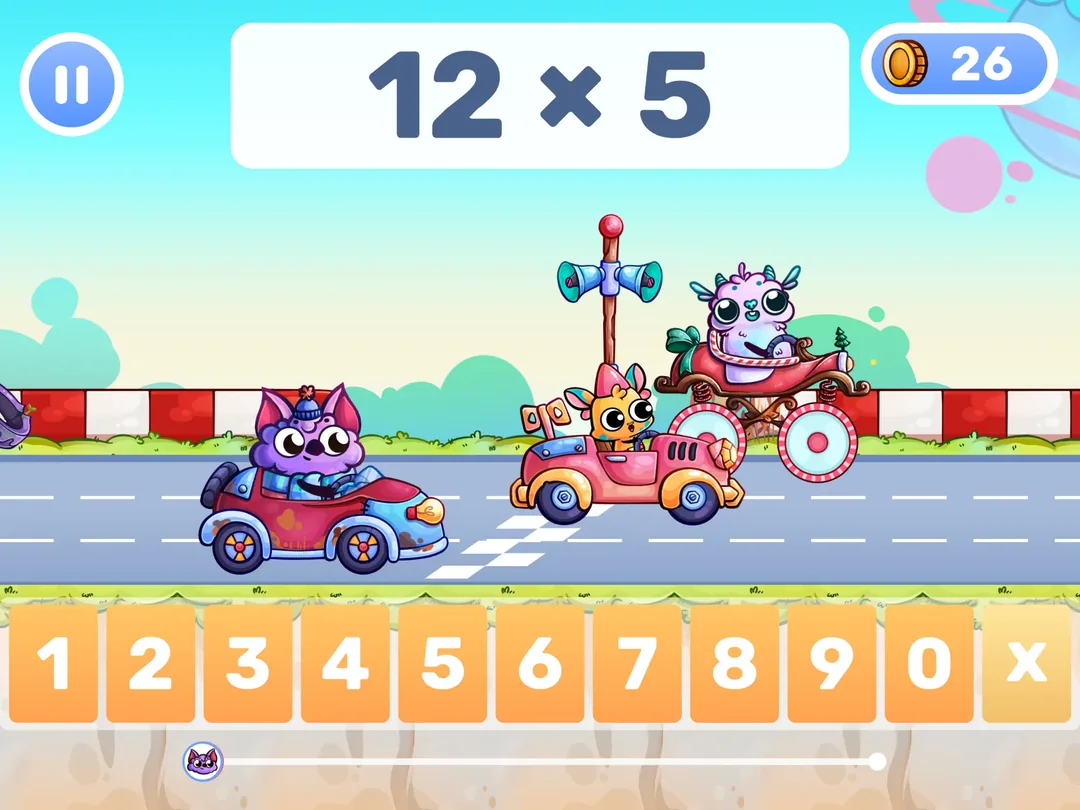
Pick one of four free 3rd grade math games and play it right in your browser, with no account, download or ads. Then choose what to practice: multiplication and division facts to 10 × 10 or 12 × 12, and addition and subtraction within 100 or 1,000.
- 3rd grade · ages 8-9
- Multiplication and division to 10 × 10
- Free
- No account
- No ads
- Phone, tablet and computer
Pick a 3rd Grade Math Game to Play
Pick a game, then choose what to practice: multiplication and division facts to 10 × 10 to begin with, 1-12 for the 11s and 12s, “Custom” for just the tables your child is learning (such as 2, 5 and 10), or addition and subtraction within 1,000, with “No regrouping” for easier problems.
Practice One 3rd Grade Skill
Math Games by Grade
For parents


Get MathHero: The Full Adventure
Keep practicing in the MathHero app: a story-driven math game for ages 5-10, from first addition to division.
- Step-by-step learning programs that build the multiplication tables one table at a time
- Custom Practice: multiplication and division for the tables you choose, from ×1 to ×12, and addition and subtraction up to 1,000
- Typed answers or multiple choice, in Easy, Medium or Hard mode
Free at 5 levels a day, with no ads and nothing locked.
What Math Do 3rd Graders Learn?
3rd grade is the year of multiplication. Children move from adding equal groups to knowing the multiplication facts by heart, meet division and fractions as numbers, and start measuring area. The Common Core State Standards name four critical areas for the year: multiplication and division within 100, fractions (especially unit fractions, like 1/4), area and its link to multiplication, and describing two-dimensional shapes. This guide follows those standards and gives each one’s code, so you can match it to your child’s report card. Many states use them, some under their own name or with changes, so your school’s list can differ in details: Texas, for example, has its own standards (TEKS), which ask 3rd graders to recall the multiplication facts up to 10 by 10 and the matching division facts.
Operations and algebraic thinking (3.OA)
- What multiplication and division mean (3.OA.A.1-2). 5 × 7 is the total in 5 groups of 7. 56 ÷ 8 is either the number in each share when 56 things are split into 8 equal shares, or the number of shares when 56 things are put into groups of 8.
- Word problems within 100 (3.OA.A.3). Equal groups, arrays and measurements, solved with drawings and equations: 4 bags hold 6 apples each, so there are 4 × 6 = 24 apples.
- Missing numbers (3.OA.A.4). Find the unknown in a multiplication or division equation: 8 × ? = 48 (6), or 24 ÷ ? = 6 (4).
- Properties as strategies (3.OA.B.5). If 6 × 4 = 24, then 4 × 6 = 24 too. 8 × 7 can be broken into 8 × 5 and 8 × 2: 40 + 16 = 56. Children use these ideas without needing the formal names.
- Division as a missing factor (3.OA.B.6). 32 ÷ 8 is the number that makes 32 when multiplied by 8: 4.
- The facts (3.OA.C.7). Multiply and divide fluently within 100, and by the end of 3rd grade know from memory all products of two one-digit numbers, from 0 × 0 to 9 × 9.
- Two-step word problems (3.OA.D.8) with all four operations, written as an equation with a letter for the unknown, and checked by estimating. Sam buys 3 packs of 8 stickers and gives away 5. How many are left? 3 × 8 − 5 = s: multiply first, 3 × 8 = 24, then subtract, 24 − 5 = 19, so s = 19. This is the usual order of operations when there are no parentheses.
- Patterns (3.OA.D.9) in the addition and multiplication tables, like 4 times any number is always even, because it is a double of a double.
Number and operations in base ten (3.NBT)
- Rounding (3.NBT.A.1). Round to the nearest 10 or 100 with place value: 347 rounds to 350 to the nearest 10, and to 300 to the nearest 100.
- Adding and subtracting within 1,000 (3.NBT.A.2). Fluently, with strategies and written methods based on place value: 465 + 278 = 743, 602 − 358 = 244. In 2nd grade this was done with models; now it should be quick and accurate. The standards allow a range of written methods.
- Multiplying by multiples of 10 (3.NBT.A.3). A one-digit number times 10 to 90: 9 × 80 = 720, because 9 × 8 tens is 72 tens.
Fractions (3.NF)
3rd grade fractions use halves, thirds, fourths, sixths and eighths.
- Unit fractions (3.NF.A.1). 1/4 is one part when a whole is split into 4 equal parts, and 3/4 is three of those parts.
- Fractions on a number line (3.NF.A.2). Split the space from 0 to 1 into 4 equal parts: the first mark is 1/4, the third is 3/4.
- Equivalent fractions and comparing (3.NF.A.3). 1/2 = 2/4 and 4/6 = 2/3; whole numbers as fractions, like 3 = 3/1 and 4/4 = 1; comparing fractions with the same numerator (top number) or denominator (bottom number): 3/8 < 5/8, and 1/3 > 1/6 because thirds of the same whole are bigger pieces than sixths.
Measurement and data (3.MD)
- Time (3.MD.A.1). Tell and write time to the nearest minute and solve elapsed-time problems in minutes: practice starts at 2:45 and ends at 3:20, so it lasts 35 minutes. 2nd grade stopped at the nearest five minutes.
- Liquid volume and mass (3.MD.A.2). Measure and estimate in liters, grams and kilograms, and solve one-step word problems with them. A paper clip weighs about 1 gram.
- Graphs (3.MD.B.3-4). Scaled picture graphs and bar graphs, where one square can stand for 5 pets, with “how many more” and “how many fewer” questions; line plots of lengths measured to the half and quarter inch.
- Area (3.MD.C.5-7). Area is the number of unit squares that cover a shape. A rectangle 4 squares by 6 squares has an area of 24 square units, the same as 4 × 6, and an L-shaped figure is split into rectangles whose areas are added.
- Perimeter (3.MD.D.8). The distance around a shape: a 4 by 6 rectangle has a perimeter of 4 + 6 + 4 + 6 = 20 units. A 2 by 8 rectangle also has a perimeter of 20, but an area of 16: same perimeter, different area.
Geometry (3.G)
- Quadrilaterals (3.G.A.1). Shapes in different groups can share attributes: rhombuses, rectangles and squares all have four sides, so they are all quadrilaterals. Children also draw quadrilaterals that fit none of those groups.
- Equal areas as fractions (3.G.A.2). Split a shape into 4 parts with equal area, and each part is 1/4 of the shape.
3rd Grade Math at a Glance
Multiplication and Division in 3rd Grade
Multiplication and division take up most of the 3rd grade year. Children first learn what the operations mean, then strategies for working out facts, and by the end of the year they know the facts from memory. The order matters: a child who understands 4 × 6 as 4 groups of 6 can always work it out again when the answer does not come from memory.
Equal groups and arrays
Multiplication starts with equal groups: 4 bags with 6 apples each is 4 × 6. An array shows the same idea as rows and columns, like 4 rows of 6 chairs. Turn the array on its side and it becomes 6 rows of 4, which is why 4 × 6 and 6 × 4 are both 24 (3.OA.B.5). Arrays also lead to area: cover a rectangle with 4 rows of 6 squares and its area is 24 square units (3.MD.C.7), and the same picture splits a hard fact into two easy ones, like 7 × 8 = 7 × 5 + 7 × 3 = 35 + 21 = 56.
The order kids learn the multiplication facts
Common Core sets the goal, all products of two one-digit numbers from memory by the end of the year, but no order. Some numbers have patterns that make them easier, so schools usually start there and teach the facts in different orders. A common one:
- the 2s (doubles), 5s and 10s (skip counting), then the 0s and 1s;
- the 3s, the 4s (double the 2s) and the 9s (9 × 7 = 70 − 7 = 63);
- the 6s, 7s and 8s last, built from facts your child already knows.
Every fact works both ways, so once your child knows the 1s, 2s, 5s and 10s, only 21 facts of the 10 × 10 chart are left to learn. The multiplication games let your child practice the tables they are on, mixed or one at a time. Our guide on how to teach multiplication goes through the whole sequence.
Division as multiplication turned around
Division has two meanings: sharing (12 cookies on 3 plates gives 4 on each) and grouping (12 cookies in bags of 3 fills 4 bags). Both are 12 ÷ 3 = 4. The standards then ask children to see division as a multiplication fact with a missing factor (3.OA.B.6): for 56 ÷ 8, ask “8 times what makes 56?” The numbers 7, 8 and 56 make a fact family, 7 × 8 = 56, 8 × 7 = 56, 56 ÷ 8 = 7 and 56 ÷ 7 = 8, so every multiplication fact your child learns gives two division facts. That is why multiplication and division can be learned at the same time: the multiplication and division games mix them, and the division games practice division on its own.
Word problems and bar diagrams
To decide whether a word problem calls for multiplication or division, many classes draw a bar diagram, also called a tape diagram or strip diagram. For “24 stickers shared equally by 4 friends”, the child draws one bar for 24, splits it into 4 equal parts and asks what each part is: 24 ÷ 4 = 6. For two-step problems (3.OA.D.8), the bar shows which step comes first.
What Should a 3rd Grader Know at the Start and at the End of the Year?
Most 3rd graders are 8 at the start of the year and turn 9 during it. They arrive with addition and subtraction from 2nd grade and leave with multiplication, division and fractions, the base for 4th grade’s multi-digit multiplication and long division. The table compares the Common Core goals for the end of 2nd grade, where a typical 3rd grader starts, with the goals for the end of 3rd grade.
From the start to the end of 3rd grade
| Skill | Coming in from 2nd grade | By the end of 3rd grade |
|---|---|---|
| Facts | All sums of two one-digit numbers from memory (2.OA.B.2) | All products of two one-digit numbers from memory; divide fluently within 100 (3.OA.C.7) |
| Multiplication | Arrays up to 5 by 5, added up: 4 + 4 + 4 (2.OA.C.4) | Multiplication and division word problems within 100 (3.OA.A.3) |
| Adding and subtracting | Fluently within 100; within 1,000 with models (2.NBT.B.5, 2.NBT.B.7) | Fluently within 1,000 (3.NBT.A.2) |
| Place value | Hundreds, tens and ones; compare 3-digit numbers (2.NBT.A) | Round to the nearest 10 or 100; multiply by multiples of 10 (3.NBT.A.1, 3.NBT.A.3) |
| Fractions | Halves, thirds and fourths as equal shares of a shape (2.G.A.3) | Unit fractions, the number line, equivalent fractions, comparing (3.NF.A.1-3) |
| Time | Nearest five minutes, a.m. and p.m. (2.MD.C.7) | Nearest minute; elapsed time in minutes (3.MD.A.1) |
| Measuring | Length in inches, feet, centimeters and meters (2.MD.A.1-4) | Liters, grams and kilograms; area and perimeter (3.MD.A.2, 3.MD.C, 3.MD.D) |
| Graphs | Picture and bar graphs with up to four categories (2.MD.D.10) | Scaled picture and bar graphs; line plots to the quarter inch (3.MD.B.3-4) |
| Shapes | Shapes by their sides, angles and faces (2.G.A.1) | Quadrilaterals grouped by shared attributes (3.G.A.1) |
End-of-year checklist for parents
By June, can your child:
- answer 7 × 8 and 56 ÷ 7 without skip counting from the start?
- show 4 × 6 as equal groups or an array, and make up a story for it?
- find the missing number in 6 × ? = 42 (7)?
- solve 465 + 278 (743) and 602 − 358 (244), and explain the steps?
- round 347 to the nearest 10 (350) and to the nearest 100 (300)?
- work out 6 × 40 (240) in their head?
- solve a two-step word problem, like 3 packs of 8 stickers with 5 given away?
- mark 3/4 on a number line, and say which is bigger, 1/3 or 1/6, and why?
- read 4:37 on a clock with hands and work out how long it is until 5:10 (33 minutes)?
- find the area (15 square units) and the perimeter (16 units) of a 3 by 5 rectangle?
- read a bar graph where each square stands for 5?
A few gaps in the spring are normal: 4th grade builds on all of these, and the multiplication facts keep coming back. If several items are hard, our guide to whether a child is behind in math explains what to look for and when to talk to the teacher.
How Is 3rd Grade Math Tested and Graded?
Report cards by standard
Many elementary schools use standards-based report cards: instead of one grade for math, each skill (multiplication facts, fractions, area) gets its own mark. A common scale runs from 1 to 4, where 3 means your child meets the grade-level standard and 4 means they exceed it, as on the 3rd grade report card in Berkeley, California, which calls 3 the minimum target for all students. A 3 is the goal, not a B, and some standards are marked only in the part of the year when they are taught.
Unit tests and classwork
Most of what the teacher knows comes from daily work: worksheets, quick checks, math journals and a test at the end of each unit, such as multiplication, fractions or area. These show how your child solves a problem, not only whether the answer is right, which matters because the standards ask children to explain their strategies.
Benchmark tests at the start, middle and end of the year
Many schools also give a computer test a few times a year to see where each child stands and how much they have grown. Two common ones are NWEA MAP Growth, which is taken up to three times a year, usually at the start of the school year, halfway through and near the end, and i-Ready, whose diagnostic is now called i-Ready Inform. Both are adaptive: the questions get harder or easier depending on your child’s answers, so a score is not a percentage correct. Ask the teacher what the score means and compare it with your child’s own earlier scores.
The first state test
Federal law requires states to test reading and math every year from 3rd grade through 8th grade, so for most children 3rd grade brings the first state math test, usually in the spring. Each state chooses its own test and its own name for it, and many state education departments, Texas and New York among them, post released questions or practice tests online. The test covers the state’s own standards for the year: in states that use Common Core or standards based on it, those are the topics in this guide, while states with their own standards, like Texas, differ in places. Going through a few released questions together shows your child what the questions will look like.
Timed fact checks and what fluency means
Some 3rd grade teachers give short timed sheets of multiplication facts, sometimes called a “mad minute”. They connect to standard 3.OA.C.7, which asks children to multiply and divide fluently within 100 and, by the end of 3rd grade, to know all products of two one-digit numbers from memory. The standard sets no time limit. The National Council of Teachers of Mathematics defines fluency as using procedures efficiently, flexibly and accurately. Experts disagree on timed practice: NCTM advises against timed tests, while the federal What Works Clearinghouse recommends regular timed activities as one way to build fluency for students who struggle. Our article on math fact fluency and timed tests goes into the research.
What Do 3rd Graders Struggle With in Math?
Most 3rd grade sticking points come from the three new ideas of the year, multiplication, fractions and area, or from older skills used in a new way. Here is what each one looks like on homework and one thing that helps.
1. The harder facts: 7 × 8
What it looks like: your child knows the 2s, 5s and 10s but counts up from zero for 7 × 8, loses track, and writes 54 or 58. What helps: build the hard fact from easy ones. 7 × 8 is 7 × 5 plus 7 × 3: 35 + 21 = 56. Then practice that fact a little every day until the answer comes without the steps; the 7s games and 8s games ask only those facts.
2. Times 0 and times 1
What it looks like: 6 × 0 = 6 and 6 × 1 = 7, because the child uses the rules for adding 0 and 1. The standards’ authors note that children often mix up these patterns. What helps: tell it as equal groups: 6 plates with 0 cookies on each is 0 cookies, and 6 plates with 1 cookie each is 6 cookies.
3. What division means
What it looks like: your child can recite 6 × 4 = 24 but freezes at 24 ÷ 4, or picks the wrong operation in a word problem. What helps: share real objects into equal groups, then say the multiplication sentence: “4 times what makes 24?” Practicing the two together, as in the multiplication and division games, keeps the link alive.
4. Comparing fractions: 1/8 and 1/4
What it looks like: your child says 1/8 is bigger than 1/4, because 8 is bigger than 4. What helps: fold two same-size paper strips, one into 4 parts and one into 8. The more parts a whole is cut into, the smaller each part is. Pizza and chocolate bars work too, as long as both wholes are the same size. Our guide on how to teach fractions has more hands-on ideas.
5. Area or perimeter?
What it looks like: for a 4 by 6 rectangle, your child adds the sides when asked for area, or multiplies them when asked for perimeter. What helps: area is the tiles inside (cover it with squares and count: 24), perimeter is the fence around it (walk along the edges: 20). Square sticky notes on a table make it concrete.
6. Elapsed time across the hour
What it looks like: from 2:45 to 3:20, your child subtracts 20 − 45 or answers 75 minutes, as if an hour had 100 minutes. What helps: jump on a number line or a clock face: 15 minutes from 2:45 to 3:00, then 20 more to 3:20, so 35 minutes.
7. Subtracting across zeros: 400 − 167
What it looks like: with no tens or ones to take from, your child writes 367 or gets lost regrouping twice. What helps: count up from 167 to 200 (33), then to 400 (200): 233. Or take 1 from both numbers, 399 − 166, which needs no regrouping at all. The 3-digit subtraction games practice these problems.
How to Help Your 3rd Grader with Math at Home
- Multiplication facts, a few minutes a day. Short, regular practice works better than a long session once a week. Start with the 2s, 5s and 10s, add a table at a time, and practice the matching division facts with them. The games on this page start on all the facts to 10 × 10; the single-table pages, like the 6s, focus on one table. Our guide to making the multiplication facts easier has tricks for each table.
- Equal groups everywhere. Eggs in a carton (2 rows of 6), muffin tins, packs of juice boxes: ask how many there are without counting one by one.
- Fractions in the kitchen. Cut a sandwich into fourths, measure half a cup, share a pizza into eighths and ask which is bigger, a fourth or an eighth.
- Time and planning. Ask how long until practice or bedtime, and how long a trip took, in minutes.
- Rounding at the store. Round prices to the nearest dollar or ten dollars to estimate the total before you pay.
- Ask how they got the answer. School teaches several strategies for 7 × 8 or 602 − 358, and explaining one keeps you on the same page as the teacher. Our guide to the methods your child brings home shows the common ones.
- Play. The games on this page practice multiplication and division facts, and adding and subtracting within 1,000; card and dice games practice the same facts. For homework time, see how to help with math homework.
Learn 3rd Grade Math with the MathHero App
How is the MathHero app different from the online games on this page?
The online games on this page are mini-games for short multiplication, division, addition and subtraction practice. The MathHero app is a full math adventure with step-by-step learning programs, rewards for your hero and saved progress for each child. If your child enjoys these mini-games, try the app: you can play 5 levels a day for free, with no ads and nothing locked.
What Parents Say About the MathHero App
Verbatim from public App Store and Google Play reviews of the MathHero app, with spelling as written. Rated 4.7 on Google Play (48.2K reviews) and 4.6 on the App Store (12K ratings), checked .
“My eight-year-old daughter loves this game. It's making math fun for her, and she is enjoying learning. I love that you can customize and choose which number facts you want your children to work on and can change this at any time. It has helped her very much in learning her multiplication facts.”
“My 8 year old granddaughter really looks forward to doing these math questions every day. It’s the repetition that is really helping her. The cute little characters also help.”
“So my daughter has been needing help with her multiplication facts and was wanting something fun. We came across this game and she loves it and is definitely learning. It’s kid friendly and exciting.”
3rd Grade Math: Common Questions
What math do 3rd graders learn?
Under the Common Core standards, 3rd grade math centers on four areas: multiplication and division within 100, fractions (especially unit fractions like 1/4), area and how it connects to multiplication, and describing 2-D shapes. Children also round numbers to the nearest 10 or 100, add and subtract fluently within 1,000, tell time to the nearest minute, measure liquid volume and mass, read scaled bar graphs and find perimeters. By the end of the year they should know all products of two one-digit numbers from memory.
What should a 3rd grader know in math by the end of the year?
By the end of 3rd grade, a child should know all products of two one-digit numbers from memory, like 7 × 8 = 56, and use them to divide, like 56 ÷ 8 = 7. They should add and subtract fluently within 1,000, round to the nearest 10 or 100, and solve two-step word problems with all four operations. They should also place fractions like 3/4 on a number line, compare fractions such as 1/3 and 1/6, tell time to the minute, work out elapsed time, and find the area and perimeter of a rectangle.
What is an array in 3rd grade math?
An array is a set of objects arranged in equal rows and columns, like 4 rows of 6 chairs. In 3rd grade, an array is a picture of a multiplication fact: 4 rows of 6 is 4 × 6 = 24, and turning the array on its side shows 6 × 4 = 24, so every fact works both ways. Arrays also explain division (24 chairs in 4 equal rows makes 6 in each row) and area, because a rectangle covered with 4 rows of 6 unit squares has an area of 24 square units.
How do you explain division to a 3rd grader?
Start with real objects and the two ways to divide: sharing 12 cookies equally among 3 plates gives 4 on each plate, and packing 12 cookies into bags of 3 fills 4 bags. Both are written 12 ÷ 3 = 4. Then connect it to multiplication: to find 12 ÷ 3, ask 3 times what makes 12? Once your child sees division as a multiplication fact turned around, every multiplication fact they know gives them a division fact too.
What is a fact family in 3rd grade math?
A fact family is a set of related facts made from the same three numbers. For 7, 8 and 56, the family is 7 × 8 = 56, 8 × 7 = 56, 56 ÷ 8 = 7 and 56 ÷ 7 = 8. Fact families show that division undoes multiplication, so a child who knows one fact of the family can work out the other three.
What is a bar diagram in 3rd grade math?
A bar diagram, also called a tape diagram or strip diagram, is a drawing of rectangular bars that shows how the numbers in a word problem fit together. For 24 stickers shared equally by 4 friends, a child draws one long bar for 24 and splits it into 4 equal parts, then finds that each part is 6. The drawing helps a child decide which operation to use before calculating.
Is 3rd grade math hard?
3rd grade math is a big step for many children, because three new ideas arrive in one year: multiplication and division, fractions as numbers, and area. The multiplication facts take steady practice over months, and fractions can feel strange at first, since 1/8 is smaller than 1/4. A child who is fluent with addition and subtraction within 100 has a good base, and a few minutes of fact practice most days makes the rest of the year easier.
What do 3rd graders struggle with in math?
The usual sticking points are the harder multiplication facts like 7 × 8, mixing up times 0 with plus 0, knowing what division means, comparing fractions such as 1/8 and 1/4, mixing up area and perimeter, elapsed time across the hour, and subtracting across zeros, like 400 − 167. Most of them get easier with a drawing or real objects: equal groups, a fraction strip, square tiles, a number line or a clock with hands.
How can I help my 3rd grader with math?
Practice the multiplication facts for a few minutes most days, starting with the 2s, 5s and 10s, and practice the matching division facts at the same time. Use everyday math: fractions when cooking or sharing food, elapsed time before practice or bedtime, rounding to estimate a shopping bill. When your child solves a problem, ask how they got the answer, and talk with the teacher if one topic stays hard for several weeks.
Do 3rd graders take a state math test?
Yes, in US public schools. Federal law requires states to test reading and math every year from 3rd grade through 8th grade, so 3rd grade is usually the first year of the state math test, typically given in the spring. Each state chooses its own test and name, and many state education departments post released questions or practice tests online.
Are timed multiplication tests normal in 3rd grade?
Some 3rd grade teachers give short timed fact checks, because the Common Core standard asks children to know all products of two one-digit numbers from memory by the end of the year. The standard itself sets no time limit. Experts disagree about timed practice: the National Council of Teachers of Mathematics advises against timed tests, while the federal What Works Clearinghouse recommends regular timed activities as one way to build fluency for students who struggle.
Are these online 3rd grade math games free?
Yes. The online games on this page are free to play in your browser on a phone, tablet or computer, with no account, no download and no ads. The MathHero app is free too, at 5 levels a day with nothing locked, and a subscription with a 7-day free trial removes the daily limit.
About This Page
Last updated · App ratings checked
- Common Core State Standards: Grade 3 Mathematics
- Common Core State Standards for Mathematics (full document, grades 2 and 3)
- Common Core State Standards: Grade 2 Mathematics
- Progressions for the Common Core State Standards: Counting and Cardinality, K-5 Operations and Algebraic Thinking
- Texas Essential Knowledge and Skills for Mathematics, Grade 3 (19 TAC 111.5)
- Berkeley Unified School District: Family Guide for 3rd Grade Report Card
- NWEA: MAP Growth 101, everything families need to know
- Curriculum Associates: i-Ready Inform announcement
- Congressional Research Service: Educational Assessment and the Elementary and Secondary Education Act
- Texas Education Agency: STAAR released test questions
- New York State Education Department: Grades 3-8 mathematics tests and released questions
- NCTM: Procedural Fluency in Mathematics
- What Works Clearinghouse: Assisting Students Struggling with Mathematics (2021)
- MathHero on the App Store
- MathHero on Google Play