
Multiplication Games for Kids
Practice the multiplication tables with free MathHero adventure games for kids, right in your browser: every multiplication fact from 1 × 1 to 12 × 12, like 3 × 4 = 12 and 7 × 8 = 56. No account, no download, no ads.
- 1 × 1 to 12 × 12
- Grade 3 · ages 8-9
- Free in the browser
- No account, no download
- No ads
- Phone, tablet and computer
Pick a Multiplication Game to Play
Practice One Multiplication Table
Each multiplication table page has games that ask only that table's facts, with strategies and the full table.
Get MathHero: The Full Adventure
Keep practicing in the MathHero app: a story-driven math game for ages 5-10, from first addition to division.
- Step-by-step learning programs that build the multiplication tables one table at a time
- Custom Practice: any multiplication tables from ×1 to ×12, or a mix like only ×6, ×7 and ×8
- Typed answers or multiple choice, in Easy, Medium or Hard mode
Free at 5 levels a day, with no ads.

How MathHero Games Teach Multiplication
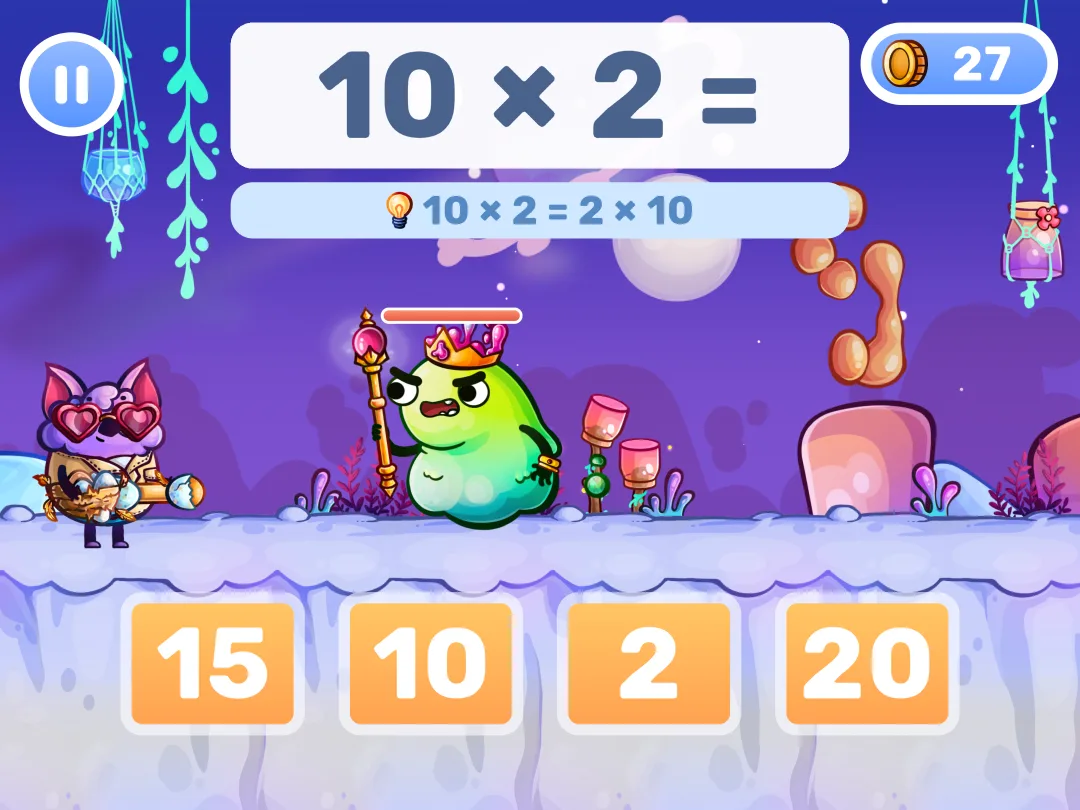
MathHero teaches multiplication through practice inside a story. Every action in the adventure is a multiplication fact to solve, so your child answers many facts in one session without it feeling like a drill, and wants to come back for the next level.
In the MathHero app, a parent chooses one of two ways to work on the multiplication tables:
- Step-by-step learning. A guided path adds new facts a little at a time, so your child learns each multiplication table and practices it before moving on.
- Custom Practice. For tables your child already knows: pick any multiplication tables from ×1 to ×12 and a difficulty, and practice until the answers come quickly.
The games on this page work like practice: they mix all the multiplication tables from 1 × 1 to 12 × 12. Each multiplication table page is closer to a step: its games start with that table's facts, like 7 × 3, and add the turnarounds, like 3 × 7, from the third level, with a tip that both give the same answer.
MathHero has no video lessons. It builds the skill through practice, so the games work best once your child knows what multiplication means, for example as equal groups.
How to Learn the Multiplication Tables
To learn the multiplication tables, start with the easy tables, use every fact both ways, and build the hard facts from ones your child already knows. Then practice a little most days until the answers come from memory.
Learn the tables in a helpful order
Start with the 2s, 10s and 5s: doubling, adding a zero and counting in fives make them quick wins. Then learn the 3s and 4s (the 4s are the 2s doubled) and the 9s. Leave the 6s, 7s and 8s for last, because they lean on everything learned before.
Every fact works both ways
3 × 7 is the same as 7 × 3, so every fact your child learns gives a second one for free. Once your child knows the 1s, 2s, 5s and 10s and uses this turnaround rule, only 21 facts of the 10 × 10 chart are left to learn.
Build hard facts from easy ones
- Double a known fact. The 4s are the 2s doubled and the 8s are the 4s doubled: 8 × 7 is double 4 × 7, so 28 + 28 = 56.
- Add one more group. The 6s are the 5s plus one group: 6 × 7 = 5 × 7 + 7 = 35 + 7 = 42.
- Take one group away. The 9s are the 10s minus one group: 9 × 6 = 60 − 6 = 54.
Spot the patterns in the chart
The multiplication chart below is a mirror along its diagonal, because of the turnaround rule. Answers in the 5s end in 5 or 0, answers in the 2s, 4s, 6s and 8s are even, and the digits of the 9s up to 9 × 10 add up to 9: 18, 27, 36 and on.
Common mistakes
- Adding instead of multiplying. 3 × 4 is not 7. Picture 3 rows of 4 to see that it is 12.
- Mixing up neighbor facts. 6 × 8 = 48 and 7 × 8 = 56 sit next to each other in the chart. To check, count on from a fact you are sure of: 7 × 7 = 49, and 49 + 7 = 56.
- Swapped digits. 7 × 9 is 63, not 36, which is 6 × 6. Saying the whole fact out loud, seven nines are sixty-three, helps it stick.
Each multiplication table from 2 to 10 also has its own page, with games on that table only and the strategies that work best for it. For the methods your child's class is probably using, see our guide on how to teach multiplication. Curious where multiplication tables come from? Read who invented times tables.
Multiplication Chart 1-12
The multiplication chart shows every fact from 1 × 1 to 12 × 12. Find one number in the top row and the other in the left column: the answer is where the row and the column meet. The squares, like 7 × 7 = 49, run along the diagonal.
| × | 1 | 2 | 3 | 4 | 5 | 6 | 7 | 8 | 9 | 10 | 11 | 12 |
|---|---|---|---|---|---|---|---|---|---|---|---|---|
| 1 | 1 | 2 | 3 | 4 | 5 | 6 | 7 | 8 | 9 | 10 | 11 | 12 |
| 2 | 2 | 4 | 6 | 8 | 10 | 12 | 14 | 16 | 18 | 20 | 22 | 24 |
| 3 | 3 | 6 | 9 | 12 | 15 | 18 | 21 | 24 | 27 | 30 | 33 | 36 |
| 4 | 4 | 8 | 12 | 16 | 20 | 24 | 28 | 32 | 36 | 40 | 44 | 48 |
| 5 | 5 | 10 | 15 | 20 | 25 | 30 | 35 | 40 | 45 | 50 | 55 | 60 |
| 6 | 6 | 12 | 18 | 24 | 30 | 36 | 42 | 48 | 54 | 60 | 66 | 72 |
| 7 | 7 | 14 | 21 | 28 | 35 | 42 | 49 | 56 | 63 | 70 | 77 | 84 |
| 8 | 8 | 16 | 24 | 32 | 40 | 48 | 56 | 64 | 72 | 80 | 88 | 96 |
| 9 | 9 | 18 | 27 | 36 | 45 | 54 | 63 | 72 | 81 | 90 | 99 | 108 |
| 10 | 10 | 20 | 30 | 40 | 50 | 60 | 70 | 80 | 90 | 100 | 110 | 120 |
| 11 | 11 | 22 | 33 | 44 | 55 | 66 | 77 | 88 | 99 | 110 | 121 | 132 |
| 12 | 12 | 24 | 36 | 48 | 60 | 72 | 84 | 96 | 108 | 120 | 132 | 144 |
Highlighted: the squares. The games on this page practice the whole chart, from 1 × 1 to 12 × 12: all the multiplication tables that schools in England expect by Year 4.
What Grade Learns Multiplication?
In the US, children meet multiplication in 2nd grade as equal groups and arrays, and learn the multiplication facts in 3rd grade, usually at ages 8-9. Common Core standard 3.OA.C.7 expects children to know all one-digit multiplication facts, up to 9 × 9, from memory by the end of grade 3, and in 4th grade they use those facts for multi-digit multiplication. In England, children learn the 2, 5 and 10 multiplication tables in Year 2, the 3, 4 and 8 multiplication tables in Year 3, and all the tables up to 12 × 12 in Year 4, when they also take the multiplication tables check.
- Age
- 8-9
- US grade
- Grade 3
- Standard
- Common Core 3.OA.C.7
- England
- Years 2-4
What Parents Say About MathHero
Verbatim from public App Store and Google Play reviews of the MathHero app, with spelling as written. Rated 4.7 on Google Play (48.2K reviews) and 4.6 on the App Store (12K ratings), checked .
“My daughter loved playing this game to work on her multiplication facts. This is a child who fights me every time we have to practice facts, but not with this game!”
“So my daughter has been needing help with her multiplication facts and was wanting something fun. We came across this game and she loves it and is definitely learning.”
“I love that you can customize and choose which number facts you want your children to work on and can change this at any time. It has helped her very much in learning her multiplication facts.”
Multiplication Games: Common Questions
What are the best free multiplication games for kids?
How do the MathHero multiplication games work?
Which multiplication tables should kids learn first?
What grade learns multiplication?
Are MathHero's multiplication games free?
Do the multiplication games work on a tablet or phone?
Can my child practice only some multiplication tables?
Does MathHero teach fractions?
About This Page
Last updated · App ratings checked