
Multiplication by 8 Games for Kids
Practice multiplication by 8 with free MathHero adventure games for kids, right in your browser: 8, 16, 24 and on up to 80. No account, no download, no ads.
- 8 × 1 to 8 × 10
- Grade 3 · ages 8-9
- Free in the browser
- No account, no download
- No ads
- Phone, tablet and computer
Pick a Multiplication by 8 Game to Play
Practice Multiplication by Another Number
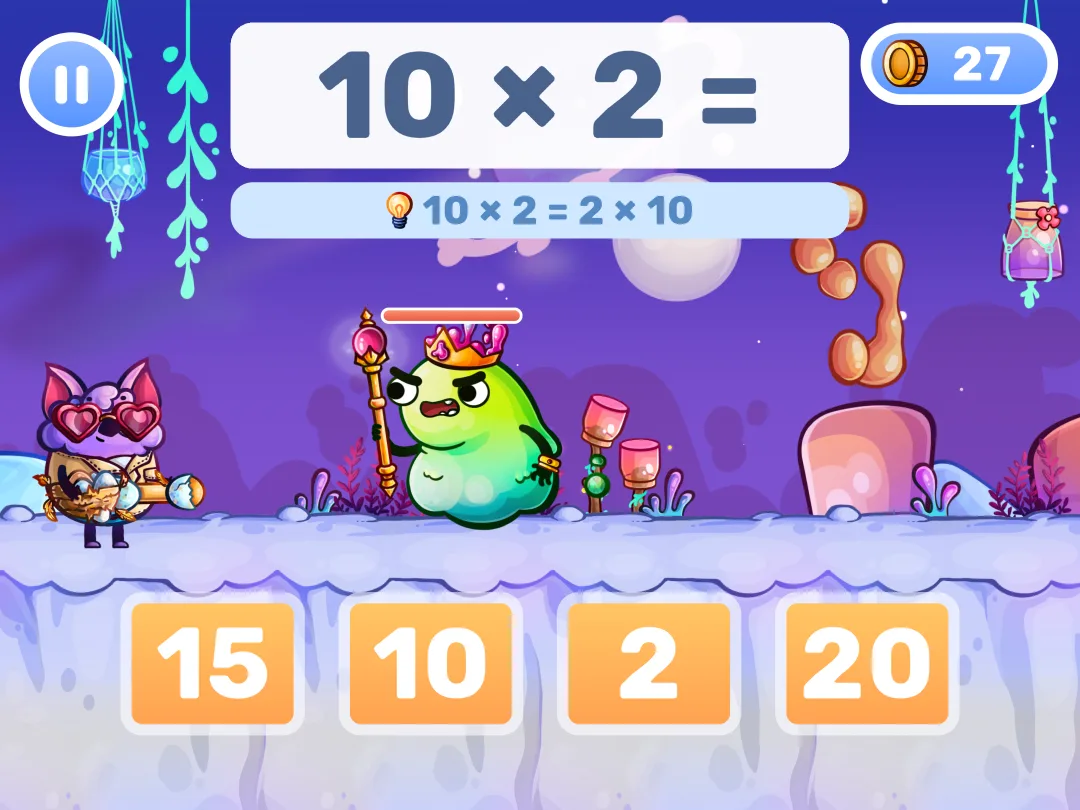
Get MathHero: The Full Adventure
Keep practicing in the MathHero app: a story-driven math game for ages 5-10, from first addition to division.
- Step-by-step learning programs that build the times tables one table at a time
- Custom Practice: any times tables from ×1 to ×12, or a mix like only ×4 and ×8
- Typed answers or multiple choice, in Easy, Medium or Hard mode
Free at 5 levels a day, with no ads.

How to Learn the 8 Times Table
To learn the 8 times table, start from the multiplication facts your child already knows, cover the remaining facts with a strategy, and practice until recall is automatic. Most children meet the 8s already knowing the 2s, 3s, 4s, 5s and 10s, and every fact works both ways: 8 × 3 is the same as 3 × 8. Add 8 × 1 = 8, and six of the ten facts are already in place. Only four are new: 8 × 6, 8 × 7, 8 × 8 and 8 × 9 (and even fewer if your child has already learned the 6s or 7s).
Double the 4s
Eight is double four, so every 8 times table answer is double the matching 4 times table answer. For 8 × 6, take 4 × 6 = 24 and double it to get 48. For 8 × 8, take 4 × 8 = 32 and double it to get 64.
Double, Double, Double
Because 8 is 2 × 2 × 2, multiplying any number by 8 is the same as doubling it three times in a row. Even when a 4s fact slips your child's mind, three quick doubles get them there. For 8 × 6:
- Double 6 to get 2 × 6 = 12.
- Double 12 to get 4 × 6 = 24.
- Double 24 to get 8 × 6 = 48.
Take 2s away from 10s
Eight groups are ten groups minus two groups. To work out 8 × 7, start with 10 × 7 = 70 and subtract 2 × 7 = 14: 70 − 14 = 56. And for 8 × 9, take one 8 away from 80: 80 − 8 = 72.
Remember 5, 6, 7, 8 and the even-digit pattern
Two quick checks help answers stick. First, 56 = 7 × 8 (or 8 × 7): the digits run 5, 6, 7, 8 in order. Second, every answer in the 8 times table is even, and the ones digits repeat a countdown of even numbers: 8, 6, 4, 2, 0 (8, 16, 24, 32, 40, then 48, 56, 64, 72, 80). You can also picture spider legs or octopus arms: 1 octopus has 8 arms, 3 octopuses have 24, and 8 spiders have 64 legs.
Common mistakes
- 54 or 58 instead of 56 for 8 × 7. 54 belongs to the 6s and 9s (6 × 9 = 54), and 58 is two too high. Use the 5, 6, 7, 8 hook (56 = 7 × 8) or add 8 to 8 × 6 = 48: 48 + 8 = 56.
- 46 instead of 48 for 8 × 6, or 66 instead of 64 for 8 × 8. When doubling 24 or 32 in their head, children sometimes slip on the ones digit. Check the repeating pattern 8, 6, 4, 2, 0: the 6th multiple ends in 8 (48) and the 8th multiple ends in 4 (64).
- Stopping after two doubles. Answering 24 for 8 × 6 or 28 for 8 × 7 means your child doubled twice (×4) instead of three times (×8). Remind them to double one more time: 24 → 48, 28 → 56.
For the methods your child's class is probably using, see our guide on how to teach multiplication. Curious where times tables come from? Read who invented times tables.
| Fact | Answer | Quick way |
|---|---|---|
| 8 × 1 | 8 | one 8 |
| 8 × 2 | 16 | double 8 |
| 8 × 3 | 24 | from the 3s |
| 8 × 4 | 32 | double 16 |
| 8 × 5 | 40 | half of 80 |
| 8 × 6 | 48 | double 24 |
| 8 × 7 | 56 | 5, 6, 7, 8 |
| 8 × 8 | 64 | double 32 |
| 8 × 9 | 72 | 80 − 8 |
| 8 × 10 | 80 | 8 tens |
| 8 × 11 | 88 | 80 + 8 |
| 8 × 12 | 96 | 80 + 16 |
Highlighted: the four new facts, 8 × 6 to 8 × 9. The games on this page practice 8 × 1 to 8 × 10. 8 × 11 and 8 × 12 complete the table up to 12, which schools in England test in Year 4.
What Grade Learns the 8 Times Table?
The 8 times table is a 3rd grade skill in the US, usually learned at ages 8-9. Common Core standard 3.OA.C.7 expects children to know all one-digit multiplication facts, up to 9 × 9, from memory by the end of grade 3. In England, the 3, 4 and 8 times tables are a Year 3 objective (ages 7-8), and all tables up to 12 × 12 are tested in the Year 4 multiplication tables check.
- Age
- 8-9
- US grade
- Grade 3
- Standard
- Common Core 3.OA.C.7
- England
- Year 3
What Parents Say About MathHero
Verbatim from public App Store and Google Play reviews of the MathHero app, with spelling as written. Rated 4.7 on Google Play (48.2K reviews) and 4.6 on the App Store (12K ratings), checked .
“The story about the koala getting his party ruined by the monsters made my son want to play the game to help to koala. I homeschool and this is a game my son enjoys learning his math from”
“Even for my child who hates math drills this game is enticing.”
“Fantastic game, very interactive and customisable to suit child's target area.”
Multiplication by 8 Games: Common Questions
What are the best free games for the 8 times table?
How do the MathHero 8 times table games work?
How can my child practice the 8 times table?
What grade learns the 8 times table?
Are MathHero's 8 times table games free?
Do the 8 times table games work on a tablet or phone?
Can my child practice only the 4s and 8s?
How long should kids practice the 8 times table each day?
About This Page
Last updated · App ratings checked