
| Topic | What it looks like | Example | Standard |
|---|---|---|---|
| Counting to 100 | By ones and by tens | 10, 20, 30 … 100 | K.CC.A.1 |
| Counting on | Start from any number | 6, 7, 8, 9, 10 | K.CC.A.2 |
| Writing numbers | 0 to 20, for a group of objects | 0 for an empty plate | K.CC.A.3 |
| Counting objects | One number per object; the last one tells how many | Count out 12 spoons | K.CC.B.4-5 |
| Comparing | More, fewer or the same; numbers 1 to 10 | 8 is more than 6 | K.CC.C.6-7 |
| Showing + and − | Objects, fingers, drawings, equations | 3 fingers and 2 more | K.OA.A.1 |
| Within 10 | Add, subtract and solve word problems | 4 + 3 = 7, 8 − 3 = 5 | K.OA.A.2 |
| Breaking numbers apart | Pairs that make a number up to 10 | 6 = 4 + 2, 6 = 5 + 1 | K.OA.A.3 |
| Making 10 | The partner of 1 to 9 that makes 10 | 7 + 3 = 10 | K.OA.A.4 |
| Facts within 5 | Quickly, without counting each one | 2 + 3 = 5, 4 − 1 = 3 | K.OA.A.5 |
| Teen numbers | Ten ones and some more ones | 14 = 10 + 4 | K.NBT.A.1 |
| Length and weight | Describe and compare two objects | Who is taller? | K.MD.A.1-2 |
| Sorting | Sort into groups and count each | 6 red, 4 blue, 2 yellow | K.MD.B.3 |
| Shapes and positions | Flat and solid shapes; above, behind, next to | A can is a cylinder | K.G.A.1-3 |
| Comparing and joining shapes | Sides and corners; build bigger shapes | 2 triangles make a rectangle | K.G.B.4-6 |
Kindergarten Math Games
Pick one of four free kindergarten math games and play it right in your browser, with no account, download or ads. Then choose what to practice: addition, subtraction or both, within 5 or within 10.
- Kindergarten · ages 5-6
- Addition and subtraction to 10
- Free
- No account
- No ads
- Phone, tablet and computer
Pick a Kindergarten Math Game to Play
Pick a game, then choose addition, subtraction or both: “1-10” for the kindergarten goal, or “1-5” for first facts like 2 + 3.
Practice One Kindergarten Skill
Math Games by Grade
For parents


Get MathHero: The Full Adventure
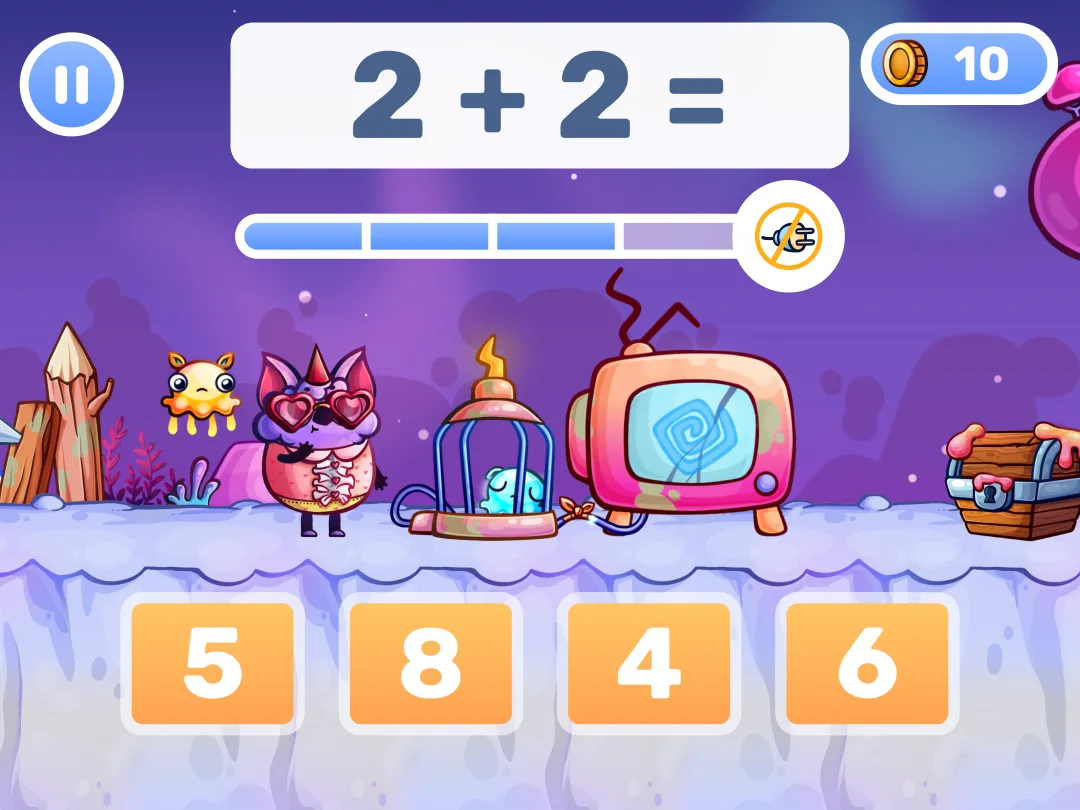
Keep practicing in the MathHero app: a story-driven math game for ages 5-10, from first addition to division.
- Step-by-step learning program: Addition & Subtraction up to 10 adds new facts a little at a time
- Custom Practice: addition and subtraction up to 10, 20, 100 or 1,000
- Typed answers or multiple choice, in Easy, Medium or Hard mode
Free at 5 levels a day, with no ads and nothing locked.
What Math Do Kindergarteners Learn?
In kindergarten, children move from saying numbers to understanding them: counting objects to tell how many, writing numbers and solving their first addition and subtraction problems with blocks, fingers and drawings. The Common Core State Standards name two critical areas for the year, whole numbers (first with sets of objects) and shapes and space, and say that more time should go to numbers than to anything else. This guide follows those standards and gives each one’s code, so you can match it to your child’s report card. Many states use them, some under their own name or with changes: North Carolina’s kindergarten parent guide lists the same main end-of-year goals, while Texas has its own standards (TEKS), which also have kindergarteners name pennies, nickels, dimes and quarters.
Counting and cardinality (K.CC)
- Counting to 100 (K.CC.A.1), by ones and by tens: 10, 20, 30 and on to 100.
- Counting on (K.CC.A.2). Start from any number instead of 1: “Start at 6”, and your child goes on 7, 8, 9, 10. This is the first step toward adding by counting on.
- Writing numbers 0 to 20 (K.CC.A.3), and writing the number for a group of objects, with 0 for an empty plate.
- Counting objects (K.CC.B.4). One number name for each object, never two for the same block; the last number said tells how many there are; the number stays the same however the objects are moved around; and each next number means one more.
- “How many?” (K.CC.B.5). Count up to 20 things in a line, in rows or in a circle, or up to 10 scattered ones, and count out a given number: “Please bring me 12 spoons.”
- Comparing (K.CC.C.6-7). Say whether one group has more, fewer or the same number of objects as another, for groups of up to 10, by matching or counting, and compare two written numbers from 1 to 10: 8 is more than 6. The symbols > and < come in 1st grade (1.NBT.B.3).
Operations and algebraic thinking (K.OA)
- Showing addition and subtraction (K.OA.A.1) with objects, fingers, mental images, drawings, sounds like claps, acting it out, words or equations. Kindergartners should see equations like 5 + 2 = 7; writing them is encouraged but not required.
- Word problems and sums within 10 (K.OA.A.2). Adding to, taking from, putting together and taking apart, with objects or drawings: 4 ducks are in the pond and 3 more swim over. How many ducks are there now? 4 + 3 = 7. Or: Mia has 8 crayons and gives 3 to her brother: 8 − 3 = 5.
- Breaking numbers apart (K.OA.A.3). Split a number up to 10 into two parts in more than one way and record it: 6 = 5 + 1, 6 = 4 + 2, 6 = 3 + 3. Many schools call these pairs number bonds.
- Making 10 (K.OA.A.4). For any number from 1 to 9, find the number that makes 10 with it: 7 and 3, 6 and 4. A ten-frame, a box with two rows of five, shows the empty spaces. This prepares children for the making 10 strategy in 1st grade, 8 + 5 = 10 + 3.
- Fluency within 5 (K.OA.A.5). The one set of facts kindergarteners are expected to know well: 2 + 3, 4 + 1, 5 − 2, 4 − 1, answered quickly and without counting each one. Fluency within 10 is a 1st grade goal (1.OA.C.6).
Number and operations in base ten (K.NBT)
- Teen numbers as ten and some ones (K.NBT.A.1). Build 11 to 19 from ten ones and some more ones, and write it as an equation: 14 = 10 + 4, a full ten-frame and 4 more. This is the start of place value, which becomes tens and ones in 1st grade.
Measurement and data (K.MD)
- Describing what can be measured (K.MD.A.1). Notice what can be measured, like length, height and weight, and describe several of these for one object: a book is tall, thick and heavy.
- Comparing two objects directly (K.MD.A.2). Stand back to back to see who is taller, hold two bags to feel which is heavier, and say it in words: taller, shorter, heavier, lighter.
- Sorting and counting (K.MD.B.3). Sort objects into groups, count each group (up to 10) and order the groups by count: 6 red blocks, 4 blue ones and 2 yellow ones, so red has the most.
Rulers, clocks and coin values are not part of the Common Core kindergarten year: measuring with same-size units and telling time to the hour come in 1st grade, and money word problems in 2nd grade.
Geometry (K.G)
- Shapes and positions (K.G.A.1). Name shapes in the world, a clock face is a circle and a door is a rectangle, and describe where things are with words like above, below, beside, in front of, behind and next to.
- Shapes in any size or position (K.G.A.2). A triangle standing on its point is still a triangle. Kindergarteners learn five flat shapes (squares, circles, triangles, rectangles and hexagons) and four solid ones (cubes, cones, cylinders and spheres).
- Flat or solid (K.G.A.3). A square is flat (two-dimensional); a cube is solid (three-dimensional).
- Comparing shapes (K.G.B.4) in everyday words: how many sides and corners they have, and whether the sides are the same length.
- Building and drawing shapes (K.G.B.5), for example with sticks and clay balls, and joining shapes into bigger ones (K.G.B.6): two triangles make a rectangle.
Kindergarten Math at a Glance
What Should a Kindergartener Know at the Start and at the End of the Year?
In most states, children start kindergarten at 5, so most kindergarteners turn 6 during the year. No math is required to start, and kindergarten teaches counting from the beginning. The first column shows what children usually bring with them: the CDC’s milestones for age 5, which most children reach, and the goals that Head Start preschool programs set for age 5. Children differ a lot here, and Head Start notes that some reach its goals earlier and some later. The second column shows the Common Core goals for the end of kindergarten.
From the start to the end of kindergarten
| Skill | Coming in, usually by age 5 | By the end of kindergarten |
|---|---|---|
| Counting aloud | To 10 (CDC); Head Start aims for 20 | To 100 by ones and by tens; count on from any number (K.CC.A.1-2) |
| Counting objects | About 10 in a row, one number each; 5 scattered ones (Head Start) | 20 in a line or circle, 10 scattered; count out up to 20 (K.CC.B.5) |
| Written numbers | Names some numbers from 1 to 5 (CDC); writes some up to 10 with help (Head Start) | Writes 0 to 20; compares written numbers 1 to 10 (K.CC.A.3, K.CC.C.7) |
| Comparing groups | More, less or the same for up to 5 objects (Head Start) | Up to 10 objects, by matching or counting (K.CC.C.6) |
| Adding and subtracting | Adds or takes away up to 5 with objects and fingers (Head Start) | Within 10 with objects and drawings; fluently within 5 (K.OA.A.2, K.OA.A.5) |
| Teen numbers | Not yet expected | 11 to 19 as ten and some ones (K.NBT.A.1) |
| Shapes | Names basic shapes like circles, squares and triangles in any size or position (Head Start) | Also rectangles, hexagons, cubes, cones, cylinders, spheres; flat or solid (K.G.A.1-3) |
| Measuring and patterns | Orders up to 5 objects by height or weight; extends patterns like red, blue, red, blue (Head Start) | Describes and compares length and weight; sorts and counts groups (K.MD) |
End-of-year checklist for parents
By June, can your child:
- count to 100 by tens, and by ones?
- start counting at 17 instead of 1: 18, 19, 20, 21?
- count out 15 spoons from a pile and say how many there are without counting again?
- write the numbers 0 to 20?
- say which is more, 7 or 9, when you show the written numbers?
- solve “5 apples, you eat 2, how many are left?” with fingers, objects or a drawing?
- answer 3 + 2 and 4 − 1 quickly, without counting each one?
- show two ways to make 7, like 5 and 2 or 4 and 3, and say which number goes with 6 to make 10?
- show 13 as a full ten-frame and 3 more?
- find a cylinder, a sphere and a cube in the kitchen and say which shapes are flat and which are solid?
- sort toys into groups and say which group has the most?
A few gaps in the spring are normal: 1st grade keeps working on counting (now to 120) and on facts within 10 (1.NBT.A.1, 1.OA.C.6). Our article on what math a 5-year-old should know goes deeper into this age, and our guide to whether a child is behind in math explains what to look for and when to talk to the teacher.
How Is Kindergarten Math Tested and Graded?
A readiness check at the start of the year
Many kindergarteners do a check near the start of the school year, often called a kindergarten entry or readiness assessment. In a federal survey for the 2023-2024 school year, 27 states required school districts to give one, typically covering early math together with early reading, language and social and emotional skills. Teachers say these early checks typically have to be done one-on-one. They are a snapshot that helps the teacher plan, not a test a child passes or fails.
Report cards by standard
Many kindergarten report cards are standards-based: they list skills instead of giving one grade for math: counting to 100, writing numbers to 20, adding and subtracting within 10, naming shapes. Each skill gets a mark, often on a scale from 1 to 4. In San Francisco’s public schools, for example, a 3 or higher means your child has mastered the end-of-year expectation, so a 2 in the fall usually means “still learning”, not “behind”.
Watching children work
Much of the checking happens during class: the teacher asks a child to count out 12 counters, show 4 + 2 on their fingers or find the hexagon, and notes what they see. Worksheets matter less in kindergarten than how a child counts and explains, because the standards ask children to show their thinking with objects, fingers and drawings (K.OA.A.1).
Benchmark tests
Some schools also give a computer test a few times a year to see where each child stands, such as NWEA MAP Growth, which covers kindergarten through 12th grade and is taken up to three times a year, usually at the start, in the middle and near the end of the school year. It is adaptive: the questions get harder or easier depending on your child’s answers, so a score is not a percentage correct. Other schools start these tests in a later grade.
State tests usually start in 3rd grade
Federal law requires yearly state tests in math from 3rd grade through 8th grade, so most kindergarteners do not take a state math test. A few states test earlier: Florida, for example, gives its FAST math test three times a year from kindergarten through 2nd grade. Kindergarten is when counting and number sense, the base for everything those tests cover, are laid down.
What “fluently within 5” means
Standard K.OA.A.5 asks kindergarteners to add and subtract fluently within 5. It sets no time limit. The National Council of Teachers of Mathematics defines fluency as using procedures efficiently, flexibly and accurately: a child who knows that 4 + 1 is 5 because it is one more than 4 is fluent, even without speed drills. Our article on math fact fluency explains how fluency grows, and why counting on fingers is a normal step.
What Do Kindergarteners Struggle With in Math?
Most kindergarten sticking points come from the jump between saying numbers and understanding what they mean. Here is what each one looks like and one thing that helps.
1. Counting each object once
What it looks like: your child counts a pile of 8 grapes and gets 10, because they touched some twice, or skipped some, or kept saying numbers after their finger stopped. What helps: move each object to a “done” pile as you say its number, or line the objects up first. One number, one object, then stop.
2. Knowing that the last number tells how many
What it looks like: your child counts 6 cars correctly, and when you ask “So how many cars are there?”, they count again from 1. Or they think the same 6 cars are more when spread out in a long row. What helps: after counting, ask “How many?” and let them answer with the last number. Then spread the cars out, ask whether there are more now, and count again together: still 6.
3. Teen numbers and counting past 29
What it looks like: fourteen gets written as 41, because you hear “four” first, and counting goes “twenty-eight, twenty-nine, twenty-ten”. Backward digits like a reversed 3 or 7 are common too, and usually fade by about age 7. What helps: build teen numbers as a full ten and some more, with a ten-frame or 10 sticks in a bundle: 14 is ten and 4, so the 1 for the ten comes first. Count by tens, 10, 20, 30, so your child knows which number comes after 29.
4. Counting all instead of counting on
What it looks like: for 5 + 3, your child counts out 5 fingers and 3 fingers, then counts all 8 from 1. That is a normal start in kindergarten, but it gets slow and error-prone as numbers grow. What helps: hold up 5 and say “five”, then count on: 6, 7, 8. Practicing counting from any number (K.CC.A.2) makes this easier, and our addition to 10 games practice it.
5. Word problems
What it looks like: in “Sam has 7 balloons and 2 fly away”, your child adds, because they heard two numbers, or answers with one of the numbers from the story. What helps: act it out with toys or draw it, and ask “Will Sam have more balloons or fewer at the end?” before solving. A drawing with 7 circles and 2 crossed out shows the answer, 5.
How to Help Your Kindergartener with Math at Home
- Count real things every day. Count stairs, grapes or forks for the table, touching each one, and ask “How many?” at the end. Our counting activities article has more ideas that work at this age too.
- Count from anywhere and by tens. In the car, start at 17 and count on, take turns saying the next number, or count by tens to 100 and back.
- Small story problems with toys. “You have 3 cars and I give you 2 more. How many now?” Let your child use fingers or the cars. A few minutes of facts within 5 most days builds the year’s fluency goal: the addition and subtraction within 10 games let you pick numbers up to 5 for exactly that.
- Break numbers apart and make 10. Hide some of 7 pennies under a cup and ask how many are hidden. Cut two cups off an egg carton for a ten-frame and fill it: 6 eggs, so 4 more make 10. The number bonds games and making 10 games practice the same pairs.
- Shapes and positions. Go on a shape hunt (a can is a cylinder, a ball is a sphere), and give directions with position words: put the teddy behind the box, next to the lamp.
- Compare and sort. Who is taller? Which bag is heavier? Sort the laundry or the toy box and count which group has the most.
- Play. Board games with a die practice counting dots and counting on along the track, card games practice comparing numbers, and the games on this page practice addition and subtraction within 5 or 10. For more, see our number sense activities, hands-on math activities and the best math apps for kids.
Learn Kindergarten Math with the MathHero App
How is the MathHero app different from the online games on this page?
The online games on this page are mini-games for short addition and subtraction practice. The MathHero app is a full math adventure with step-by-step learning programs, rewards for your hero and saved progress for each child. If your child enjoys these mini-games, try the app: you can play 5 levels a day for free, with no ads and nothing locked.
What Parents Say About the MathHero App
Verbatim from public App Store and Google Play reviews of the MathHero app, with spelling as written. Rated 4.7 on Google Play (48.2K reviews) and 4.6 on the App Store (12K ratings), checked .
“I’m a teacher and a parent and I have to say, MathHero is one of the best apps I’ve found! I like that there’s not a lot of extra stuff to get lost in. My five year old son has seen incredible improvement in a few days of playing, and I like that the app has nice big buttons/numbers to click on when looking at it on a small iPhone screen.
The one thing I’d like is to be able to focus on a certain skill, say +7 or +8.”
“Absolutely brilliant! This is a low stimulation game with a nice pace that's really well-suited to younger kids, and a lovely premise to boot. Love that you can earn and buy a different monster blaster - my 5yo has had a whale of a time learning and playing!”
“My son and daughter LOVE this app. My daughter likes the clothes and my son likes that there is a BOSS to battle. It has difficulty levels so both my older and younger child can learn at their own pace. Neither child got bored with this app like they do with most apps.”
Kindergarten Math: Common Questions
What math do kids learn in kindergarten?
Under the Common Core standards, kindergarten math is mostly about numbers: counting to 100 by ones and tens, counting objects to tell how many, writing numbers 0 to 20, comparing groups, and adding and subtracting within 10 with objects, fingers and drawings. Children also break numbers into pairs, find the partner that makes 10, see 11 to 19 as ten and some ones, compare objects by length and weight, sort and count, and name flat and solid shapes.
What math should kids know before kindergarten?
No math is required to start kindergarten, and kindergarten teaches counting from the beginning. By age 5, most children count to 10 and name some numbers between 1 and 5, according to the CDC's milestones. Preschool programs such as Head Start aim for a bit more by that age: counting to 20, counting about 10 objects one by one, seeing up to 5 objects without counting and naming basic shapes.
What should a kindergartener know by the end of the year?
By the end of kindergarten, a child should count to 100 by ones and by tens, count on from any number, write numbers 0 to 20 and count out up to 20 objects. They should add and subtract within 10 with objects or drawings, like 4 + 3 = 7, and answer facts within 5, like 2 + 3, quickly. They should also know that 14 is ten and four more, compare objects by length and weight, and name squares, circles, triangles, rectangles, hexagons, cubes, cones, cylinders and spheres.
How high should a kindergartener be able to count?
The Common Core goal is to count to 100 by ones and by tens by the end of kindergarten, and to count on from any number, like 37, 38, 39, 40. Counting objects does not go as high: up to 20 things in a line or up to 10 scattered ones. At the start of the year, many children count aloud to 10 or 20, so the year covers a lot of ground.
Do kindergarteners learn addition and subtraction?
Yes. Kindergarteners add and subtract within 10, usually with objects, fingers or drawings, and solve simple word problems like 5 apples take away 2. The only facts they are expected to know fluently are those within 5, like 2 + 3 and 4 − 1. Fluency within 10 is a 1st grade goal.
Is it OK for kindergarteners to count on their fingers?
Yes. The Common Core kindergarten standards list fingers as one way to show addition and subtraction, together with objects, drawings and acting it out. Fingers help children see 5 and 10, and with practice they move from counting every finger to counting on and then to knowing small facts like 3 + 2 from memory.
What math should a 5-year-old know?
Most 5-year-olds in the US are in kindergarten or about to start it. At the start of kindergarten, many count to 10 or 20, count small groups of objects and name basic shapes. During the year they learn to count to 100, write numbers to 20 and add and subtract within 10, so a 5-year-old who is not adding yet is usually right on time.
What do kindergarteners struggle with in math?
Common sticking points are counting each object exactly once, knowing that the last number counted tells how many, the teen numbers (writing 41 for fourteen), counting past 29, and word problems. Touching and moving each object, building teen numbers as a full ten and some more, and acting out word problems with toys help with most of them.
How can I help my kindergartener with math at home?
Count real things every day and ask how many there are at the end, count from any number and by tens in the car, and make up small story problems with toys, like 3 cars and 2 more. Shape hunts, sorting laundry and comparing who is taller are math too. A few minutes of play most days is enough at this age.
Is there a math test in kindergarten?
Usually there is no state math test in kindergarten: federal law requires yearly state math tests from 3rd to 8th grade. A few states test earlier: Florida gives its FAST math test from kindergarten on, three times a year. Many children do a readiness check near the start of the year, often one-on-one with the teacher, and in 2023-2024, 27 states required districts to give one. Teachers then check skills like counting and adding during the year, and some schools also use computer tests like MAP Growth.
Are these online kindergarten math games free?
Yes. The online games on this page are free to play in your browser on a phone, tablet or computer, with no account, no download and no ads. The MathHero app is free too, at 5 levels a day with nothing locked, and a subscription with a 7-day free trial removes the daily limit.
About This Page
Last updated · App ratings checked
- Common Core State Standards: Kindergarten Mathematics
- Common Core State Standards for Mathematics (full document, kindergarten and grade 1)
- Common Core State Standards: Grade 1 Mathematics
- CDC: Important Milestones by 5 Years
- Head Start Early Learning Outcomes Framework: Mathematics Development, Preschool
- NCES: State requirements for kindergarten entrance and attendance
- NC Department of Public Instruction: Kindergarten Math Parent Guide
- Texas Essential Knowledge and Skills for Mathematics: Kindergarten (19 TAC §111.2)
- GAO: State and Selected Teachers’ Use of Kindergarten Readiness Information (2024)
- San Francisco Unified School District: Grade K Report Card Family Guide
- NWEA: MAP Growth 101, everything families need to know
- Florida Department of Education: FAST Grades K–2 fact sheet, 2025–26
- Congressional Research Service: Educational Assessment and the Elementary and Secondary Education Act
- NCTM: Procedural Fluency in Mathematics
- Understood: Why do some kids write numbers backwards?
- MathHero on the App Store
- MathHero on Google Play