

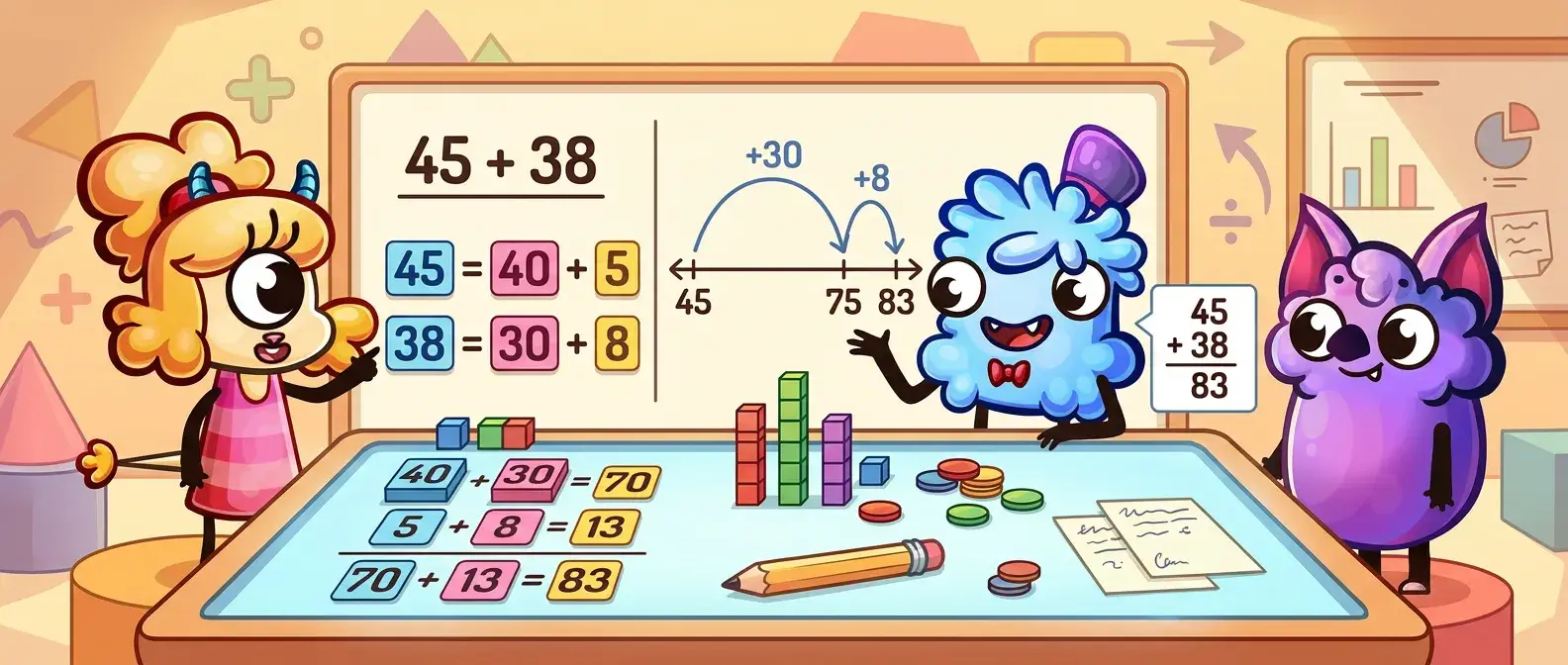
Your third grader brings home a worksheet. The problem is 45 + 38. You know how to solve this problem immediately because you learned how to add by stacking the numbers and carrying the one. This method almost feels automatic.
Your child draws a number line, makes a few jumps, breaks the numbers apart, and writes a sentence explaining how they got their answer.
You stare at it. Where did the carrying go?
If this sounds familiar, you've probably encountered what parents often call "new math."
Trust me, I get it! New things and changes can be scary sometimes. As a teacher, I also understand why these methods can feel confusing when they look completely different from the math you learned as a kid.
The good news? Your child isn't learning a different kind of math. They're learning to understand what's happening underneath the procedures you already know.
Let's take a look at what "new math" actually means, why your child is being asked to solve problems this way, and what you can do when the homework on your kitchen table looks nothing like the math you used to know.
New math, in one paragraph
"New math" isn't actually the official name of a curriculum. It's a nickname parents use for the strategies and methods many children are taught in elementary school today. Many of these methods ask children to understand and explain why a calculation works before becoming fluent with a standard procedure. You might see number bonds, expanded form, open number lines, area models, bar models, and multiple strategies for solving the same problem. Many of the strategies parents now associate with "new math" became especially common during the Common Core era, but Common Core itself does not prescribe specific methods like number lines or bar models. The standards emphasize both conceptual understanding and procedural skills, while leaving schools and teachers to decide how those goals are taught. Your job is to ask which method your child is using, not to reteach the one you know.
Two different things get called "new math"
Here's where things can get confusing.
If you search "new math," you may find articles talking about space exploration, set theory, and the 1950s, or you may also find articles about the number lines and visual models your child is using to solve math problems.
The original New Math, 1951 to the mid-1970s
The first New Math was a real, capitalized, historical movement in American mathematics education. It started in 1951 when the University of Illinois put a young teacher named Max Beberman in charge of rebuilding the high school math curriculum. Beberman emphasized discovery learning as a way for students to develop real understanding. Then Sputnik launched in October 1957, intensifying concerns in the United States about American scientific and technological competitiveness, and federal funding for mathematics and science education increased. The School Mathematics Study Group formed in 1958 under Edward Begle. It became one of the major forces behind the New Math movement, developing mathematics curriculum materials used widely across the country.
It introduced students to ideas like set theory, Venn diagrams, and different number bases other than base ten. The goal was to help students understand the structure behind mathematics rather than simply memorize arithmetic procedures. It was a very different approach from what most parents experienced growing up.
The movement eventually faced significant criticism and began to fade. One challenge was that teachers and schools had to adapt to new approaches and content, and not everyone had the preparation or support needed to make that transition easily. If your own parents complained about new math, this is what they meant. That is not the "new math" your child is doing on their homework today.
Common Core and the new math your child brings home
The second thing called "new math" arrived in 2010. The Common Core State Standards were released that June, and by 2013 most of the United States had signed on. They were a set of standards describing what students should know and be able to do at each grade in math and English language arts. They were not a curriculum or a set of textbooks. Districts still chose their own materials, which is why no single Common Core math curriculum exists anywhere.
The standards emphasized depth, conceptual understanding, problem solving, and procedural fluency. To support those goals, many elementary math programs began using more visual models and multiple strategies. That's the "new math" many parents are actually looking at on their child's homework.
Not every state adopted Common Core, and several states later replaced or substantially revised their standards. South Carolina, for example, adopted Common Core in 2010 and replaced it with its own standards in 2014.
So if your child is drawing number lines or breaking numbers apart, that doesn't necessarily mean their school is using a textbook labeled "Common Core." The names and standards may change. The math strategies often stick around.
Old math vs new math
When parents say "old math," they're usually talking about the way many of us learned math: learn one procedure, practice it, and eventually become quick and accurate. That approach worked really well for plenty of people, including many of us! The difference is that many classrooms use underlying concepts and visual strategies to help students understand the standard algorithm rather than treating the algorithm as the whole lesson.
| Math you may have learned | Math strategies your child may be learning | |
|---|---|---|
| Starting point | The standard algorithm | Understanding why it works |
| Methods per operation | Usually one main method | Multiple strategies |
| Focus | Correct answer & efficient procedure | Reasoning & efficient procedure |
| Place value | Often hidden in the procedure | Made visible and named |
| Fluency | Often emphasized through repeated practice | Built alongside understanding and practice |
| Word problems | Find the operations, then solve | Model the situation, then solve |
| If a child is stuck | Try the steps again | Try a different model or strategy |
I want to be clear about something here: traditional math isn't "bad."
Many of us learned this way and became perfectly capable mathematicians. The concern is what happens when a child can follow a series of steps but doesn't actually understand what those steps mean.
A student might be able to complete a long division problem correctly but still struggle to explain what division represents. Then, when the problem changes or becomes a fraction or an algebra problem, the procedure they've memorized may not be enough.
That's one reason today's instruction puts so much emphasis on understanding the math underneath the procedure.
Why did math instruction change?
The goal wasn't to get rid of computation. It was to help students become flexible problem solvers who can use math even when a problem doesn't look exactly like the examples they've practiced.
In other words, we don't just want students to know how to solve a problem. We also want them to understand why the strategy works.
As a middle school math teacher, I can tell you that understanding the "why" becomes incredibly important once students reach fractions, equations, ratios, geometry, and the list can go on.
The new math methods you'll meet on math problems at home
Let's get to the part you probably care about most.
What is my child actually doing on this worksheet?!
Here are some of the strategies you may see.
Expanded form
Expanded form breaks a number according to its place value.
For example: 347 = 300 + 40 + 7
Now let's look at 45 + 38. Instead of immediately stacking the numbers, a child might think:
- 45 = 40 + 5 and 38 = 30 + 8
- Then: 40 + 30 = 70 and 5 + 8 = 13
- And finally: 70 + 13 = 83
Nothing is being "carried" because the place value is being shown instead of hidden inside the traditional algorithm. That little 1 you learned to carry? Your child is learning that it's actually one ten. That's the concept hiding inside the shortcut!
Number bonds and making ten
Number bonds show how numbers can be broken apart.
For example: 10 can be 6 + 4, or 10 can be 7 + 3.
Children practice these combinations until they become familiar, and then they can use them to make calculations easier.
For example, in the problem 8 + 5, a child might take 2 from the 5 to make 10: 8 + 2 = 10. That leaves 3. So: 10 + 3 = 13. At first, this might feel slower than simply knowing that 8 + 5 = 13. But eventually, the goal is for children to recognize these relationships automatically and use the same thinking with larger numbers.
Open number lines for subtraction
An open number line is exactly what it sounds like: a number line that doesn't have every number already marked.
For 83 − 45, a child might start at 45 and count up to 83:
- 45 → 50 = 5
- 50 → 80 = 30
- 80 → 83 = 3
Then: 5 + 30 + 3 = 38. So, 83 − 45 = 38.
This strategy helps students see subtraction as the distance between two numbers, rather than only thinking about "taking away."
Here's something I love about this strategy: it connects to something you may actually do in real life! If something costs $45 and you hand the cashier $83, you may think about how much change you need to get back by counting up. Your child is practicing that same idea.
The box or area model for multiplication
You may also see a big rectangle or box split into smaller sections. Don't panic! This is an area model, and it's a visual way to show what is happening when you multiply using place value and the distributive property.
For example: 23 × 14
Break the numbers apart: 23 = 20 + 3 and 14 = 10 + 4
Then multiply each part:
| 23 × 14 = | |
|---|---|
| 20 × 10 = | 200 |
| 3 × 10 = | 30 |
| 20 × 4 = | 80 |
| 3 × 4 = | 12 |
| 200 + 30 + 80 + 12 = | 322 |
You might look at that and think, "Why are we doing FOUR multiplication problems?!" But here's the important part: the traditional multiplication algorithm is doing those same calculations. The box just makes those calculations visible.
Once students understand what is happening, the standard algorithm becomes a shortcut for all of that thinking. For the full sequence from equal groups to multi-digit products, see How to Teach Multiplication.
Bar models for word problems
Bar models are another visual strategy you may encounter, especially with word problems.
Imagine this problem: Maya has 3 times as many stickers as Ben. Together they have 48 stickers. How many stickers does Ben have?
Instead of immediately deciding whether to multiply or divide, a child can draw one bar for Ben and three equal bars for Maya: four equal bars in total, representing 48 stickers. Now the structure of the problem is visible.
There are four equal parts: 48 ÷ 4 = 12. So Ben has 12 stickers, and Maya has 36.
The goal is to help students understand the situation before choosing an operation. That skill becomes especially useful as math gets more complicated.
Does new math get rid of the standard algorithm?
No! This is probably the biggest misconception I hear.
The standard algorithms (the traditional methods you probably learned) are still part of mathematics instruction. Students are expected to eventually become fluent with them. The difference is that many classrooms introduce the underlying concepts and visual strategies before students rely on the standard algorithm.
| Operation | Standard algorithm required by | Standard |
|---|---|---|
| Addition and subtraction, multi-digit | End of grade 4 | 4.NBT.B.4 |
| Multiplication, multi-digit | End of grade 5 | 5.NBT.B.5 |
| Division, multi-digit | End of grade 6 | 6.NS.B.2 |
Think of it like this: Understanding → Strategies → Fluency
Not every classroom follows that exact sequence for every skill, but the goal is for understanding and practice to work together so students eventually become fluent.
The goal isn't for your child to draw a number line forever. The goal is for them to understand the mathematics well enough that they can eventually solve the problem efficiently.
Children still need math fact fluency, too. The idea isn't that memorization is bad. We want both understanding and fluency.
Same story for the times tables. Many parents assume nobody memorizes anything now. But, by the end of grade 2, a child should know from memory all sums of two one-digit numbers. By the end of grade 3, all products of two one-digit numbers. The times tables are still in there. The standards pair fact fluency with strategies and understanding rather than treating memorization as the only goal.
Whether that's what happens in every classroom is another matter. In a 2016 Fordham Institute survey of more than 1,000 K–8 math teachers, teachers were more likely to report having fewer students who memorized basic math formulas and multiplication tables than before the Common Core. Importantly, the same report notes that the Common Core standards themselves still included expectations for students to know basic facts from memory.
Why new math takes so many steps
Because, in many cases, the steps are the lesson!
Think about the phrase "carry the one." It's a very efficient way to describe what you're doing. But if you've never learned about place value, those four words don't actually explain much. When students understand that the "1" represents one ten, the procedure makes more sense instead of feeling like a rule they simply have to remember.
Newer strategies often take the reasoning that is hidden inside the traditional algorithm and make it visible. That can make the work look longer, and of course slower too. That's okay at first. But here's where I think parents have a really important point: the goal is not for your fifth grader to draw a giant number line for every basic calculation forever. The strategies are supposed to eventually become more efficient. Students need practice so that the scaffolding can gradually come down.
What the math change delivered, and what it didn't
Being honest with you here matters more than trying to defend any one set of standards or curriculum.
The evidence on whether Common Core and related college- and career-ready standards improved student achievement is mixed. A 2019 study from the Center on Standards, Alignment, Instruction, and Learning (C-SAIL) found significant negative effects in fourth-grade reading and, seven years after adoption in one of its analyses, eighth-grade math. Most of the other estimated effects were not statistically significant, although they tended to be negative. The researchers also cautioned that their findings should be interpreted carefully because of limitations in the study design and the timing of implementation.
Other research has found different results. A 2021 study by Joshua Bleiberg, for example, found an initial positive effect of Common Core on math scores, with larger gains among economically advantaged students and no detectable initial effect among economically disadvantaged students.
So the research doesn't give us a simple "Common Core worked" or "Common Core failed" answer. Different studies have found different effects, and the effects are generally modest.
We can also look at what has happened nationally on the NAEP assessment. In 2024, 39 percent of fourth-graders performed at or above the NAEP Proficient level in mathematics: 3 percentage points higher than in 2022, but 2 percentage points lower than in 2019. Eighth-grade mathematics performance remained statistically unchanged from 2022 after the substantial decline between 2019 and 2022. One important note: NAEP's Proficient level is specific to the NAEP assessment and is not the same thing as a state's definition of grade-level proficiency.
There are two important caveats here. First, standards are not the same thing as math instruction. A state can adopt a set of standards while classrooms, curriculum materials, assessments, and teacher training vary considerably in how those standards are actually put into practice. Second, national test scores are influenced by far more than one set of standards, especially across a period that included major disruptions from the COVID-19 pandemic.
What that means for you: the method on your child's worksheet isn't, by itself, evidence that your child is being taught well or poorly. What matters is whether the strategy helps your child understand the math, develop fluency, and eventually use that understanding independently. That's really the goal behind all of these methods.
What can you do when you don't understand your child's math?
Try not to start with the method that you learned. I know this is easier said than done. You see the problem and immediately think, "Oh! I know how to do this." But if your child is learning a different strategy, showing them your method first can sometimes make things more confusing. They may walk away thinking there are two sets of math rules: one from school and one from Mom or Dad.
Instead, let them show you their strategy first. If they want to learn your method later, that's great! You can even say, "That's another way to solve it. Your teacher is showing you this strategy first because they want you to understand what's happening." And if they can't explain the strategy? That's useful information, too. It may mean they need some extra support with the concept, and that's a great thing to communicate to their teacher.
Please be careful with "I'm not a math person." I know this one is usually said casually. But kids are listening. If your child is struggling with math, they need to hear that struggling doesn't mean they're "bad at math."
You can say: "This one is tricky. Let's figure it out together." That small shift can make a huge difference in how a child sees themselves as a math learner.
For more on staying a thinking partner at the kitchen table, see How to Help Your Child With Math Homework.
Don't forget about the basics
There's one piece of the conversation about "new math" that I don't want to lose: math fact fluency still matters. When basic facts become automatic, children don't have to spend as much effort figuring out those facts while they're also trying to reason through a more complicated problem.
Think about reading. If you have to stop and sound out every single word, it's hard to focus on what the sentence means.
Math can work the same way. If a child is still spending all of their mental energy figuring out basic facts, there's less working memory available for the multi-step reasoning the problem requires.
How MathHero fits in
Building fact fluency alongside conceptual understanding is so important! That's the gap MathHero fills. It's a story-driven adventure game for ages 5 to 10 where short sets of math facts are how your child moves the story forward: build, race, battle, help characters, earn coins and gear. Solving problems is the action, not a quiz between levels. You pick the topic (addition and subtraction within 10, 20, 100 or 1000, times tables, division) and either set an open practice level or hand your child a guided step-by-step path. Then you can leave them to it.
The goal isn't to replace what your child is learning in math class. Instead, it gives them a way to build the automatic recall that supports all of that bigger mathematical thinking.
I especially like that distinction. MathHero isn't trying to teach your child how to draw an area model or a bar model. That's a teacher's job. Instead, it can help strengthen the basic math facts that those strategies eventually build upon.
The game has a free version with some limits, no third-party ads, and short practice sessions. Because for most kids, a little bit of practice consistently is much more manageable than sitting down for one giant math-fact marathon.
The best part is that to your child it just feels like they're playing a game!
Let the teacher handle the number lines and area models. Pick the facts underneath them, and let MathHero turn the practice into play.
Explore MathHeroQuestions parents ask about new math
The next time the math homework looks like a foreign language
Take a breath. You don't have to remember every strategy your child is learning and you don't have to become a math teacher overnight.
Instead, start with one simple question: "What is this strategy called?"
Then let your child show you what they know. Because sometimes the most helpful thing you can do isn't picking up the pencil and solving the problem. It's giving your child the chance to explain the math.
Sources
- Common Core State Standards Initiative. Common Core State Standards for Mathematics. Grade-level standards and Frequently Asked Questions.
- Institute of Education Sciences, What Works Clearinghouse. (2021). Assisting Students Struggling with Mathematics: Intervention in the Elementary Grades. U.S. Department of Education.
- National Center for Education Statistics / National Assessment of Educational Progress. (2024). NAEP Mathematics: National Trends and Student Skills.
- Bay-Williams, J. M., Duffett, A., & Griffith, D. (2016). Common Core Math in the K–8 Classroom: Results from a National Teacher Survey. Thomas B. Fordham Institute.
- Bleiberg, J. (2021). Does the Common Core have a common effect? An exploration of effects on academically vulnerable students. AERA Open, 7.
- Song, M., Yang, R., & Garet, M. (2019). Effects of States' Adoption of College- and Career-Ready Standards on Student Achievement. Center on Standards, Alignment, Instruction, and Learning (C-SAIL).
- University of Illinois Archives. University of Illinois Committee on School Mathematics (UICSM), Administrative Subject File, 1951–1968.
