
5 Times Table Games for Kids
Practice multiplication by 5 with free MathHero adventure games for kids, right in your browser: 5, 10, 15 and on up to 50. No account, no download, no ads.
- 5 × 1 to 5 × 10
- Grades 2-3 · ages 7-9
- Free in the browser
- No account, no download
- No ads
- Phone, tablet and computer
Pick a 5 Times Table Game to Play
Practice Another Times Table
Get MathHero: The Full Adventure
Keep practicing in the MathHero app: a story-driven math game for ages 5-10, from first addition to division.
- Step-by-step learning programs that build the times tables one table at a time
- Custom Practice: any times tables from ×1 to ×12, or a mix like only ×5 and ×10
- Typed answers or multiple choice, in Easy, Medium or Hard mode
Free at 5 levels a day, with no ads.

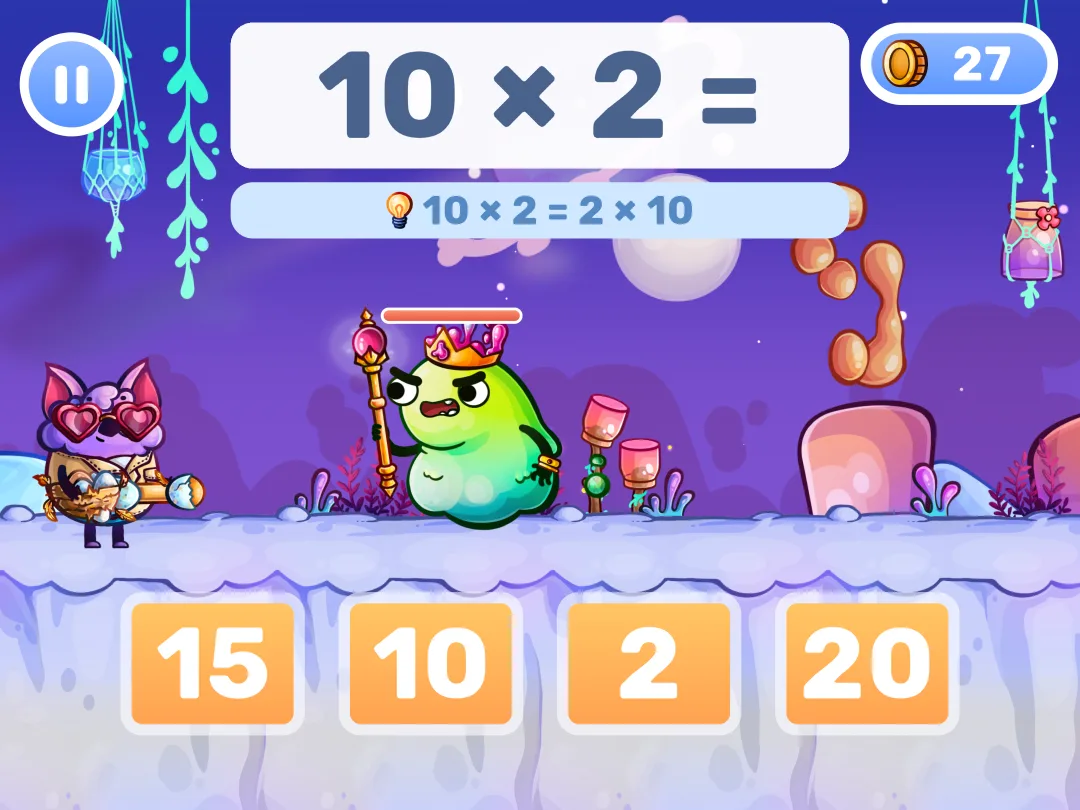
How to Learn the 5 Times Table
To learn the 5 times table, count in fives, notice how the answers end, then practice until the facts come from memory. The 5s are usually one of the first tables children learn, alongside the 2s and 10s, so your child may not know many other tables yet. The answers are 5, 10, 15, 20, 25, 30, 35, 40, 45, 50. Every fact works both ways: 5 × 4 is the same as 4 × 5.
Count in fives
Skip-count by 5: 5, 10, 15, 20, 25, 30, 35, 40, 45, 50. Say the next number each time you hold up another finger. Counting is how the table starts, not how it should stay. Reciting the list up to 5 × 7 every time is slow. The goal is to recall 35 straight away.
One finger for each five
Each finger can stand for 5. Three fingers are 15, four fingers are 20, and a whole hand is 5 × 5 = 25. Both hands are 5 × 10 = 50. The facts through 5 × 5 are easy to see on one hand. From 5 × 6 on, a pattern is faster than counting fingers on a second hand.
Answers end in 5 or 0
Every answer in the 5s ends in 5 or 0, and the endings take turns. An odd multiplier ends in 5: 5 × 1 = 5, 5 × 3 = 15, 5 × 5 = 25, 5 × 7 = 35, 5 × 9 = 45. An even multiplier ends in 0: 5 × 2 = 10, 5 × 4 = 20, 5 × 6 = 30, 5 × 8 = 40, 5 × 10 = 50. That last digit is a quick check. An odd multiplier cannot end in 0, and an even multiplier cannot end in 5.
Half of the 10s
Five is half of ten, so each 5s fact is half of the 10s fact with the same multiplier. The 10s are usually learned around the same time: put a zero on the end, then take half. 10 × 8 = 80, and half of 80 is 40, so 5 × 8 = 40. The same step helps with the facts that need the most practice: 5 × 6 is half of 60, which is 30, 5 × 7 is half of 70, which is 35, and 5 × 9 is half of 90, which is 45.
Count nickels
A nickel is 5 cents. Three nickels are 15 cents, six nickels are 30 cents and eight nickels are 40 cents. Counting a pile of nickels is the 5 times table with something to hold.
Read the 5s on a Clock
A clock face counts in fives. The minute hand moves 5 minutes for each number: on the 1 it is 5 minutes, on the 2 it is 10, and on the 4 it is 20. So 5 × 4 = 20. The same reading works all the way around. The 6 is 30 minutes, so 5 × 6 = 30. The 9 is 45 minutes, so 5 × 9 = 45. The 12 is 60 minutes, a whole hour, so 5 × 12 = 60.
Common mistakes
- The wrong last digit. 5 × 7 is 35, not 30. 30 ends in 0, and that ending belongs to an even multiplier: 5 × 6 = 30. The 7 in 5 × 7 is odd, so the answer ends in 5.
- Halving the wrong 10. 5 × 8 is half of 80, which is 40, not 45. 45 is half of 90, so it is 5 × 9. Match the multiplier first, then take half.
- One count off. Skip-counting can stop one five early or late, so 5 × 7 comes out as 30 or 40. To check, start from a fact you trust, such as 5 × 5 = 25, and count on two fives: 30, then 35.
For the methods your child's class is probably using, see our guide on how to teach multiplication. Curious where times tables come from? Read who invented times tables.
| Fact | Answer | Quick way |
|---|---|---|
| 5 × 1 | 5 | one 5 |
| 5 × 2 | 10 | double 5 |
| 5 × 3 | 15 | three nickels |
| 5 × 4 | 20 | 4 on a clock |
| 5 × 5 | 25 | one hand |
| 5 × 6 | 30 | half of 60 |
| 5 × 7 | 35 | half of 70 |
| 5 × 8 | 40 | half of 80 |
| 5 × 9 | 45 | half of 90 |
| 5 × 10 | 50 | 5 tens |
| 5 × 11 | 55 | 50 + 5 |
| 5 × 12 | 60 | 50 + 10 |
Highlighted: 5 × 6 to 5 × 9, the facts that usually need the most practice. The games on this page practice 5 × 1 to 5 × 10. 5 × 11 and 5 × 12 complete the table up to 12, which schools in England expect by Year 4.
What Grade Learns the 5 Times Table?
The 5 times table is one of the first tables children learn. In the US, children skip-count by 5s, 10s and 100s in grade 2, usually at ages 7-8 (Common Core 2.NBT.A.2), and 2.MD.C.7 asks them to tell time to the nearest five minutes. They learn the 5 times table in Grades 2-3. Common Core standard 3.OA.C.7 expects children to know all one-digit multiplication facts, up to 9 × 9, from memory by the end of grade 3. In England, the 2, 5 and 10 times tables are a Year 2 objective (ages 6-7) and part of the Year 4 multiplication tables check.
- Age
- 7-9
- US grade
- Grades 2-3
- Standard
- Common Core 3.OA.C.7
- England
- Year 2
What Parents Say About MathHero
Verbatim from public App Store and Google Play reviews of the MathHero app, with spelling as written. Rated 4.7 on Google Play (48.2K reviews) and 4.6 on the App Store (12K ratings), checked .
“Having my son do 5-10 levels every day and he has gotten so much quicker!”
“Great math practice in game form so children do not fuss about practicing math facts! Much better than a boring printout of hundreds of math facts for homework!”
“I love that you can choose what you're working on and change it easily. I keep it to where it's still easy, but they have to stop and think 10% of the time.”
5 Times Table Games: Common Questions
What are the best free games for the 5 times table?
How do the MathHero 5 times table games work?
How can my child practice the 5 times table?
What grade learns the 5 times table?
Are MathHero's 5 times table games free?
Do the 5 times table games work on a tablet or phone?
Can my child practice only the 5s and 10s?
How long should kids practice the 5 times table each day?
About This Page
Last updated · App ratings checked