
Multiplication and Division Games for Kids
Practice multiplication and division with three free math games for kids. Choose the facts your child is working on, from ×1 to ×12 and ÷1 to ÷12, then race, battle slimes or deliver parcels. Play right in your browser with no account, download or ads.
- Multiplication and division facts
- Tables 1 to 12
- Grades 3-4 · ages 8-10
- Free in the browser
- No account, no download
- No ads
- Phone, tablet and computer
Pick a Multiplication and Division Game to Play
×2 to ×10 and ÷2 to ÷10 are selected to begin with. Select ×11, ×12, ÷11 or ÷12 for more, or press “Clear all” under one sign to practice only the other operation.
Get MathHero: The Full Adventure
Keep practicing in the MathHero app: a story-driven math game for ages 5-10, from first addition to division.
- Step-by-step learning programs that build the multiplication tables one table at a time
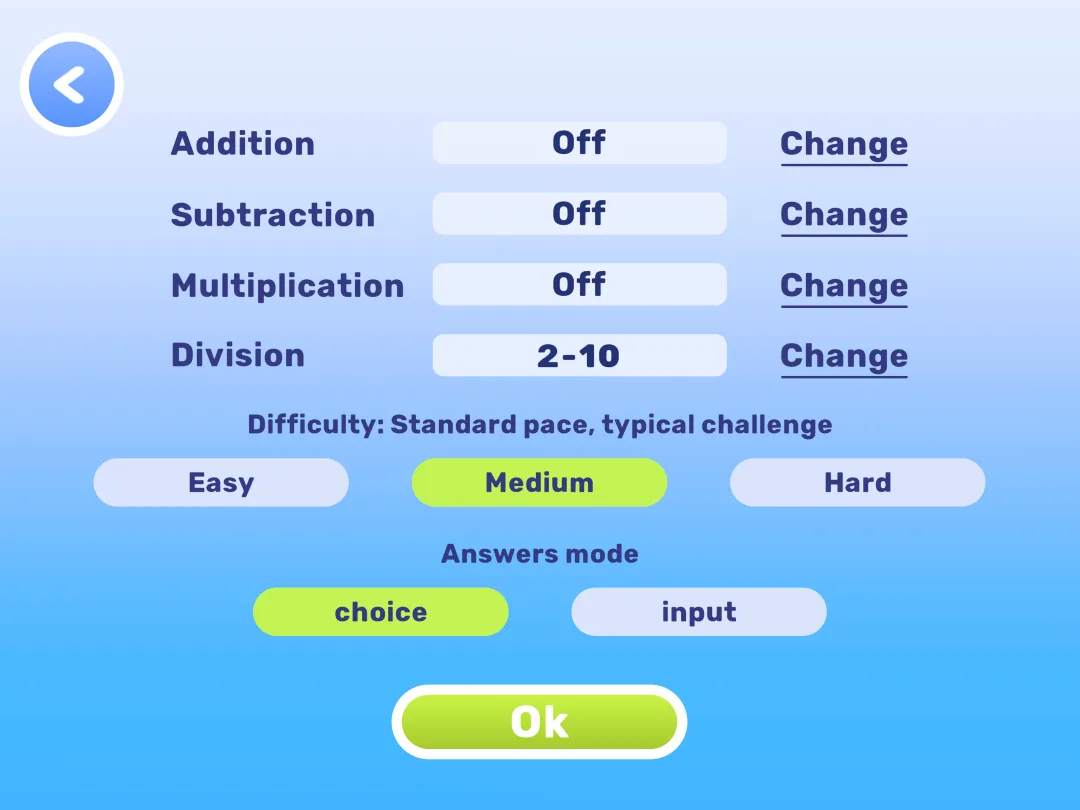
- Custom Practice: multiplication and division together or each on its own, for the tables you choose
- Typed answers or multiple choice, in Easy, Medium or Hard mode
Free at 5 levels a day, with no ads and nothing locked.

How to Learn Multiplication and Division Facts
Every division fact is a multiplication fact turned around, so learn the two together, one table at a time, and practice a little most days until the answers come from memory.
1. Division is multiplication turned around
For 56 ÷ 8, ask “8 times what makes 56?”: 8 × 7 = 56, so the answer is 7. Common Core standard 3.OA.B.6 describes division this way, as an unknown-factor problem, and 3.OA.A.4 asks children to find the missing number in facts like 8 × ? = 48 or 48 ÷ ? = 6.
2. One fact family, four facts
The numbers 7, 8 and 56 make a fact family: 7 × 8 = 56, 8 × 7 = 56, 56 ÷ 8 = 7 and 56 ÷ 7 = 8. From one fact of the family, your child can work out the other three. A square like 7 × 7 = 49 makes a smaller family of two facts: 7 × 7 = 49 and 49 ÷ 7 = 7.
3. See the whole family in an array
An array, dots in equal rows, shows all four facts of a family at once. Lay out 24 counters in 4 rows of 6 and read them two ways:
- Read the rows: 4 rows of 6 make 24, so 4 × 6 = 24. Shared into 4 rows, 24 gives 6 in each, so 24 ÷ 4 = 6.
- Read the columns: 6 columns of 4 make 24, so 6 × 4 = 24. Shared into 6 columns, 24 gives 4 in each, so 24 ÷ 6 = 4.
4. Learn the tables in a helpful order
Start with the 2s, 5s and 10s: doubling and halving, counting in fives and the tens make them quick wins for multiplying and dividing. 35 ÷ 5 is counting in fives to 35, and 70 ÷ 10 is 7 tens. Then learn the 3s and 4s (the 4s are the 2s doubled), and leave the 6s, 7s, 8s and 9s for last, because they lean on everything learned before. With each table, practice its division facts too: when your child knows 4 × 9 = 36, ask 36 ÷ 4 and 36 ÷ 9.
Common mistakes
- Confusing similar facts. 7 × 8 = 56 and 7 × 9 = 63 sit next to each other, and so do 56 ÷ 7 and 63 ÷ 7. To check, step from a fact you are sure of: 7 × 10 = 70, and 70 − 7 = 63, so 7 × 9 is 63 and 7 × 8 is 56.
- Writing the division backward. From 7 × 8 = 56, some children write 8 ÷ 56 = 7. In a division fact from the tables, the biggest number of the family, the one being shared, comes first: 56 ÷ 8 = 7.
- Swapped digits. 7 × 9 is 63, not 36, which is 6 × 6. Saying the whole fact out loud, seven nines are sixty-three, helps it stick, and 63 ÷ 9 = 7 then follows.
For the methods your child's class is probably using, see our guide on how to teach multiplication, and to see why quick recall of facts matters, read about math fact fluency.
Multiplication and Division Fact Families
Each row is a multiplication and division fact family, one from each multiplication table from 2 to 10. Read it from left to right: the two numbers multiplied give the third, and dividing the third by either one gives the other.
| Numbers | Multiplication facts | Division facts | ||
|---|---|---|---|---|
| 2, 9, 18 | 2 × 9 = 18 | 9 × 2 = 18 | 18 ÷ 9 = 2 | 18 ÷ 2 = 9 |
| 3, 7, 21 | 3 × 7 = 21 | 7 × 3 = 21 | 21 ÷ 7 = 3 | 21 ÷ 3 = 7 |
| 4, 6, 24 | 4 × 6 = 24 | 6 × 4 = 24 | 24 ÷ 6 = 4 | 24 ÷ 4 = 6 |
| 4, 9, 36 | 4 × 9 = 36 | 9 × 4 = 36 | 36 ÷ 9 = 4 | 36 ÷ 4 = 9 |
| 5, 8, 40 | 5 × 8 = 40 | 8 × 5 = 40 | 40 ÷ 8 = 5 | 40 ÷ 5 = 8 |
| 6, 8, 48 | 6 × 8 = 48 | 8 × 6 = 48 | 48 ÷ 8 = 6 | 48 ÷ 6 = 8 |
| 6, 9, 54 | 6 × 9 = 54 | 9 × 6 = 54 | 54 ÷ 9 = 6 | 54 ÷ 6 = 9 |
| 6, 10, 60 | 6 × 10 = 60 | 10 × 6 = 60 | 60 ÷ 10 = 6 | 60 ÷ 6 = 10 |
| 7, 8, 56 | 7 × 8 = 56 | 8 × 7 = 56 | 56 ÷ 8 = 7 | 56 ÷ 7 = 8 |
| 7, 9, 63 | 7 × 9 = 63 | 9 × 7 = 63 | 63 ÷ 9 = 7 | 63 ÷ 7 = 9 |
| 8, 9, 72 | 8 × 9 = 72 | 9 × 8 = 72 | 72 ÷ 9 = 8 | 72 ÷ 8 = 9 |
| 7, 7, 49 | 7 × 7 = 49 | 49 ÷ 7 = 7 | ||
Highlighted: a square, 7 × 7 = 49. Both numbers multiplied are the same, so its family has two facts instead of four.
What Grade Do Kids Learn Multiplication and Division?
In the US, children learn multiplication and division together in 3rd grade, usually at ages 8-9, and use the facts in 4th grade:
- 3rd grade: understand division as an unknown-factor problem (3.OA.B.6), find the unknown number in a multiplication or division equation, like 8 × ? = 48 (3.OA.A.4), and multiply and divide fluently within 100, knowing all products of two one-digit numbers from memory by the end of the year (3.OA.C.7).
- 4th grade: use these facts to multiply multi-digit numbers (4.NBT.B.5) and to divide numbers of up to four digits by a one-digit number (4.NBT.B.6).
In England, children learn the division facts together with the multiplication tables. After the 2, 5 and 10 multiplication tables in Year 2, they learn the 3, 4 and 8 multiplication tables in Year 3, and in Year 4 they recall the multiplication and division facts for all the tables up to 12 × 12.
- Age
- 8-10
- US grade
- Grades 3-4
- Standard
- Common Core 3.OA.C.7
- England
- Years 3-4
Learn Multiplication and Division with the MathHero App
How is the MathHero app different from the online games on this page?
The online games on this page are mini-games for short multiplication and division practice. The MathHero app is a full math adventure with step-by-step learning programs, rewards for your hero and saved progress for each child. If your child enjoys these mini-games, try the app: you can play 5 levels a day for free, with no ads and nothing locked.
What Parents Say About the MathHero App
Verbatim from public App Store and Google Play reviews of the MathHero app, with spelling as written. Rated 4.7 on Google Play (48.2K reviews) and 4.6 on the App Store (12K ratings), checked .
“my son has been frustrated at his speed at multiplication and division. I downloaded this to help build his skills. he is liking this so far! thanks”
“my kid has asked me everyday if he can play his math game and while other kids are doing addition my kid is doing multiplacation and division thank you so much MathHero!”
“The game goes the range, of simple addition/subtraction to more difficult multiplication/division tables. Difficulty is fully adjustable.”
Multiplication and Division Games: Common Questions
What are good multiplication and division games?
How are multiplication and division related?
What is a multiplication and division fact family?
Should kids learn multiplication before division?
What grade do kids learn multiplication and division facts?
Can my child practice only one table?
Are these online multiplication and division games free?
Do the online multiplication and division games work on a tablet or phone?
About This Page
Last updated · App ratings checked