
| Topic | What it looks like | Example | Standard |
|---|---|---|---|
| Word problems | Add to, take from, put together, take apart, compare within 20 | ? + 5 = 13 | 1.OA.A.1 |
| Three numbers | Word problems with a sum up to 20 | 4 + 7 + 6 = 17 | 1.OA.A.2 |
| Properties | Turn a fact around, add in an easier order | 8 + 3 = 3 + 8 | 1.OA.B.3 |
| Missing addend | Use addition to subtract | 10 − 8: 8 + ? = 10 | 1.OA.B.4 |
| Counting on | Start from a number, not from 1 | 9 + 2: 10, 11 | 1.OA.C.5 |
| Facts within 20 | Strategies within 20, fluent within 10 | 8 + 6 = 10 + 4 = 14 | 1.OA.C.6 |
| Equal sign | True or false equations | 7 = 8 − 1 is true | 1.OA.D.7 |
| Unknown numbers | The missing number in any place | 5 = ? − 3 | 1.OA.D.8 |
| Counting to 120 | Count, read and write from any number | 98, 99, 100, 101 | 1.NBT.A.1 |
| Tens and ones | Two-digit numbers as tens and ones | 47 = 4 tens, 7 ones | 1.NBT.B.2 |
| Comparing | Two-digit numbers with >, = and < | 42 > 24 | 1.NBT.B.3 |
| Within 100 | Add a one-digit number or a multiple of 10, with models | 36 + 7 = 43, 34 + 20 = 54 | 1.NBT.C.4 |
| 10 more or less | In your head, without counting | 57: 67 and 47 | 1.NBT.C.5 |
| Subtracting tens | Multiples of 10 from 10 to 90 | 70 − 30 = 40 | 1.NBT.C.6 |
| Length | Order by length, measure with same-size units | A book is 9 paper clips long | 1.MD.A.1-2 |
| Time | Hours and half hours | 3:30, half past 3 | 1.MD.B.3 |
| Data | Up to three categories | How many more chose dogs than fish? | 1.MD.C.4 |
| Shapes | Attributes that define a shape | A triangle has 3 sides, any size or color | 1.G.A.1 |
| Composing shapes | Put shapes together into new ones | Two triangles make a rectangle | 1.G.A.2 |
| Equal shares | Halves and fourths | A sandwich cut into fourths | 1.G.A.3 |
1st Grade Math Games
Pick one of four free 1st grade math games and play it right in your browser, with no account, download or ads. Then choose what to practice: addition, subtraction or both, within 10, 20 or 100.
- 1st grade · ages 6-7
- Addition and subtraction to 20
- Free
- No account
- No ads
- Phone, tablet and computer
Pick a 1st Grade Math Game to Play
Pick a game, then choose addition, subtraction or both within 20, and select “Without crossing 10” for easier facts like 13 + 4.
Practice One 1st Grade Skill
Math Games by Grade
For parents


Get MathHero: The Full Adventure
Keep practicing in the MathHero app: a story-driven math game for ages 5-10, from first addition to division.
- Step-by-step learning programs: Addition & Subtraction up to 10, Addition up to 20 and Subtraction up to 20 add new facts a little at a time
- Custom Practice: addition and subtraction up to 10, 20, 100 or 1,000
- Typed answers or multiple choice, in Easy, Medium or Hard mode
Free at 5 levels a day, with no ads and nothing locked.
What Math Do 1st Graders Learn?
In 1st grade, children move from counting objects one by one to adding and subtracting with strategies, from writing numbers to 20 to counting, reading and writing them to 120, and from saying which of two things is longer to measuring how long something is. The Common Core State Standards name four main areas for the year: addition and subtraction within 20 and the strategies for them, place value with tens and ones, measuring length with same-size units, and the attributes of shapes and how shapes fit together. This guide follows those standards and gives each one’s code, so you can match it to your child’s report card. Many states use them, some under their own name or with changes, so your school’s list can differ in details: Texas, for example, has its own standards (TEKS), and they include coins in 1st grade.
Operations and algebraic thinking (1.OA)
- Word problems within 20 (1.OA.A.1). Problems about adding to, taking from, putting together, taking apart and comparing, with the unknown number in any position. A comparing example: Ana has 12 shells and Ben has 8. How many more does Ana have? 12 − 8 = 4, or 8 + ? = 12. A missing start: some birds sat on a fence, 5 more came, and now there are 13. How many were there at first? ? + 5 = 13, so 8.
- Adding three numbers (1.OA.A.2). Word problems with three numbers whose sum is 20 or less: 4 apples, 7 pears and 6 plums are 4 + 6 = 10, then 10 + 7 = 17 pieces of fruit.
- Properties as strategies (1.OA.B.3). If 8 + 3 = 11 is known, 3 + 8 = 11 is known too, and 2 + 6 + 4 is easier as 2 + 10 = 12. Children use these ideas without learning their formal names.
- Subtraction as a missing addend (1.OA.B.4). 10 − 8 means “what goes with 8 to make 10?”, so the answer is 2.
- Counting on (1.OA.C.5). For 9 + 2, start at 9 and count 10, 11, instead of counting all eleven from 1.
- Adding and subtracting within 20 (1.OA.C.6). The main arithmetic of the year, with strategies: counting on, making ten (8 + 6 = 8 + 2 + 4 = 10 + 4 = 14), breaking a number down to get to ten (13 − 4 = 13 − 3 − 1 = 10 − 1 = 9), using a known fact (8 + 4 = 12, so 12 − 8 = 4) and using doubles (6 + 7 = 6 + 6 + 1 = 13). By the end of the year, children add and subtract within 10 fluently.
- The equal sign (1.OA.D.7). = means “is the same as”, not “the answer comes next”. Children decide whether equations are true or false: 6 = 6, 7 = 8 − 1 and 5 + 2 = 2 + 5 are true, 4 + 1 = 5 + 2 is false.
- Unknown numbers (1.OA.D.8). Find the missing number wherever it is: 8 + ? = 11, 5 = ? − 3, 6 + 6 = ?.
Fluent within 10, strategies within 20
Common Core asks 1st graders for fluency, quick and accurate answers, only within 10: facts like 7 + 3 and 9 − 4. Facts that cross 10, like 8 + 5 and 13 − 5, are worked out with a strategy in 1st grade, usually making ten. Knowing all sums of two one-digit numbers from memory is a 2nd grade goal (2.OA.B.2). So a 1st grader who still works out 8 + 5 by making ten is right on track, while 7 + 3 should come quickly by June.
Number and operations in base ten (1.NBT)
- Counting to 120 (1.NBT.A.1). Count to 120 starting at any number below it, and read and write the numbers: 98, 99, 100, 101 … 120, with 104 written as 104, not 1004.
- Tens and ones (1.NBT.B.2). The two digits of a two-digit number are tens and ones: 47 is 4 tens and 7 ones. 10 is a bundle of ten ones, the numbers from 11 to 19 are a ten and some ones, and 10, 20, 30 … 90 are one to nine tens and 0 ones.
- Comparing two-digit numbers (1.NBT.B.3). By their tens and ones, written with >, = or <: 42 > 24, because 4 tens are more than 2 tens.
- Adding within 100 (1.NBT.C.4). A two-digit number plus a one-digit number or a multiple of 10, with objects, drawings and place value strategies, then a written method: 34 + 20 = 54, 36 + 7 = 43. Tens go with tens and ones with ones, and sometimes a new ten is made: in 36 + 7, the ones make 13, a ten and 3. Adding and subtracting any two two-digit numbers fluently, like 52 − 28, is 2nd grade work (2.NBT.B.5).
- 10 more and 10 less (1.NBT.C.5). In your head, without counting: 10 more than 57 is 67, and 10 less is 47.
- Subtracting multiples of 10 (1.NBT.C.6). From 10 to 90, with answers of 0 or more: 70 − 30 = 40, because 7 tens minus 3 tens is 4 tens.
Measurement and data (1.MD)
- Ordering and comparing lengths (1.MD.A.1). Put three objects in order by length, and compare two objects that cannot be put side by side by using a third one: if a piece of string is longer than the bookshelf but shorter than the bed, the bed is longer than the bookshelf.
- Measuring with same-size units (1.MD.A.2). Lay paper clips or cubes end to end with no gaps or overlaps and count them: the book is 9 paper clips long. Rulers with inches and centimeters come in 2nd grade (2.MD.A.1).
- Time (1.MD.B.3). Tell and write time in hours and half hours on analog and digital clocks: at 3:30, half past 3, the minute hand points at the 6 and the hour hand is halfway between the 3 and the 4.
- Data (1.MD.C.4). Sort and show data with up to three categories and answer questions about it: 7 children chose dogs, 5 chose cats and 3 chose fish. How many children answered? 15. How many more chose dogs than fish? 4.
Money is not a Common Core 1st grade standard: word problems with dollar bills and coins come in 2nd grade (2.MD.C.8). Some states teach coins earlier. Texas asks 1st graders to identify pennies, nickels, dimes and quarters by value, write their values with the ¢ sign and count collections of pennies, nickels and dimes by twos, fives and tens.
Geometry (1.G)
- Defining attributes (1.G.A.1). A triangle is a closed shape with three sides, whatever its color, size or the way it points. Children build and draw shapes that have a given attribute.
- Composing shapes (1.G.A.2). Put flat shapes (rectangles, squares, trapezoids, triangles, half-circles and quarter-circles) or solid shapes (cubes, boxes, cones and cylinders) together to make a new shape: two triangles make a rectangle. The formal names, like “right rectangular prism”, are not required.
- Halves and fourths (1.G.A.3). Split circles and rectangles into two and four equal shares and use the words halves, fourths and quarters, half of and quarter of. Children see that more equal shares of the same whole means smaller shares. Thirds come in 2nd grade (2.G.A.3).
1st Grade Math at a Glance
What Should a 1st Grader Know at the Start and at the End of the Year?
Most 1st graders are 6 at the start of the year and turn 7 during it. They arrive with what kindergarten covered and leave with the base for 2nd grade place value to 1,000 and adding and subtracting within 100. The table compares the Common Core goals for the end of kindergarten, where a typical 1st grader starts, with the goals for the end of 1st grade. For the years before, see what math a 5-year-old should know.
From the start to the end of 1st grade
| Skill | Coming in from kindergarten | By the end of 1st grade |
|---|---|---|
| Counting | Count to 100 by ones and tens; write numbers 0 to 20 (K.CC.A.1, K.CC.A.3) | Count, read and write to 120, starting at any number (1.NBT.A.1) |
| Facts | Add and subtract within 10 with objects; fluently within 5 (K.OA.A.2, K.OA.A.5) | Within 20 with strategies; fluently within 10 (1.OA.C.6) |
| Making 10 | Find the number that makes 10 with 1 to 9 (K.OA.A.4) | Use making ten to add and subtract within 20 (1.OA.C.6) |
| Place value | 11 to 19 as ten ones and some more ones (K.NBT.A.1) | Tens and ones in any two-digit number; compare with >, = and < (1.NBT.B.2, 1.NBT.B.3) |
| Bigger numbers | Not a kindergarten standard | Add within 100 with models, 10 more and 10 less, subtract multiples of 10 (1.NBT.C.4-6) |
| Word problems | Add and subtract within 10 (K.OA.A.2) | Within 20, the unknown in any position, three numbers (1.OA.A.1-2) |
| Equations | Record pairs as equations, like 5 = 2 + 3 (K.OA.A.3) | The meaning of =, true or false equations, unknown numbers (1.OA.D.7-8) |
| Length | Compare two objects directly (K.MD.A.2) | Order three objects; measure with same-size units (1.MD.A.1-2) |
| Time | Not a kindergarten standard | Hours and half hours (1.MD.B.3) |
| Data | Sort objects into categories and count them (K.MD.B.3) | Up to three categories; how many more or less (1.MD.C.4) |
| Shapes | Name shapes, flat or solid; join simple shapes (K.G) | Defining attributes, composing shapes, halves and fourths (1.G.A.1-3) |
End-of-year checklist for parents
By June, can your child:
- answer 7 + 3 and 9 − 4 quickly, without counting on fingers?
- solve 8 + 5 and 14 − 6 with a strategy, like making ten, and explain it?
- count on from 87 to 120 and write 104 correctly?
- say how many tens and ones are in 63, and which is bigger, 46 or 64?
- say 10 more and 10 less than 58 without counting?
- solve 36 + 7 (43), 40 + 25 (65) and 80 − 30 (50) with objects or a drawing?
- find the missing number in 9 + ? = 15?
- say whether 5 + 2 = 2 + 5 is true, and why?
- solve a word problem like “Mia had some stickers, got 6 more and now has 14. How many did she have at first?”
- read 7:00 and 7:30 on a clock with hands?
- put three toys in order by height and measure a book with paper clips?
- cut a sandwich into fourths and show half of a paper circle?
A few gaps in the spring are normal: the year’s topics keep coming back in 2nd grade. If several items are hard, our guide to whether a child is behind in math explains what to look for and when to talk to the teacher.
How Is 1st Grade Math Tested and Graded?
Report cards by standard
Many elementary schools use standards-based report cards: instead of one grade for math, each area or skill gets its own mark. A common scale runs from 1 to 4, where 3 means your child regularly meets the grade-level standard and 4 means they exceed it, as on the 1st grade report card in Berkeley, California. A 3 is the goal, not a B, and some standards are not marked in every trimester, when mastery is not expected yet.
Classwork and unit tests
Most of what the teacher knows comes from daily work: counting with objects, drawings, quick checks on whiteboards and a short test at the end of each unit. In 1st grade, how your child gets an answer matters as much as the answer, because the standards ask children to use models and explain the reasoning they used (1.NBT.C.4). A worksheet that shows ten-frames, number lines or sticks for tens is part of the lesson, not extra work.
Benchmark tests at the start, middle and end of the year
Many schools also give a computer test a few times a year to see where each child stands and how much they have grown. Two common ones start as early as kindergarten: NWEA MAP Growth, which is taken up to three times a year, usually at the start of the school year, halfway through and near the end, and i-Ready, whose diagnostic is now called i-Ready Inform. Both adjust to your child: the questions get harder or easier depending on the answers, so a score is not a percentage correct. Ask the teacher what the score means and compare it with your child’s own earlier scores.
Usually no state math test yet
Federal law requires yearly state tests in math from 3rd grade through 8th grade, so most 1st graders do not take a state math test. A few states test earlier: Florida, for example, gives its FAST math test three times a year from kindergarten through 2nd grade. Elsewhere, a “1st grade math test” is usually a unit test, a benchmark test or an end-of-year check from the teacher.
Timed fact checks and what fluency means
Some teachers give short timed sheets of addition and subtraction facts. They connect to standard 1.OA.C.6, which asks 1st graders to add and subtract within 20 and to do it fluently within 10. The standard sets no time limit, and facts within 20 from memory are a 2nd grade goal. The National Council of Teachers of Mathematics defines fluency as using procedures efficiently, flexibly and accurately. Experts disagree on timed practice: NCTM advises against timed tests, while the federal What Works Clearinghouse recommends timed activities as one way to build fluency for students who struggle. Our article on math fact fluency and timed tests goes into the research.
What Do 1st Graders Struggle With in Math?
Most 1st grade sticking points come down to moving past counting one by one, or to tens and ones. Here is what each one looks like on homework and one thing that helps.
1. Facts that cross 10: 8 + 5
What it looks like: your child counts out 8 fingers, then 5 more, then counts all of them from 1, and often loses track on the way to 13. What helps: a ten-frame, a card with two rows of five boxes. Put 8 counters in it, move 2 of the 5 to fill it, and 10 and 3 more is 13. Once the pairs that make 10 are quick, the making 10 games practice exactly this step.
2. Teen numbers and tens and ones: 13 or 31?
What it looks like: “thirteen” gets written as 31, because the word says the three first, or 47 is read as 4 and 7 rather than 4 tens and 7 ones. What helps: bundle craft sticks or straws into tens with a rubber band. 13 is one bundle and 3 loose sticks, and the tens digit is always written first. Expanded form helps too: 13 = 10 + 3.
3. Counting past 100
What it looks like: after 109 your child says “200”, or writes one hundred four as 1004. What helps: a 120 chart, a hundred chart with two more rows. Show each number as 1 hundred, then tens and ones: 115 is 1 hundred, 1 ten and 5 ones. One hundred four has no tens, so a 0 holds the tens place: 104.
4. The equal sign
What it looks like: for 5 + 2 = ? + 4 your child writes 7, because = has always come right before the answer. What helps: read = as “is the same as” and show both sides with blocks: 5 and 2 make 7, so the other side needs 3 with the 4. True or false questions, like 7 = 8 − 1, make it a game.
5. Word problems with a missing start or a comparison
What it looks like: Ana has 12 shells and Ben has 8. How many more does Ana have? Your child adds and says 20, because both numbers are in the problem. What helps: act it out or draw it: line up 12 shells and 8 shells in two rows, match them, and count the ones without a partner. Then the same problem can be written as 8 + ? = 12.
6. Telling time to the half hour
What it looks like: at 4:30 the hour hand is between the 4 and the 5, and your child reads 5:30. What helps: a clock with hands at home, and one rule: until the hour hand reaches the next number, it is still that hour. Say the time at real moments, like “it’s half past 7, time for bed”.
How to Help Your 1st Grader with Math at Home
- Facts within 10, a few minutes most days. Start with the pairs that make 10 and the facts within 10: the number bonds games and the addition and subtraction within 10 games cover them. Then move on to facts within 20 with making ten, on the addition and subtraction within 20 games.
- Count out loud past 100. On a walk or in the car, count by ones from 95 to 120, by tens from any number (23, 33, 43), and backwards.
- Make tens you can hold. Bundle straws or craft sticks into tens and build numbers like 47 and 74. Ask which is bigger and how you can tell.
- Read a clock with hands. Point out the hour and the half hour at breakfast, after school and at bedtime.
- Measure and compare. How many paper clips long is a spoon? Which of three toys is the tallest? Let your child line them up and check.
- Ask how they got the answer. School teaches several strategies for 8 + 6, like making ten or using doubles. Asking your child to explain keeps you on the same page as the teacher. Our guide to the methods your child brings home shows the common ones, and our mental math strategies article has more.
- Play. The games on this page practice addition and subtraction within 10, 20 or 100, and card and dice games practice the same facts. For more ideas, see our number sense activities, how to help with math homework and our pick of the best math apps for 1st graders.
Learn 1st Grade Math with the MathHero App
How is the MathHero app different from the online games on this page?
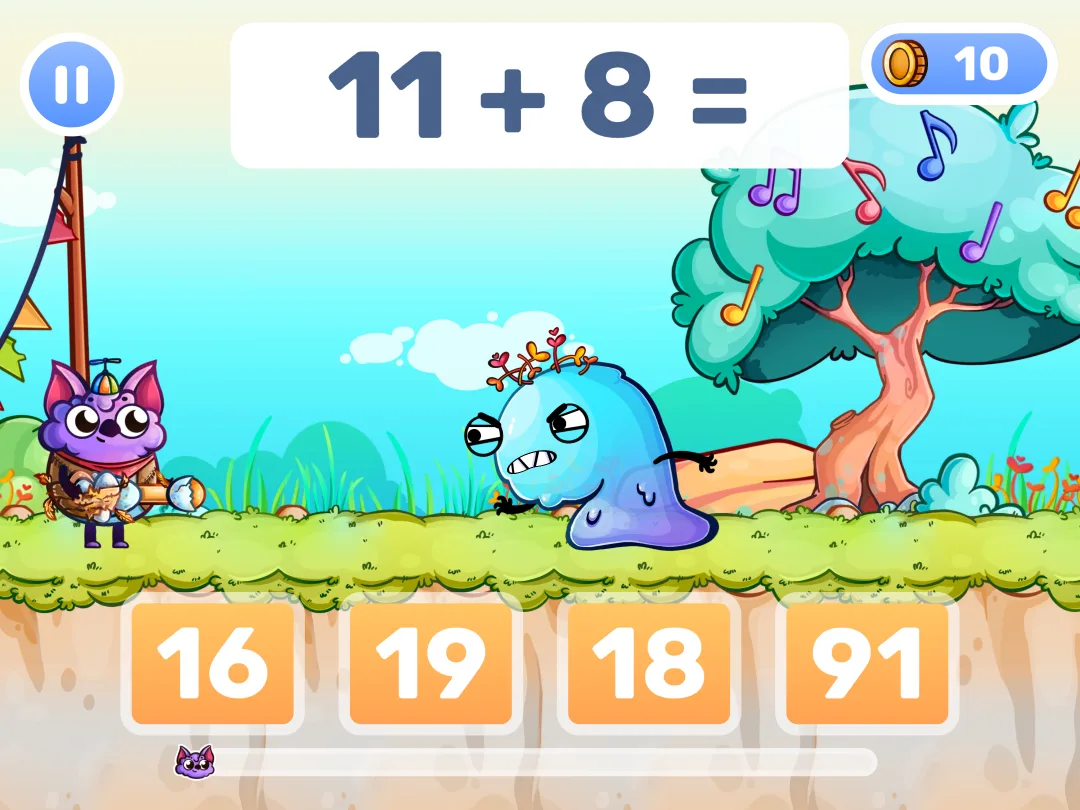
The online games on this page are mini-games for short addition and subtraction practice. The MathHero app is a full math adventure with step-by-step learning programs, rewards for your hero and saved progress for each child. If your child enjoys these mini-games, try the app: you can play 5 levels a day for free, with no ads and nothing locked.
What Parents Say About the MathHero App
Verbatim from public App Store and Google Play reviews of the MathHero app, with spelling as written. Rated 4.7 on Google Play (48.2K reviews) and 4.6 on the App Store (12K ratings), checked .
“very good for begining math. My 1st grader loves the gaming aspect. I love that you can adjust the levels and speed.”
“This is a fun game for kids from 1st grade and higher to practice the important basic mental calculations. There are settings to accomodate both slow and fast learners. My daughter enjoys slaying the funny monsters!”
“My 6 year old loves it. Really simple but good game for practicing basic maths. You can adjust the difficulty from very simple addition through to large number division.”
1st Grade Math: Common Questions
What math do 1st graders learn?
Under the Common Core standards, 1st grade math has four main parts: addition and subtraction within 20 with strategies like making ten, place value with tens and ones, measuring length with same-size units, and shapes. Children also count, read and write numbers to 120, add within 100 with models, like 34 + 5 or 34 + 20, tell time to the hour and half hour, sort data into up to three categories and split shapes into halves and fourths.
What should a 1st grader know by the end of the year?
By the end of 1st grade, a child should add and subtract within 10 fluently, like 7 + 3 or 9 − 4, and within 20 with a strategy, like 8 + 6 = 10 + 4 = 14. They should count, read and write numbers to 120, know how many tens and ones are in a two-digit number, compare numbers like 46 and 64, find 10 more or 10 less in their head, and add within 100 with models, like 36 + 7 or 40 + 25. They should also solve word problems within 20, tell time to the hour and half hour, and measure lengths with same-size units.
How do children calculate in 1st grade math?
1st graders learn strategies instead of counting everything one by one. They count on from the bigger number (9 + 2: 10, 11), make a ten (8 + 6 = 8 + 2 + 4 = 10 + 4 = 14), break a number down to get to ten (13 − 4 = 13 − 3 − 1 = 10 − 1 = 9), use doubles (6 + 7 = 6 + 6 + 1 = 13) and use addition to subtract (8 + 4 = 12, so 12 − 8 = 4). These strategies come straight from Common Core standard 1.OA.C.6.
What is making 10 in 1st grade math?
Making 10 is a strategy for facts that cross 10: you fill up a ten first and then add what is left. For 8 + 6, the 6 is split into 2 and 4, 8 + 2 makes 10, and 10 + 4 = 14. It works because children already know the pairs that make 10, like 8 and 2 or 7 and 3, from kindergarten, and Common Core names it as one of the 1st grade strategies for adding and subtracting within 20.
Is 1st grade math hard?
1st grade math is a big step for many children: they move from counting objects to adding and subtracting with strategies, the numbers they read and write grow from 20 to 120, and tens and ones become the base of everything that follows. Most of it builds on kindergarten counting and the pairs that make 10, so a child who knows those well has an easier start. A few minutes of practice most days, with objects, drawings and games, makes the new parts familiar.
What do 1st graders struggle with in math?
The usual sticking points are facts that cross 10, like 8 + 5, teen numbers and tens and ones (writing 31 for thirteen), counting past 100, the equal sign, word problems with a missing start or a comparison, and telling time to the half hour. Ten-frames, bundles of ten sticks, a 120 chart, a clock with hands and acting out the problem help with most of them.
What math should a 6-year-old know?
Most 6-year-olds in the US are finishing kindergarten or in 1st grade: most 1st graders are 6 when the year starts and turn 7 during it. By the end of kindergarten, children count to 100 by ones and tens, add and subtract within 10 with objects and know the pairs that make 10. During 1st grade they add and subtract within 20 with strategies, count to 120, learn tens and ones and tell time to the hour and half hour.
Do 1st graders learn about money?
Money is not part of the Common Core standards for 1st grade: word problems with dollar bills and coins come in 2nd grade (standard 2.MD.C.8). Some states teach coins earlier. Texas, for example, asks 1st graders to identify pennies, nickels, dimes and quarters by value and to count collections of pennies, nickels and dimes by twos, fives and tens.
How can I help my 1st grader with math?
Practice the facts within 10 and the pairs that make 10 for a few minutes most days, ideally with a game, then move on to facts within 20 with making ten. Count out loud past 100, bundle sticks or straws into tens, read a clock with hands at the hour and half hour, and measure things with paper clips or blocks. When your child solves a problem, ask how they got the answer, and talk with the teacher if one topic stays hard for several weeks.
Are timed math tests normal in 1st grade?
Some 1st grade teachers give short timed fact checks, because the Common Core standard asks for fluency with addition and subtraction within 10 by the end of the year. The standard itself sets no time limit, and knowing all sums of two one-digit numbers from memory is a 2nd grade goal. Experts disagree about timed practice: the National Council of Teachers of Mathematics advises against timed tests, while the federal What Works Clearinghouse recommends timed activities as one way to build fluency for students who struggle.
Are these online 1st grade math games free?
Yes. The online games on this page are free to play in your browser on a phone, tablet or computer, with no account, no download and no ads. The MathHero app is free too, at 5 levels a day with nothing locked, and a subscription with a 7-day free trial removes the daily limit.
About This Page
Last updated · App ratings checked
- Common Core State Standards: Grade 1 Mathematics
- Common Core State Standards for Mathematics (full document, kindergarten to grade 2)
- Common Core State Standards: Kindergarten Mathematics
- Common Core State Standards: Grade 2 Mathematics
- Texas Essential Knowledge and Skills for Mathematics, Grade 1 (19 TAC §111.3)
- Berkeley Unified School District: Family Guide for the 1st Grade Report Card
- NWEA: MAP Growth 101, everything families need to know
- Florida Department of Education: FAST Grades K–2 fact sheet, 2025–26
- Curriculum Associates: i-Ready Inform announcement
- Congressional Research Service: Educational Assessment and the Elementary and Secondary Education Act
- NCTM: Procedural Fluency in Mathematics
- What Works Clearinghouse: Assisting Students Struggling with Mathematics (2021)
- MathHero on the App Store
- MathHero on Google Play