
10 Times Table Games for Kids
Practice multiplication by 10 with free MathHero adventure games for kids, right in your browser: 10, 20, 30 and on up to 100. No account, no download, no ads.
- 10 × 1 to 10 × 10
- Grades 2-3 · ages 7-9
- Free in the browser
- No account, no download
- No ads
- Phone, tablet and computer
Pick a 10 Times Table Game to Play
Practice Another Times Table
Get MathHero: The Full Adventure
Keep practicing in the MathHero app: a story-driven math game for ages 5-10, from first addition to division.
- Step-by-step learning programs that build the times tables one table at a time
- Custom Practice: any times tables from ×1 to ×12, or a mix like only ×5 and ×10
- Typed answers or multiple choice, in Easy, Medium or Hard mode
Free at 5 levels a day, with no ads.

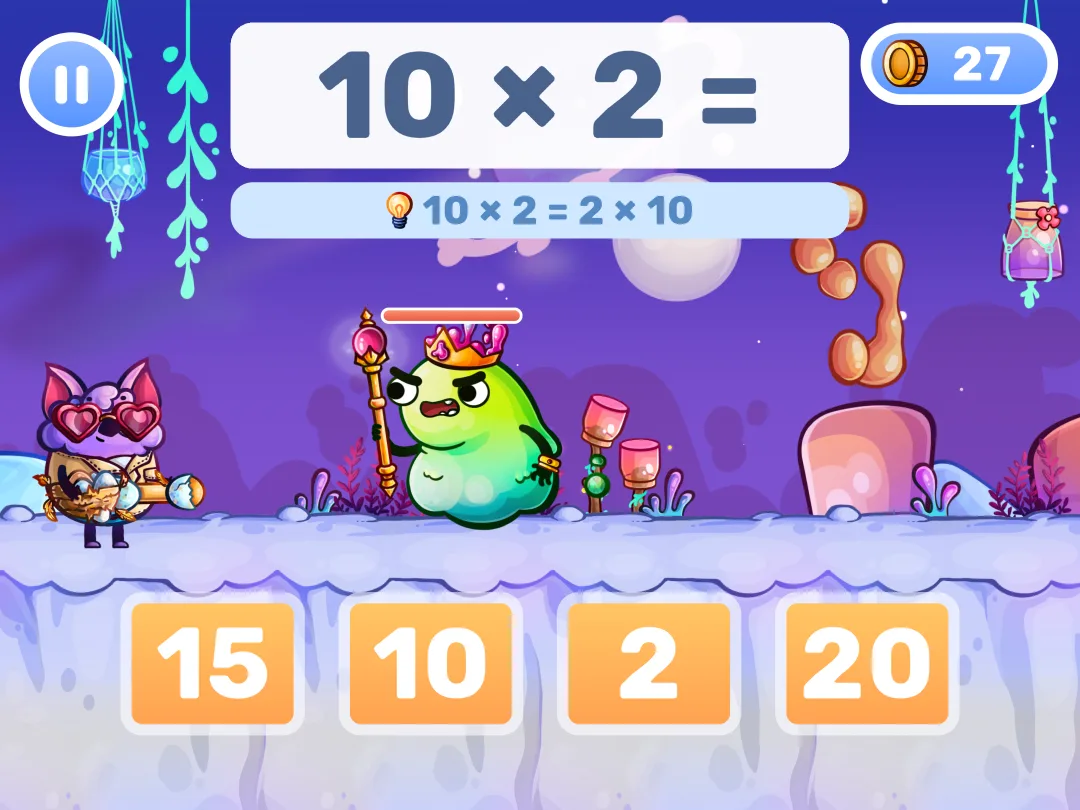
How to Learn the 10 Times Table
To learn the 10 times table, start by counting in tens, then link each fact to place value so the answers make sense, and practice until they come from memory. The 10s are often the first times table children learn, along with the 2s and 5s, and the one that helps most with the rest. Every answer is a number of tens: 6 × 10 is 6 tens, or 60.
Count in tens
Count 10, 20, 30, 40, 50, 60, 70, 80, 90, 100 out loud, on a number line or down the last column of a hundred chart. Each step adds one more ten, so the fourth number is 4 × 10 = 40. Treat counting as a step: counting up to 10 × 8 every time is slow, and the goal is recall.
Say the answer in tens
6 × 10 means 6 groups of ten, or 6 tens, and 6 tens is sixty: 60. In the same way, 8 tens is eighty and 9 tens is ninety. A few names hide their tens, so practice them out loud: 2 tens is twenty, 3 tens is thirty, 5 tens is fifty. And 10 tens make one hundred, 100.
Multiplying by 10 on a Place Value Chart
Multiplying by 10 makes a number ten times bigger, so each digit moves one place to the left: ones become tens, and tens become hundreds. The ones place is left empty, and a 0 fills it. That is why the "add a zero" shortcut gives the right answer for whole numbers: 7 × 10 = 70, 12 × 10 = 120, 25 × 10 = 250. The zero is not added on; it holds the empty ones place. Teach the shortcut together with the reason.
Count fingers and dimes
Two hands hold 10 fingers, so each time your child holds up both hands, that is one more ten. For 4 × 10, hold up both hands four times and count 10, 20, 30, 40. Dimes work the same way: each dime is 10 cents, so 6 dimes are 60 cents, and 10 dimes make a dollar, 100 cents.
Use the 10s for other tables
Once the 10s are solid, they make harder tables easier. The 5s are half of the 10s: 10 × 8 = 80, so 5 × 8 = 40. The 9s are the 10s minus one group: 9 × 6 = 10 × 6 − 6 = 60 − 6 = 54.
Facts work both ways
3 × 10 and 10 × 3 are both 30: 3 tens, or 10 threes. When your child knows 10 × 7 = 70, they also know 7 × 10 = 70, and the games ask the facts both ways.
Common mistakes
- 1000 or 110 for 10 × 10. 1000 comes from writing too many zeros, and 110 from counting one ten too far. Ten tens make one hundred: 10 × 10 = 100. To check, start from 10 × 9 = 90 and add one more ten.
- 16 for 6 × 10. Adding 10 instead of multiplying gives 6 + 10 = 16. 6 × 10 means 6 tens, which is 60.
- "Add a zero" with decimals. Later, the shortcut breaks: 0.5 × 10 is 5, not 0.50. A child who learns now that each digit moves one place to the left will get decimals right too.
For the methods your child's class is probably using, see our guide on how to teach multiplication. Curious where times tables come from? Read who invented times tables.
| Fact | Answer | Quick way |
|---|---|---|
| 10 × 1 | 10 | one 10 |
| 10 × 2 | 20 | 2 tens |
| 10 × 3 | 30 | 3 tens |
| 10 × 4 | 40 | 4 tens |
| 10 × 5 | 50 | half of 100 |
| 10 × 6 | 60 | 6 tens |
| 10 × 7 | 70 | 7 tens |
| 10 × 8 | 80 | 8 tens |
| 10 × 9 | 90 | 100 − 10 |
| 10 × 10 | 100 | 10 tens |
| 10 × 11 | 110 | 100 + 10 |
| 10 × 12 | 120 | 100 + 20 |
Every answer is a number of tens, so the ones digit is always 0. The games on this page practice 10 × 1 to 10 × 10. 10 × 11 and 10 × 12 complete the table up to 12, which schools in England expect by Year 4.
What Grade Learns the 10 Times Table?
The 10 times table is one of the first tables children learn. In the US, children skip-count by 10s in 2nd grade, usually at ages 7-8 (Common Core standard 2.NBT.A.2). By the end of grade 3, standard 3.OA.C.7 expects all one-digit multiplication facts, up to 9 × 9, from memory, and 3.NBT.A.3 builds on the 10s to multiply by multiples of 10, like 9 × 80. In England, the 2, 5 and 10 times tables are a Year 2 objective, at ages 6-7, and the 10s are part of the Year 4 multiplication tables check.
- Age
- 7-9
- US grade
- Grades 2-3
- Standard
- Common Core 2.NBT.A.2, 3.OA.C.7
- England
- Year 2
What Parents Say About MathHero
Verbatim from public App Store and Google Play reviews of the MathHero app, with spelling as written. Rated 4.7 on Google Play (48.2K reviews) and 4.6 on the App Store (12K ratings), checked .
“This game offers flexibility when choosing which math factors you want to work on.”
“Kids says it's fun and they can practice math facts and it's not boring. My daughter has to do homework and we use the game instead of flashcards.”
“This has been a great app for my granddaughter, who has been struggling learning her math facts. It has just enough game elements to keep her interest.”
10 Times Table Games: Common Questions
What are the best free games for the 10 times table?
How do the MathHero 10 times table games work?
How can my child practice the 10 times table?
What grade learns the 10 times table?
Are MathHero's 10 times table games free?
Do the 10 times table games work on a tablet or phone?
Can my child practice only the 5s and 10s?
How long should kids practice the 10 times table each day?
About This Page
Last updated · App ratings checked