

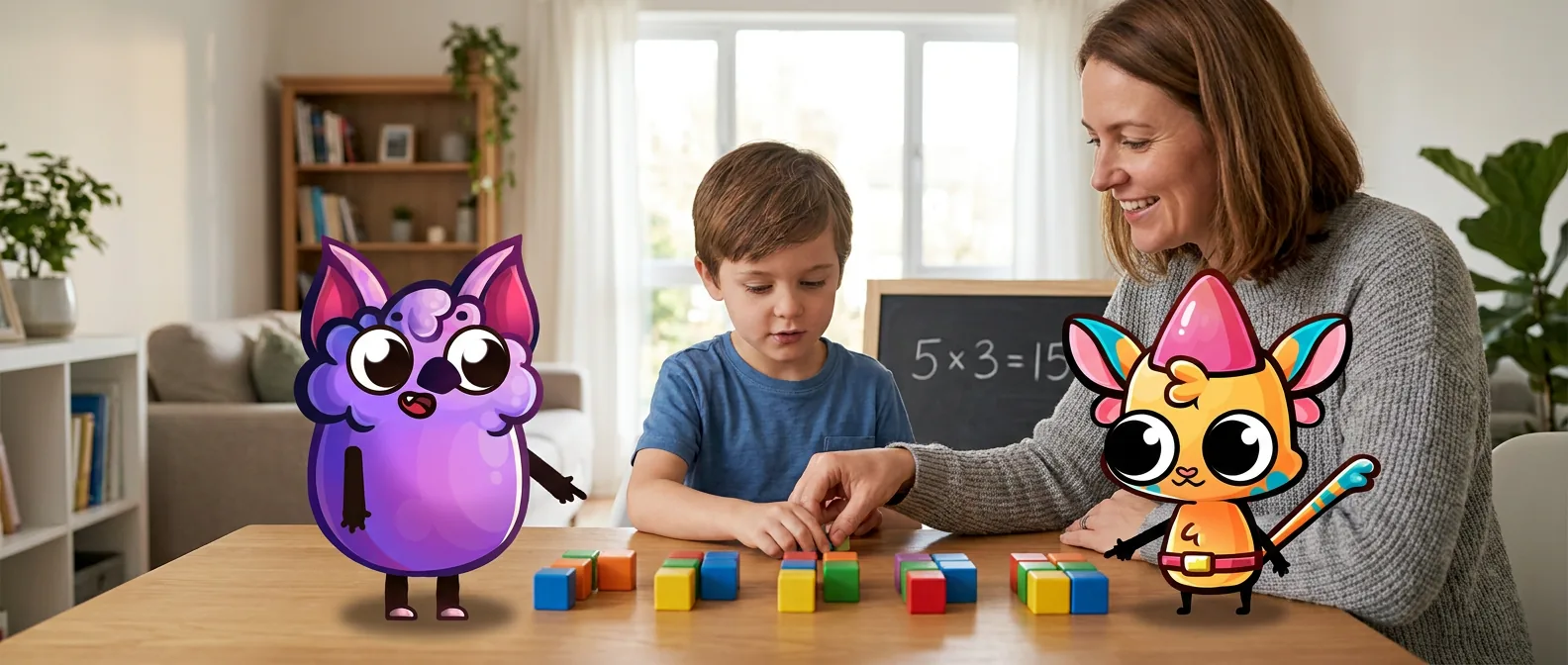
Your child comes home with multiplication homework, and suddenly you're trying to remember every trick you learned in elementary school. Do you pull out the flashcards? Practice skip counting? Have them write their multiplication facts over and over? Sing the songs? Before you pull out the timer, start with what the numbers mean.
Understanding and memorization can work together. Here's something I always remind parents: learning multiplication facts isn't just about memorizing answers. It's about understanding how multiplication works and recognizing relationships between numbers.
As a seventh-grade math teacher, I see firsthand how important multiplication fact fluency is for learning future math skills. Students use multiplication when working with fractions, proportions, equations, and so many other concepts in middle school. But I also want students to know what to do when they can't immediately remember a multiplication fact. That's where number sense and multiplication strategies come in!
Let's look at some practical ways to help your child understand multiplication, build fact fluency, and feel more confident with their times tables. And remember, you don't have to try every strategy at once! Start with what your child already understands and build from there.
Start with what multiplication really means
Before asking children to memorize multiplication facts, I want them to understand what those facts represent. One of the easiest ways to introduce multiplication is through equal groups.
For example, grab 12 crayons (pieces of candy, coins, even small pieces of paper work!) and arrange them into three groups of four. Ask your child questions like:
- "How many groups do we have?"
- "How many crayons are in each group?"
- "How many crayons do we have altogether?"
They can count the crayons in each group or use repeated addition: 4 + 4 + 4 = 12
We can represent those three groups of four using multiplication: 3 × 4 = 12
Now rearrange the crayons into four groups of three. What do they notice? We still have 12 crayons! So, 4 × 3 = 12
This is a great way to introduce the commutative property of multiplication, which tells us that changing the order of the factors doesn't change the product. When your child builds a multiplication problem out of objects, they begin to understand how multiplication represents equal groups and how repeated addition connects to multiplication. This gives children a strategy they can use to figure out multiplication facts instead of relying on memorization alone. It also gives them a picture to come back to when they forget a fact.
The order that makes learning times tables much easier
You might assume that children should learn their multiplication tables in order, starting with the 1s and working their way through the 12s. But that's not necessarily the easiest approach!
I often recommend starting with multiplication facts that have patterns children can recognize. Start with the 2s, 5s, and 10s:
- The 2s are just doubles: 2, 4, 6, 8, 10.
- The 5s end in 0 or 5, matching how we count minutes on a clock. Students also learn to skip count by 5s early on in school.
- The 10s: when we multiply a whole number by 10, each digit shifts one place to the left in our place-value system. For example, 3 × 10 = 30 and 7 × 10 = 70. Students will notice that the product ends in zero, but I want them to understand the place-value relationship behind that pattern!
After the 2s, 5s, and 10s, teach the 4s (double the 2s) and the 8s (double the 4s). Then the 3s, and use them to build the 6s. Save the 7s and 9s for last. The 0s and 1s also introduce important properties. Any number multiplied by 0 equals 0 (the zero property of multiplication). Any number multiplied by 1 stays the same (the identity property of multiplication).
| Step | Tables | What makes them easier |
|---|---|---|
| 1 | 2s, 5s, 10s | Doubles, skip counting by 5s, and place value |
| 2 | 0s and 1s | The zero and identity properties: one rule each |
| 3 | 4s, then 8s | Double the 2s, then double the 4s |
| 4 | 3s, then 6s | The 6s are double the 3s |
| 5 | 7s and 9s | Most of these facts are already known from other tables; 9s are one group less than 10s |
There isn't one perfect order for every child to learn their multiplication facts. The important thing is to build on what they already understand and help them recognize patterns along the way. The 1s, 2s, 5s, and 10s already cover more than a third of a 10 × 10 multiplication chart. What's left feels like a shorter list, and your child starts to feel like learning the rest is doable.
Here's an exercise you can do today: write out the 2, 5, and 10 times tables together. Ask what your child notices. "The 5s go 5, 10, 15, 20, and they end in 5 or 0!" Naming the pattern is a big part of the learning, and it's where many kids start getting more confident about their times tables.
Use a multiplication chart to spot patterns
A multiplication chart is one of my favorite tools for helping students understand how multiplication facts are connected! Instead of using the chart only to look up answers, encourage your child to explore the patterns. Start with a blank 10 × 10 multiplication chart and fill in a few rows or columns together.
You might begin with the 2s, 5s, and 10s. Then ask: "What patterns do you notice?", "Which products (answers) are even?", and "Do you see any multiplication facts that have the same answer?" For example, students may notice that 4 × 6 = 24 and 6 × 4 = 24. This is another opportunity to reinforce the commutative property.
Look for square numbers
Ask your child to look at the diagonal of the multiplication chart. They'll notice products like 1, 4, 9, 16, 25, 36… These are square numbers! Each one is a number multiplied by itself, for example 5 × 5 = 25. Students can even build square arrays to help visualize these facts.
Use the chart for practice
Once your child has explored the chart, cover a few products with sticky notes. Ask them to figure out the missing answers. If they get stuck, encourage them to use nearby multiplication facts or patterns to help.
I also love using multiplication charts to help students recognize common factors when simplifying fractions in higher grades. For example, with 12/15, students can use the chart to recognize that both 12 and 15 are multiples of 3. Dividing the numerator and denominator by 3 gives us the equivalent fraction 4/5!
Strategies for more challenging multiplication facts
Some multiplication facts are easier to remember than others, and that's okay! When a student struggles with a fact, I don't want them to feel like their only option is to guess or start counting from the beginning. I want them to have strategies they can use.
Strategy 1: Break apart multiplication facts
Let's say your child is struggling with 7 × 6, but they already know 7 × 5 = 35. They can use that fact to help! Since 7 × 6 is one more group of 7 than 7 × 5, we can add another 7: 35 + 7 = 42. So, 7 × 6 = 42.
This is an example of using the distributive property to break apart multiplication facts. Students don't necessarily need to know the name of the property right away, but they can begin using the relationship!
Strategy 2: Double a known fact
Let's try 6 × 8. If your child knows 6 × 4 = 24, they can double the product because 8 is twice as much as 4: 24 × 2 = 48. So, 6 × 8 = 48.
This is a great strategy for students who are comfortable with doubles.
Strategy 3: Use a nearby fact
Here's another example: 9 × 7. If your child knows 10 × 7 = 70, they can subtract one group of 7: 70 − 7 = 63. So, 9 × 7 = 63.
I especially love this strategy because it encourages students to think about the relationship between 9 groups and 10 groups.
Strategies for the 9 times table
You may remember learning the finger trick for the 9 times table! Hold out both hands and number your fingers from 1 to 10, starting with your left pinky. For 9 × 4, fold down your fourth finger. You'll have three fingers to the left and six fingers to the right, giving you 36. It's a fun trick, and some students really enjoy it! But I would also encourage children to explore why the 9s have these patterns.
For example: 9 × 4 = (10 × 4) − 4. Then, 40 − 4 = 36, so 9 × 4 = 36. That connects the trick to a mathematical relationship instead of making it something students simply memorize.
Another pattern I like to show students is that the digits in the products of 9 × 1 through 9 × 10 add up to 9! For example, 9 × 9 = 81 (8 + 1 = 9), 9 × 8 = 72 (7 + 2 = 9), and 9 × 7 = 63 (6 + 3 = 9). It's a fun pattern that can help students remember and check their 9s facts!
Remember, the goal is to help students become flexible thinkers who can use different strategies to find answers. For more ways to think through facts in your head, see Mental Math Strategies for Kids.
Fun multiplication games and activities
Math practice doesn't always have to involve flashcards or worksheets! There are plenty of ways to make multiplication practice fun while still helping children build fact fluency.
- Multiplication War. Grab a regular deck of cards and remove the face cards. Each player flips over two cards and multiplies the numbers together. For example, if your child flips a 6 and a 4, they find 6 × 4 = 24. The player with the greater product wins the round. For an extra challenge, ask your child to explain how they figured out their answer! You can also adjust the game by using only the cards for the multiplication facts your child is currently practicing.
- Multiplication flowers. Draw a large flower with a number in the center, for example 7. On each petal, write a number from 1 through 8. Your child multiplies 7 by each number and writes the product. You can create a different flower for each multiplication table. This is a simple way to practice facts without another traditional worksheet.
- Songs and skip counting. Some children enjoy learning multiplication patterns through songs, chants, or rhythm. Skip counting can help students recognize patterns in multiples: 3, 6, 9, 12, 15… But I would remind parents that skip counting is a starting strategy, not the final goal. We want children to eventually recognize multiplication facts without needing to count through the entire sequence every time. Songs and chants make the tables portable, so review happens in the car, at bath time, or walking to school.
- Celebrate consistent practice. Some children love using sticker charts or tracking their progress. Others may not find those things motivating. Choose something that works for your child. Don't forget to celebrate the strategies they're using and the progress they're making, even if it seems small. If your child solves 7 × 8 by doubling 7 × 4, that's progress worth recognizing!
If your child would rather play on a screen, MathHero's free multiplication games run in the browser, with a page for each times table.
Real-life ways to teach times tables at home
One of the easiest ways to help children understand multiplication is to connect it to situations they already experience. But remember, don't overdo it. You don't need to turn every single moment into a math lesson! Here are a few simple opportunities:
- Grocery shopping: "We need 3 apples for each person, and there are 4 people. How many apples do we need?"
- Setting the table: "Each person needs 2 utensils, and there are 5 people. How many utensils do we need?"
- Laundry: "We have 6 pairs of socks. How many individual socks is that?"
- Snack time: "There are 4 rows of crackers with 5 crackers in each row. How many crackers are there altogether?"
These activities help children see that multiplication isn't just something they practice at school. It's a skill they use in everyday situations! As a parent, you don't need to create an elaborate activity every day. A quick conversation here and there can help reinforce what your child is learning.
A daily routine for learning multiplication
When it comes to multiplication fact fluency, consistency is important. But that doesn't mean your child needs to spend an hour practicing multiplication every evening! I recommend starting with five to ten minutes of focused practice. You might spend a few minutes reviewing facts your child already knows and then introduce a small group of facts that still need attention. For example, if your child is comfortable with the 2s, 5s, and 10s but struggles with the 6s and 7s, focus your practice there.
Research supports the benefits of spaced practice and retrieval practice for learning and remembering information. Spaced practice means spreading learning across multiple sessions rather than trying to learn everything at once. Retrieval practice means trying to remember information without immediately looking at the answer.
One study involving elementary students found that practicing multiplication facts using flashcards led to stronger improvements in fact retrieval than repeatedly reciting the facts aloud. That doesn't mean flashcards are the only effective way to practice multiplication! But it does show that giving students opportunities to recall facts can be helpful.
While your child is learning multiplication facts, you can start introducing division as well! Multiplication and division are closely connected. In fact, they are opposites, or "inverse operations" as we call them in middle school. For example: 6 × 4 = 24, 24 ÷ 6 = 4, and 24 ÷ 4 = 6. These facts are part of the same fact family. As your child becomes more comfortable with multiplication, you can begin exploring the related division facts, for example with our free multiplication and division games, which mix both in one game.
Remember that a child who needs to use a strategy to solve a multiplication fact is still demonstrating mathematical understanding. Over time, meaningful practice can help those facts become more automatic.
What if my child is struggling with multiplication facts?
First, don't assume your child isn't trying! Some students need more time or a different approach before multiplication facts begin to make sense.
As a middle school math teacher, I've worked with students who still struggle with multiplication facts that were introduced years earlier. When that happens, I don't want to keep giving them more problems and hoping something eventually clicks. I want to figure out what they already understand and build from there.
Identify the facts that are causing difficulty
Instead of reviewing every multiplication fact, pay attention to which ones your child continues to struggle with. Maybe they know most of their multiplication facts but consistently get stuck on 7 × 8. That's something specific you can work on! Focus on a small group of challenging facts at a time.
Ask your child to explain their thinking
When they get a fact wrong, try saying, "Hmm. Let's see what happened here." Or when they get it right: "Wow, you used a great strategy to solve that problem!"
One of my favorite questions to ask students is: "Can you show me how you got that answer?" Even when a student's answer is incorrect, their explanation can tell us so much about what they understand. Are they using equal groups? Are they skip counting? Are they using a known multiplication fact to find an unfamiliar one?
Their strategy can help you figure out what they need next. Remember, multiplication fact fluency isn't just about answering as quickly as possible. We want students to become accurate, efficient, and flexible with multiplication while understanding the relationships behind the facts. If you'd like the full teaching sequence, from equal groups to multi-digit multiplication, see How to Teach Multiplication.
Making times tables easy with MathHero
One of the biggest challenges parents face is finding ways to make multiplication practice something their child doesn't dread. That's where educational games can be helpful!
MathHero is a story-driven math game designed primarily for children ages 5–10. It gives children opportunities to practice addition, subtraction, multiplication, and division while progressing through an adventure.
Instead of completing a traditional worksheet, children solve math problems to move through the game, help characters, and collect rewards. One feature I especially like is that parents can customize the practice. For example, if your child needs help with their 6s multiplication facts, you can focus on those facts rather than having them review every multiplication table.
Parents can also adjust the difficulty, monster speed, and whether children type their answers or select from multiple-choice options. Families with multiple children can create separate profiles with different settings.
MathHero can be played for free with a limit of five levels per day. A subscription, which includes a free trial, removes the daily limit. Of course, MathHero is a practice tool, not a replacement for math instruction. If your child doesn't understand what multiplication represents, they'll still need opportunities to explore equal groups, arrays, and number relationships. But once they begin developing that understanding, a game like MathHero can give them another way to practice multiplication facts.
One parent described that shift in a review: "My son, who hates math, started asking to do math himself on the second day!" Another parent wrote: "My daughter has fallen in love with math in about a day." Kids who used to freeze on flashcards work through their multiplication tables because they want to see what happens next in the story.
Set MathHero to the times tables your child is working on, play one five-level session together tonight, and see if they ask for another round tomorrow.
Explore MathHeroCommon questions about how to learn times tables
Helping your child build multiplication confidence
Learning multiplication facts takes time, and every child develops fact fluency at their own pace. As a math teacher, I want students to understand multiplication AND be able to recall their facts efficiently. Both are important! So start with what your child knows, practice a little at a time, and encourage them to use strategies when they get stuck.
And one day, you might ask your child what 8 × 7 is, and they'll answer 56 without having to think through a strategy first. That's when you'll see all that practice paying off!
Sources
- Common Core State Standards Initiative. Grade 3: Operations & Algebraic Thinking, 3.OA.C.7 (fluently multiply and divide within 100; know from memory all products of two one-digit numbers).
- Ophuis-Cox, F. H. A., Catrysse, L., & Camp, G. (2023). The effect of retrieval practice on fluently retrieving multiplication facts in an authentic elementary school setting. Applied Cognitive Psychology, 37(6), 1463–1469.
- Carpenter, S. K., Pan, S. C., & Butler, A. C. (2022). The science of effective learning with spacing and retrieval practice. Nature Reviews Psychology, 1, 496–511.
