
2 Times Table Games for Kids
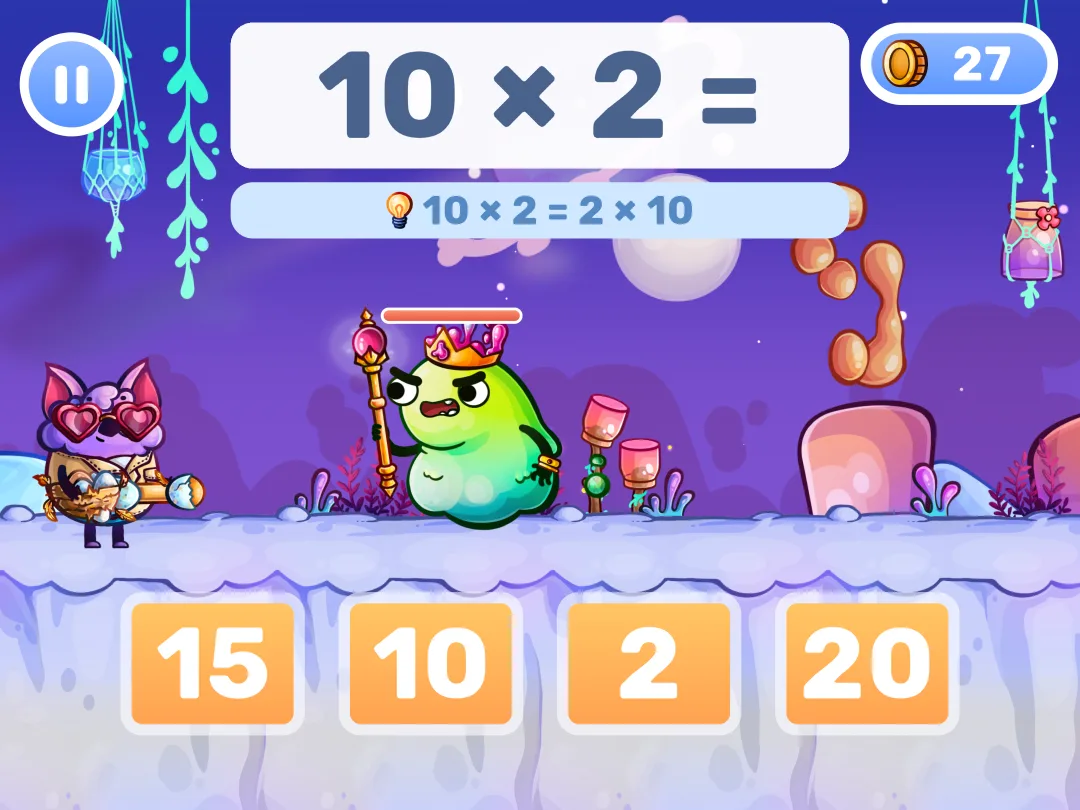
Practice multiplication by 2 with free MathHero adventure games for kids, right in your browser: 2, 4, 6 and on up to 20. No account, no download, no ads.
- 2 × 1 to 2 × 10
- Grades 2-3 · ages 7-9
- Free in the browser
- No account, no download
- No ads
- Phone, tablet and computer
Pick a 2 Times Table Game to Play
Practice Another Times Table
Get MathHero: The Full Adventure
Keep practicing in the MathHero app: a story-driven math game for ages 5-10, from first addition to division.
- Step-by-step learning programs that build the times tables one table at a time
- Custom Practice: any times tables from ×1 to ×12, or a mix like only ×2 and ×5
- Typed answers or multiple choice, in Easy, Medium or Hard mode
Free at 5 levels a day, with no ads.

How to Learn the 2 Times Table
The 2 times table is usually the first multiplication table a child learns, often alongside the 10s. The key is connecting multiplication to something your child already knows from addition: multiplying by 2 is doubling. Most children start the 2s already knowing small doubles up to 5 + 5 = 10, plus 2 × 10 = 20. Only four facts need extra practice: 2 × 6, 2 × 7, 2 × 8 and 2 × 9.
Turn ×2 into a double
Two groups of a number are that number added to itself. Whenever your child sees 2 × 6, read it as “two sixes” or “double 6”: 6 + 6 = 12. In the same way, 2 × 7 is 7 + 7 = 14, 2 × 8 is 8 + 8 = 16 and 2 × 9 is 9 + 9 = 18.
Spot the even-number pattern
Every answer in the 2 times table is an even number ending in 2, 4, 6, 8 or 0. The ones digits repeat the same pattern again from 12 to 20: 2, 4, 6, 8, 10, then 12, 14, 16, 18, 20. If an answer ends in 1, 3, 5, 7 or 9, it cannot be in the 2s.
Count pairs in real life
Pairs are everywhere at home: 2 shoes in a pair, 2 socks, 2 eyes, 2 hands, 2 wheels on a bicycle. Counting 6 pairs of socks by twos, 2, 4, 6, 8, 10, 12, shows why 2 × 6 and 6 × 2 both equal 12. Once your child sees how the table grows, encourage them to recall the double directly rather than counting up from 2 each time.
See 2 × 6 as Two Equal Rows
An array of 2 rows makes doubling visual and shows why 2 × 6 and 6 × 2 give the same answer:
- Read across the two rows: 6 on top and 6 on the bottom, so 6 + 6 = 12.
- Read down the six columns: 6 pairs of 2, or 2 + 2 + 2 + 2 + 2 + 2 = 12.
- Use the same picture for any 2s fact: 2 × 8 is two rows of 8, so 8 + 8 = 16.
Common mistakes
- Adding 2 instead of doubling (2 × 6 = 8). Children used to +2 problems often read 2 × 6 as 6 + 2. Have your child say “two sixes” out loud so they add 6 + 6 = 12.
- Mixing up 2 × 7, 2 × 8 and 2 × 9. The larger doubles (14, 16, 18) can blur together at first. Use 2 × 10 = 20 as an anchor: 2 × 9 is one pair less than 20 (18), and 2 × 8 is one pair less again (16).
For the methods your child's class is probably using, see our guide on how to teach multiplication. Curious where times tables come from? Read who invented times tables.
| Fact | Answer | Quick way |
|---|---|---|
| 2 × 1 | 2 | one 2 |
| 2 × 2 | 4 | 2 + 2 |
| 2 × 3 | 6 | 3 + 3 |
| 2 × 4 | 8 | 4 + 4 |
| 2 × 5 | 10 | 5 + 5 |
| 2 × 6 | 12 | 6 + 6 |
| 2 × 7 | 14 | 7 + 7 |
| 2 × 8 | 16 | 8 + 8 |
| 2 × 9 | 18 | 9 + 9 |
| 2 × 10 | 20 | 2 tens |
| 2 × 11 | 22 | 20 + 2 |
| 2 × 12 | 24 | 20 + 4 |
Highlighted: the four larger doubles, 2 × 6 to 2 × 9. The games on this page practice 2 × 1 to 2 × 10. 2 × 11 and 2 × 12 complete the table up to 12, which schools in England expect by Year 4.
What Grade Learns the 2 Times Table?
In the US, children start counting in twos, working with even numbers and building equal rows in 2nd grade, then learn the 2 times table in Grades 2-3 (usually ages 7-9). Common Core standard 3.OA.C.7 expects children to know all one-digit multiplication facts, up to 9 × 9, from memory by the end of grade 3. In England, the 2, 5 and 10 times tables are a Year 2 objective (ages 6-7) and part of the Year 4 multiplication tables check.
- Age
- 7-9
- US grade
- Grades 2-3
- Standard
- Common Core 3.OA.C.7
- England
- Year 2
What Parents Say About MathHero
Verbatim from public App Store and Google Play reviews of the MathHero app, with spelling as written. Rated 4.7 on Google Play (48.2K reviews) and 4.6 on the App Store (12K ratings), checked .
“My sons love this game. It is helping them learn their times tables.”
“My son loves this game and asks to play it all the time.”
“They have the option to do slow or regular speed, which I like being able to choose slow to make it less stressful for my child.”
2 Times Table Games: Common Questions
What are the best free games for the 2 times table?
How do the MathHero 2 times table games work?
How can my child practice the 2 times table?
What grade learns the 2 times table?
Are MathHero's 2 times table games free?
Do the 2 times table games work on a tablet or phone?
Can my child practice only the 2s and 5s?
How long should kids practice the 2 times table each day?
About This Page
Last updated · App ratings checked