
Math fact fluency is your child's ability to use the basic math facts (addition, subtraction, multiplication and division) flexibly, accurately and efficiently, choosing a sensible strategy and arriving at the right answers without stalling. Math fact fluency is not the same as being fast under pressure.
Research from the National Council of Teachers of Mathematics, Common Core progressions, cognitive science, and classroom studies converges on a clear recipe for math fact fluency practice: build conceptual understanding first, then focus on small sets of basic math facts in short daily sessions, use retrieval with immediate corrective feedback, and space the practice out over days and weeks.
What math fact fluency actually is (and what it isn't)
Fluency gets used loosely in math class and in marketing copy. In mathematics education research, math fact fluency has a specific meaning.
The National Council of Teachers of Mathematics defines procedural fluency as being able to use procedures accurately, efficiently, and flexibly, apply them to different problems and situations, build or adapt procedures from existing ones, and recognize which strategy works best in a given situation. Four interlocking components, not one. Speed shows up as a result of fluency, not as a test of it.
A fluent child knows that 7 + 8 is 15. Maybe they just do. Maybe they use doubles (7 + 7 = 14, plus one). Maybe they make ten (7 + 3 + 5). A child who hasn't yet developed fluency counts on fingers or guesses. Both might land on the correct answer, 15. The difference is how much mental energy kids have left to focus on the problem itself once they’ve worked out the basic facts.
That brings us to why math fact fluency matters at all.
Why math fact fluency is important: working memory and what comes next
Working memory is the small mental workspace where your child holds information while solving math problems. It is finite, and small in young children. Cognitive-load research going back decades shows that when that workspace is tied up chasing basic math facts, there isn't enough capacity left for the actual reasoning a math problem demands.
Picture a two-step word problem. "Mia bought 6 bags of 7 apples. She gave 15 away. How many apples does she have left?" If "6 × 7" takes 10 seconds of counting, by the time your child has 42, they have lost the thread of the problem. They are not stuck because they can't reason. They are stuck because the thinking space is full of basic facts work. That is the exact mechanism cognitive scientists mean when they talk about freeing up capacity for more complex problem solving.
That is a local effect on individual math problems. A longer-term effect on complex problem solving and future success in math shows up years later.
A longitudinal study of elementary students in the US and UK found that fifth-graders' knowledge of fractions and whole-number long division predicted their algebra and overall math achievement in high school five to six years later, even after statistically controlling for IQ, working memory, reading comprehension, and family income and education.
The whole-number core elementary math and basic math facts you build in the early grades are the foundation that most later math topics sit on. Fluency built in the early grades carries forward; gaps in those skills carry forward too. If facts students need are not automatic, each new math concept is likely to become harder than it has to be.
Which is a case for working on math fact fluency, and a case for building strong math skills in elementary years. It is not a case for drill sheets. Those are different things, and the research on math fluency practice is clear on which one works.
The three phases every child goes through
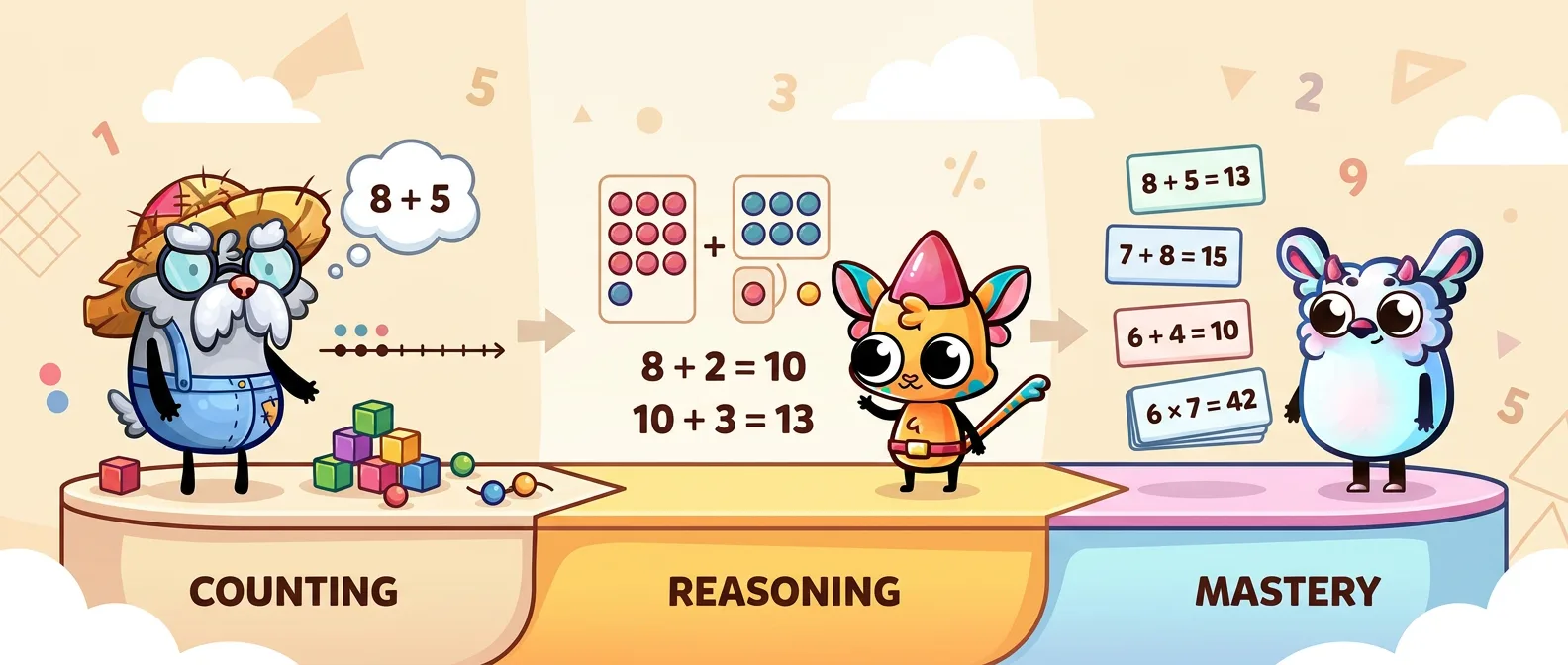
One of the clearest maps of how math fact fluency actually develops comes from Arthur Baroody, a mathematics education researcher who has spent decades on basic fact learning. Baroody describes three phases of basic fact mastery:
Phase 1, counting. Your child counts to get the answer. Fingers, dots, number lines, verbal counting on, counting back, skip counting. For 8 + 5 they start at 8 and count 9, 10, 11, 12, 13.
Phase 2, reasoning. They use what they already know to work out what they don't. For 8 + 5 they turn it into 8 + 2 + 3 (making ten), or 5 + 5 + 3 (doubles plus more). They are not memorizing math facts. They are deriving them. Number lines are often the visual that makes this stage click.
Phase 3, mastery. They just know. 8 + 5 is 13, retrieved from memory, no visible work. This is math fact automaticity: the point where direct recall of answers takes under a second and no conscious strategy is needed.
The important part: phase 2 is where the real learning happens, and phase 2 is the part most "drill" programs skip. In the NCTM-published guidance from Kling and Bay-Williams, phase 2 is specifically the point where reasoning strategies are built before mastery is expected. Skipping it is one of the main reasons drill-first programs don't stick.
Kids who jump straight to phase 3 through pure repetition can look fluent at first. Jennifer Bay-Williams and Gina Kling, co-authors of the book Math Fact Fluency, make the point plainly: a child who has only memorized a fact has nothing to fall back on when it slips, while a child who knows a strategy can work it out again.
That is one of the few places math education researchers across different camps on learning really agree. Reasoning first, mastery second.
What the research says actually works for math fact fluency practice
Pull the strongest studies on math fact learning together and you get something close to consensus. Five principles do most of the work when you want students to build math skills and develop fluency that lasts.
Build conceptual understanding before memorization
Memorization of a math fact your child does not understand is a fragile thing. If they don't know what multiplication actually is (equal groups, repeated addition, arrays, scaled number lines), knowing that 6 × 7 is 42 doesn't help them with 60 × 7, or with word problems in math class, or with later math topics like area and ratios.
The NCTM position on this is blunt. Basic facts should be taught using number relationships and reasoning strategies, not only through drill of isolated math facts. Common Core takes the same line, with a strong focus on strategy. The standards require reasoning strategies first (counting on, making ten, decomposing a number leading to a ten, the inverse relationship between addition and subtraction, skip counting toward multiplication), and only then ask for recall from memory: all sums of two one-digit numbers by the end of grade 2, all products of two one-digit numbers by the end of grade 3.
Conceptual learning sits underneath every strategy that later becomes automatic. If your child is stuck on their math facts, "practice harder" usually is not the answer. The question is whether the math concepts underneath are solid. For a worked example of what "concept first" looks like for multiplication learning, our guide on how to teach multiplication steps through the sequence from equal groups to arrays, and the strategic order to learn multiplication facts.
Practice small sets of math facts at a time
The multiplication table has 100 facts. Nobody memorizes 100 of anything by staring at the whole set for an hour. Research-based math fluency programs use small sets of basic facts at a time, usually a handful, brought to mastery before the next set is added.
Bay-Williams lists five fundamentals of fact fluency, and one of them is learning foundational facts before derived ones: for addition, +1 and +2, doubles and combinations that make 10; for multiplication, the 2s, 10s, 5s, 1s, 0s and squares. Pile too many on at once and nothing sticks. Narrow the focus to a few math facts, and many kids make visible progress inside a week.
A rough shape that usually works at home for building these math skills: focus on four or five math facts your child doesn't yet know. Mix them with four or five basic facts they already know. Work on that set until the new math facts are automatic, which usually takes a few days to a week. Then add the next set and keep the old math facts in the learning rotation. That rotation is the engine of the next principle.
Retrieval, not re-reading
In 2013, John Dunlosky and a team of cognitive and educational psychologists reviewed ten of the most common learning techniques across hundreds of studies and rated two as "high utility" because their benefits held up across ages, subjects and kinds of material: practice testing (retrieval) and distributed (spaced) practice.
Retrieval means your child pulls the math fact answer out of their own head, not off a page. A flashcard where your child says the answer out loud ("7 × 8 = 56") is retrieval. A worksheet where they copy the times tables isn't. The retrieval effect holds across subjects, grade levels and material types, and holds especially strongly when combined with corrective feedback on the answers. Spaced practice means spreading out your math practice sessions over days, not cramming them into one weekend. Spaced retrieval is a truly sturdy finding across the whole learning science literature.
Together, retrieval and spacing are the engine of improved fluency on math facts. Short practice sessions, retrieval of basic facts, over days and weeks. A single long sitting is likely to be less effective than the same time split across five short practice sessions.
Immediate corrective feedback
If your child answers 6 × 8 as 42 and nobody tells them the right answer is 48, they have just strengthened the wrong memory. Research on math fluency practice programs consistently points to immediate, specific corrective feedback as one of the non-negotiables. Not "nice try" at the end of the session. The right answer, right then.
This is where screens can have a learning advantage over paper flashcards. A well-built math app or assessment tool checks every answer in real time and surfaces the math facts your child got wrong. A busy parent at the kitchen table is usually working with one eye on the stove and can't always do that reliably. Neither can a classroom teacher with 28 students. Software can provide immediate feedback, but neither screens nor paper flashcards are inherently superior.
Individual placement and student self-pacing
The research-backed programs for math fluency practice let each child start where their current skills actually are, and progress at their own pace. One child in third grade may be solid on multiplication facts up to 5 × 5 and need the rest. Another may still be shaky on addition facts within 20. A one-size program that drops both kids into the same set of 100 problems helps neither of them.
Good math fact fluency practice starts with a baseline check, places the student at the right level, and only adds new math facts once the current set is mastered. For a child who struggles with basic skills, that means stepping back into earlier basic facts first. For a child who is ahead, it means moving faster through math concepts they already know.
Fluency expectations by grade level
Common Core sets specific math fluency benchmarks across K to 5. These are the targets US schools work to, and they map closely to what most national math curricula expect at the same grade level. Knowing them helps you tell when a child is genuinely behind and when they only seem to be. For a broader look at whether your child is actually behind in math, see our guide Is My Child Behind in Math?
Kindergarten (K.OA.5)
Fluently add and subtract within 5. That is the whole target for the kindergarten grade level. Not within 10. Not from memory. Just comfortable with the small combinations: 2 + 3, 4 − 1, 5 − 2. Kindergarten is a conceptual year for math. Decomposing numbers less than or equal to 10 is also expected (K.OA.A.3), as groundwork for the strategies that come next. Number sense, built through counting, matching, and comparing small quantities, is what makes any of this stick.
First grade (1.OA.6)
Fluency with addition and subtraction within 10, with strategies for solving problems within 20. Common Core expects first graders to add and subtract within 20 while demonstrating fluency with addition and subtraction within 10. It lists strategies such as counting on, making ten, decomposing numbers to reach ten, using the relationship between addition and subtraction, and creating equivalent but easier or familiar sums.
For example, kids can solve 6 + 7 by using the familiar fact 6 + 6 = 12, then adding 1 to get 13. The focus isn't just on memorizing facts; kids also learn strategies for working them out. Number sense keeps growing: kids who can see that 7 and 3 make 10 without counting have the raw material they need to build fluency.
Second grade (2.OA.2)
Fluency with addition and subtraction within 20 using mental strategies, with the additional requirement to know from memory all sums of two one-digit numbers by the end of grade 2. This is the first point in the standards where "from memory" shows up. The strategies from first grade do most of the heavy lifting through the year. Memory of these facts follows, not precedes.
Third grade (3.OA.7)
Fluency with multiplication and division within 100, and knowing from memory all products of two one-digit numbers by the end of third grade. The whole times tables, in effect. Division facts follow multiplication facts through fact families, the same way sums and differences link up through fact families in earlier grades. If your child knows 8 × 5 = 40, they also know 40 ÷ 5 = 8 and 40 ÷ 8 = 5. Third grade is also when most students should move cleanly past finger counting on simple sums; if that is still the default in third grade, something earlier needs attention.
Fourth and fifth grades
By fourth and fifth grade, kids are expected to get quicker at recalling basic math facts, leaving them more brainpower for bigger problems. Fourth graders work on multi-digit multiplication and division with one-digit divisors. In fifth grade, they move on to division with two-digit divisors and more complex work with whole numbers and decimals. The standards' own fluency targets for these years are multi-digit: fluently adding and subtracting multi-digit whole numbers in grade 4 (4.NBT.B.4) and fluently multiplying them with the standard algorithm in grade 5 (5.NBT.B.5).
When basic facts still take a lot of effort, these problems can feel much harder. Multiplication and division also come into play when kids work with equivalent fractions and learn to add, subtract, multiply, and divide fractions.
The question of timed tests
This is the part where researchers genuinely disagree, and it is worth being honest about it.
The strongest critic is Jo Boaler at Stanford. In her widely cited paper "Fluency Without Fear", Boaler argues that timed tests are a leading cause of math anxiety, and that math anxiety affects students across the achievement range, including the strongest. Her estimate: for about a third of students, the onset of timed testing marks the start of math anxiety. NCTM has adopted a similar position. Speed-pressured testing does not assess math fluency and can negatively affect students, and thus should be avoided.
The opposing voice is the US Department of Education's What Works Clearinghouse. Its 2021 practice guide for struggling elementary math students recommends regularly including timed activities as one way to build fluency in mathematics, based on studies that met its evidence standards.
Who is right? Both, mostly. The disagreement is less about speed itself and more about the pressure around speed. A quick game your child plays willingly, with no judgement attached, is nothing like a weekly 100-problems-in-five-minutes assessment with the whole math class watching the clock. The first can build fluency. The second can build anxiety, especially in children who already feel exposed in math class.
Beilock, Ramirez and colleagues have shown that math anxiety can appear in children as young as first and second grade and hurt achievement most in children with strong working memory. So the mechanism is clear. Pressure can shut down the very system math fluency is supposed to protect.
The practical rule most researchers converge on: timing is fine when it is internal (your child competing against their own last score, in a format they enjoy, at their own pace). Timing becomes damaging when it is external, public, and tied to judgement.
What finger counting really means
A quick step aside because this one trips up a lot of parents.
Fingers are not the enemy. In the counting phase (Baroody's phase 1) they are a sensible tool. The warning sign is not that your 6-year-old uses fingers for 3 + 4. But if your 9 or 10-year-old still does it, it could be. Researchers including David Geary have found that children with math learning difficulties rely on finger counting and other immature strategies much longer than their peers.
If finger counting is still a default well into third grade and beyond, the underlying issue can be a learning gap in phase 2: the child never built the reasoning strategies. The answer isn't to ban fingers. The answer is to work on the strategies that make fingers unnecessary.
That usually means stepping back to addition facts within 10, finding the gap, and rebuilding from strategies like making ten and doubles. Extra practice on those foundations pays off faster than extra practice on the facts they are failing on.
A home routine that reflects the research
Fact fluency is one slice of a bigger set of math skills, and the routine for building it at home is almost absurdly simple once you pull the research principles together.
About five to ten minutes a day, same time if you can swing it. One operation at a time: addition this month, subtraction next, multiplication after that. Small sets of math facts, not the whole table. Mix in a handful of basic facts your child already knows the answers to, so they get a few easy wins and the session doesn't feel like climbing uphill. Immediate corrective feedback on every answer. Spaced return to any math facts whose answers they got wrong.
That is it. Do that four or five days a week for a term and the math facts come in. Try to cover everything in one 45-minute Sunday session and they may not. More practice spread across the week tends to beat more practice crammed into one day.
The hard part isn't the skills to teach or the content to cover. The hard part is doing math fluency practice on the days you don't feel like it. Which is where the next section comes in.
Where a math app fits in
A good math app does the two things research on math learning says matter most for math fluency practice. It gives your child retrieval with immediate feedback, and it makes consistent short daily sessions actually happen. The second one is usually the bottleneck. Spaced practice beats cramming, but a worksheet on Monday is only a worksheet on Monday if someone prints it and sits down with the child.
Not every math app does this well. Some of them wrap drill in a thin skin of cartoons and call that engagement. Within a week or two, the cartoons wear off and so does the kid's willingness.
The math apps that last are the ones kids actually open on their own.
MathHero is built around these principles. The game runs on short mission-based math practice sessions where solving math facts is how your child moves the story forward: new characters to meet, coins to earn, an adventure that keeps going. The parent picks the focus (addition facts within 10, times tables up to 10, division facts, by operation and difficulty), and the game delivers it inside the gameplay, with every answer checked in real time.
The structural fit with the research on math fact fluency is specific.
Retrieval because every mission is answer-the-math-fact, not re-read-the-fact.
Spaced practice because the game is designed for short sessions rather than long sittings.
Corrective feedback because wrong answers are flagged immediately and recycled into the next round.
Mastery before progression because new math facts are introduced in small sets and in a sensible order.
Student self-pacing because every child moves at their own pace rather than against a classroom clock.
MathHero is free up to five levels per day with no other restrictions on math content. Five levels is a solid short session and lines up with what a solid fluency routine looks like. A subscription (with a free trial) removes the daily cap if your child wants to play beyond that.
Nothing a math app can do replaces the conceptual teaching your child's teacher does in math class, or the "why does this work" conversations you have at home about math concepts. A good app does what parents can't easily do: run a short, well-designed learning session, keep track of what is sticking and what isn't, and make the whole thing something the child looks forward to rather than a battle.
For more on the home-side pieces that sit around that, our guide on the best ways to learn math covers the practice-at-home routines in more depth, and how to make math fun covers the attitude side: how to help your child enjoy math rather than dread it.
Want to try it? MathHero is free to play at five levels a day.
Explore MathHeroCommon misconceptions worth clearing up
A few things parents hear a lot that the research on math fact fluency does not support.
"Math fluency means fast." Not quite. Being quick at answering math facts under pressure makes sense as a loose shorthand, but speed is a byproduct of fluency, not the definition of it. A child who answers quickly but can't explain why, and who falls apart when the math problem looks slightly different, is not fluent in the research sense of the word.
"Memorize the whole times tables first, understand them later." The order is backwards. Pure memorization of multiplication facts without concept may last weeks, but years? Not likely. Common Core and NCTM both put reasoning strategies before memory of basic math facts for good reason.
"If my child counts on fingers, they are behind in math." Not in kindergarten or first grade. Fingers are a legitimate counting tool at that stage. The question is whether finger counting is still the default in third grade and beyond.
"Flashcards are old-fashioned and useless." Practicing math facts with flashcards used right (small sets, retrieval, immediate feedback, spaced over time) is actually a good match for the research on fluency practice. The problem is flashcards used wrong (whole stack, no feedback, in one long sitting). A well-designed app does the same job with less parent effort.
"Speed drills build fluency because real math has deadlines." The research on speed-pressured assessment is mixed (see above), and lands most comfortably on: internal timing yes, external high-pressure drills no. Speed drills under judgement trade a small gain on fluency measures for a measurable rise in math anxiety.
"Games are not real math practice." The opposite is closer to the truth. So many students develop fluency with their math facts through games than through worksheets because games keep them doing the retrieval long enough to get the reps in.
Common questions
For a game-based option, MathHero is free up to five levels per day, which lines up with how short daily math practice is meant to look. XtraMath is a well-established free program used widely in US schools: more drill-focused, less game-like, probably the stronger pick if your child just wants structured daily reps of basic facts and does not need motivation.
Khan Academy Kids is free and strong on earlier math skills (counting, number recognition, early number sense) but does not go deep on fact fluency itself. The right choice usually depends on whether motivation is the bottleneck (go game-based) or whether your child will do the reps willingly (XtraMath).
Research-backed math fact fluency games that focus on retrieval and quick feedback include card games like Addition War, Multiplication War and Make Ten (a Go Fish variant), plus dice games where kids race to compose or decompose numbers.
Bay-Williams and Kling's book "Math Fact Fluency: 60+ Games and Assessment Tools to Support Learning and Retention" lists more than 60 of these math games, written for math class and home use. The common feature of the good math fluency games: they build in retrieval and feedback without feeling like a worksheet. For a card game you can play tonight with any deck, see our guide on number sense activities.
A typical IEP goal for math fact fluency is written as a rate: something like "In X weeks, the student will correctly answer Y math problems per minute on grade-level addition probes (or for the other three operations), measured weekly."
Target rates vary by grade level and by the child's own writing speed, which caps how many math facts anyone can physically record in a minute during a learning probe. The exact numbers are set by the school's special education team in consultation with the classroom teacher, usually benchmarked against grade-level math fluency expectations in Common Core.
About five to ten minutes a day, four to five days a week, is the shape many research-backed math fluency programs point to. If your child can only do three minutes on a bad day, three minutes of math practice still beats skipping.
Common Core expects students to know from memory all products of two one-digit numbers by the end of third grade (roughly age 8 or 9). In practice, individual kids reach times tables mastery anywhere from mid second grade to the end of fourth grade. If multiplication facts aren't fluent by the end of fourth grade, that is a signal to look at what is going on underneath. It could be gaps in earlier addition facts, skip counting or multiplication strategies, and not necessarily a crisis.
Because basic math facts come up in so many areas of math, from multi-digit core elementary math and long division to equivalent fractions, decimals, ratios, and algebra. When kids can recall these facts more easily, they can spend less mental effort working out the basics and more on understanding the problem and figuring out how to solve it. Fluency doesn't guarantee success, but it can make more complex math feel easier to manage.
Sources
- National Council of Teachers of Mathematics. Procedural Fluency in Mathematics (position statement, 2023).
- Common Core State Standards for Mathematics (K.OA, 1.OA, 2.OA, 3.OA) via Achievethecore.org Required Fluencies summary.
- Dunlosky, J., Rawson, K. A., Marsh, E. J., Nathan, M. J., & Willingham, D. T. (2013). Improving Students' Learning With Effective Learning Techniques. Psychological Science in the Public Interest.
- Siegler, R. S., Duncan, G. J., Davis-Kean, P. E., et al. (2012). Early Predictors of High School Mathematics Achievement. Psychological Science, 23(7), 691-697.
- Ramirez, G., Gunderson, E. A., Levine, S. C., & Beilock, S. L. (2013). Math Anxiety, Working Memory, and Math Achievement in Early Elementary School. Journal of Cognition and Development, 14(2), 187-202.
- Boaler, J. (2015). Fluency Without Fear: Research Evidence on the Best Ways to Learn Math Facts. Youcubed, Stanford.
- Fuchs, L. S., Newman-Gonchar, R., Schumacher, R., et al. (2021). Assisting Students Struggling with Mathematics: Intervention in the Elementary Grades. IES / What Works Clearinghouse Practice Guide WWC 2021006.
- Bay-Williams, J. M., & Kling, G. (2019). Math Fact Fluency: 60+ Games and Assessment Tools to Support Learning and Retention. ASCD. Summary handout by J. M. Bay-Williams, NCTM.
- DeStefano, D., & LeFevre, J.-A. (2004). The role of working memory in mental arithmetic. European Journal of Cognitive Psychology, 16(3), 353-386.
- Bay-Williams, J. M., & Kling, G. (2014). Enriching Fact Mastery Through Games (full article). Teaching Children Mathematics 21(4), 238-247. NCTM.
- Geary, D. C. (2004). Mathematics and Learning Disabilities. Journal of Learning Disabilities, 37(1), 4-15.
- Baroody, A. J. (2006). Why Children Have Difficulties Mastering the Basic Number Combinations and How to Help Them. Teaching Children Mathematics, 13(1), 22-31.
