

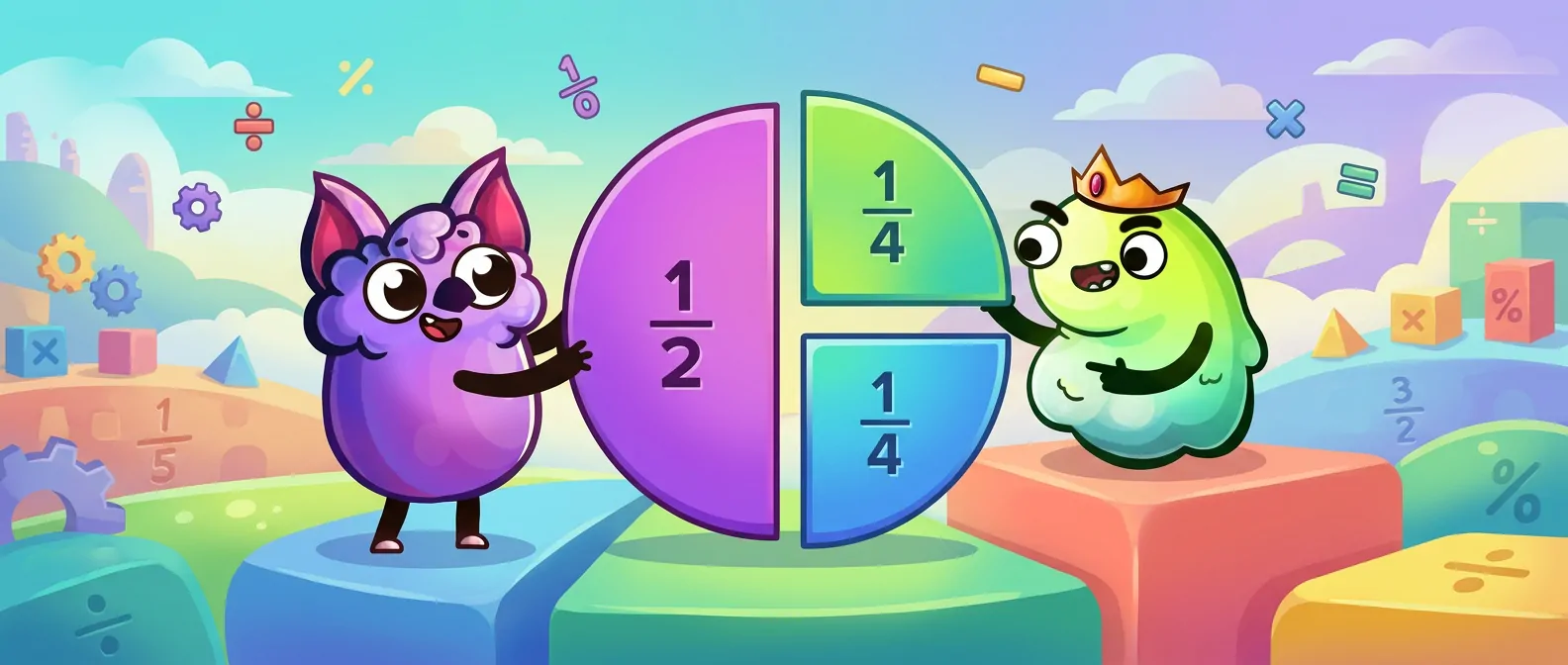
If you've ever helped your child with fractions and thought, Why does this have to be so complicated?, you're definitely not alone!
Fractions are one of those math concepts that can be challenging for students AND parents. And as a seventh-grade math teacher, I can tell you that fractions continue to show up in math long after elementary school.
But here's the good news: you don't have to start with complicated rules or memorized steps to help your child understand fractions.
In fact, I recommend doing the opposite! Start with hands-on activities, move to visual models, and help your child understand what fractions actually represent before introducing procedures.
Most children in the U.S. are formally introduced to fractions in third grade, but their understanding can start much earlier! In fact, the very first lesson I ever taught involved using chocolate bars to introduce fractions to third graders. It's still one of my favorite ways to show how everyday objects can help children understand math concepts!
Let's look at some simple ways to teach fractions, build your child's understanding, and make fraction practice a little less frustrating for everyone. And don't worry, you don't have to do all of this in one week!
Why teaching fractions matters so much
Understanding fractions is one of the strongest predictors of later math success. A long-running study of children in the US and UK found that fifth graders' knowledge of fractions uniquely predicted their algebra and overall math achievement in high school. The patient work of teaching fractions in the elementary years will pay off in future years.
What a fraction is, in kid language
When we first introduce fractions, we often describe them as parts of a whole. For example, imagine cutting a sandwich into four equal pieces. Each piece represents one-fourth of the sandwich. That is a good starting point, and it gives your child something concrete to build on as fractions become more abstract.
Here's the sentence I would use with a third grader: "The bottom number tells us how many equal parts make up one whole, and the top number tells us how many of those parts we're talking about."
Two things can trip children up early. The first common misconception is that any cut makes a fraction. Draw a wonky pizza with three unequal slices and ask, "Is one of these one third of the pizza?" Your child will usually see the problem. The second is that a bigger denominator means bigger pieces. But when we're dividing the same whole into equal parts, the larger the denominator, the smaller each piece becomes!
When fractions show up in elementary school
Children begin exploring fraction concepts earlier than many parents realize. Under the Common Core State Standards, first-grade students learn to divide circles and rectangles into two or four equal shares and describe those shares using words like halves and fourths.
Second-grade students continue working with equal shares, including thirds. By third grade, students begin formally working with fractions as numbers. They learn to represent fractions on number lines, recognize equivalent fractions, and compare fractions in certain situations.
In fourth grade, students build on those ideas by working with equivalent fractions, comparing fractions with different numerators and denominators, adding and subtracting fractions with like denominators, and multiplying fractions by whole numbers. Fifth grade introduces more complex operations, including adding and subtracting fractions with unlike denominators and multiplying fractions by fractions.
| Grade | What children work on |
|---|---|
| 1st grade | Splitting circles and rectangles into two or four equal shares: halves and fourths |
| 2nd grade | Equal shares, now including thirds |
| 3rd grade | Fractions as numbers, fractions on a number line, simple equivalent fractions, comparing in certain cases |
| 4th grade | Equivalent fractions, comparing any two fractions, adding and subtracting with like denominators, multiplying a fraction by a whole number |
| 5th grade | Adding and subtracting with unlike denominators, multiplying a fraction by a fraction |
But you can start talking about fractions at home even before children are introduced to them at school. Young children can begin understanding halves, thirds, and fourths through everyday activities like sharing snacks or dividing food into equal portions.
Start with real things, not the symbols
One of my favorite ways to introduce fractions is to use objects children can actually touch and move. Before we expect students to understand what 1/3 means on paper, let's help them experience what one-third represents!
Give your child something to divide fairly: a chocolate bar, a granola bar, or a paper strip. Ask them to share it equally between two, three, or four people. Then name what they made: "You cut it into three equal pieces. Each one is one third of the whole bar."
Here's another example. Give your child a sandwich and ask: "How could we share this equally between two people?"
Once they've divided it into two equal pieces, explain that each person gets one-half. Then try sharing something equally among four people. Now each person gets one-fourth.
You can even ask questions like:
- What do you notice about the size of the pieces?
- What happens when we divide the same whole into more equal parts?
- Would you rather have one-half or one-fourth of the same brownie? Why?
These conversations help children develop an understanding of fractions without needing a worksheet. Also, you don't have to just use food! Paper strips are another great option because children can fold them into equal parts and compare the different-sized pieces.
The goal is to connect the mathematical language to something that is already relevant and meaningful to your child.
Move from hands-on activities to visual models
Once your child can talk about halves and thirds with familiar objects, the next move in teaching fractions is visual representations. I am a HUGE fan of visual models in math! They help students make sense of what they're learning instead of relying on memorized steps.
One common visual representation is an area model. For example, draw two rectangles that are the same size. Divide one rectangle into two equal parts and shade one-half. Divide the second rectangle into four equal parts and shade two-fourths.
Ask your child: "What do you notice about the amount that's shaded?"
Even though the fractions look different, they represent the same amount! This is a great way to introduce equivalent fractions.
Don't forget the number line!
Another visual model I highly recommend is the number line. Students often think about fractions as pieces of pizza or parts of a shape, but fractions are also numbers with specific locations on a number line. This will also help them when they are expected to make line/dot plots with fractions on number lines in middle school.
Start by drawing a number line from 0 to 1. Mark the halfway point and label it 1/2. Then divide the distance from 0 to 1 into four equal intervals. Next, ask your child to locate 1/4 and 3/4.
Now ask: "Where would 2/4 go?"
They'll discover that 2/4 and 1/2 are at the exact same location! This is such a powerful way to help students understand equivalent fractions. As your child becomes more comfortable, extend the number line beyond 1.
Where would 5/4 go? What about 7/4? These activities reinforce that fractions can represent amounts greater than one, too.
Teach equivalent fractions before common denominators
Equivalent fractions are fractions that represent the same value.
For example: 1/2 = 2/4 = 4/8
One of the easiest ways to demonstrate this is with paper folding. Start with a strip of paper and fold it in half. Then fold it in half again to create fourths. Fold it once more to create eighths. When you unfold the paper, ask your child to look at how many eighths make up one-half. They should be able to see that four-eighths is the same amount as one-half!
You can repeat this activity with thirds and sixths. For example: 1/3 = 2/6
Once your child understands equivalent fractions visually, you can introduce the mathematical procedure. Multiplying the numerator and denominator by the same number creates an equivalent fraction. (This works because you are really multiplying by 1: any number written over itself as a fraction is equal to 1!)
But I wouldn't start by asking a child to memorize that rule. I want them to understand why the value stays the same. We're changing the number and size of the pieces, but not the total amount they represent.
This understanding becomes especially important when students begin comparing, adding, and subtracting fractions with different denominators.
Comparing fractions without panic
Comparing fractions is another area where students can get confused. For example, a child might look at 1/8 and 1/3 and assume that 1/8 is greater because 8 is greater than 3. I can understand why they might think that! When students first learn about whole numbers, they spend a lot of time understanding that larger numbers represent greater quantities. Fractions introduce a new way of thinking.
Strategy 1: Use visual models
Draw two rectangles of the same size. Divide one into eight equal parts and shade one. Divide the other into three equal parts and shade one. Ask your child which shaded area is larger. This helps them see why 1/3 is greater than 1/8.
Strategy 2: Compare fractions to benchmarks
Benchmark fractions like 0, 1/2, and 1 can make comparisons easier. For example: "Is 3/8 greater than or less than one-half?" Since 4/8 is equivalent to 1/2, we know that 3/8 is less than one-half. Now try 5/6. Because 3/6 is one-half, 5/6 must be greater than one-half.
Strategy 3: Use equivalent fractions
This is typically how I teach my students to compare fractions. Let's compare 2/3 and 3/4. We can rewrite both fractions using a common denominator of 12:
2/3 = 8/12
3/4 = 9/12
Since 9/12 is greater than 8/12, we know that 3/4 is greater than 2/3. I would still encourage students to use a visual model or number line to check whether their answer makes sense.
Practice ordering fractions
Once your child is comfortable comparing two fractions, try ordering three fractions from least to greatest.
For example: 1/2, 2/5, 3/4
Using a number line or benchmark fractions, your child can determine that the correct order is: 2/5, 1/2, 3/4
Remember, the goal isn't just getting the correct order. Ask your child to explain how they know!
Adding and subtracting fractions
When teaching students to add and subtract fractions, I always want them to understand what they're actually combining or taking away. Let's start with fractions that have the same denominator.
Adding fractions with like denominators
Think about: 2/5 + 1/5 = 3/5
If we have two-fifths of a whole and add another one-fifth, we now have three-fifths. We're combining pieces that are all the same size. That's why the denominator stays the same!
I connect this idea to thinking of the word "fifths" like any object. If I have 2 pencils plus 1 pencil, I have 3 pencils. Just like if I have 2 fifths plus 1 fifth, now I have 3 fifths. But I cannot add pencils and markers, just like I cannot add fifths and thirds.
Adding fractions with unlike denominators
Now let's look at: 1/2 + 1/3
This is where students sometimes want to add straight across and say the answer is 2/5. But one-half and one-third are different-sized pieces, so we can't simply combine the numerators and denominators. We need to rename the fractions using equal-sized pieces.
1/2 = 3/6 and 1/3 = 2/6
Now we can add: 3/6 + 2/6 = 5/6
Visual models can make this process much easier to understand.
Subtracting fractions
Subtraction follows the same idea. For example: 4/5 − 1/5 = 3/5
We're starting with four pieces that are each one-fifth of a whole and taking away one of those pieces. When subtracting fractions with unlike denominators, we first rewrite them using a common denominator.
Reminder: don't rush this process! Understanding equivalent fractions makes adding and subtracting fractions so much easier.
Multiplying fractions
The standard algorithm for multiplying fractions is often easier for students to understand than adding and subtracting fractions, because when you multiply fractions you don't need to create equivalent fractions with common denominators.
Let's start with: 2/3 × 3/4
We can think of this as finding two-thirds of three-fourths. An area model is a great way to show what that means.
Draw a rectangle and divide it into three equal columns and four equal rows, creating 12 equal parts. Shade two of the three columns in one direction. Then shade three of the four rows in another direction. The overlapping region contains 6 of the 12 equal parts.
So: 2/3 × 3/4 = 6/12 = 1/2
Once students understand what the multiplication represents, we can introduce the procedure of multiplying the numerators and multiplying the denominators.
Here's something else that can surprise students! When we multiply a positive number by a fraction between 0 and 1, our answer is actually smaller than the number we started with. For example, 2/3 × 3/4 means finding two-thirds of three-fourths. Since we're finding part of an amount, our answer is smaller than three-fourths. This is different from what students are used to seeing when they multiply positive whole numbers greater than one!
Use real-life examples
Cooking is one of my favorite ways to make fraction multiplication meaningful! Let's say a recipe calls for 3/4 cup of flour, but you only want to make half the recipe.
You need to find half of three-fourths: 1/2 × 3/4 = 3/8
So you'll need 3/8 cup of flour.
Multiplying fractions by whole numbers
Another example is: 3 × 1/4 = 3/4
This represents three groups of one-fourth. Students can draw three one-fourth pieces or use repeated addition to make sense of the multiplication!
Dividing fractions
Fraction division can feel especially confusing because students are often taught the procedure before understanding what division means. You may remember learning "keep, change, flip" or "multiply by the reciprocal." But I don't want students to rely on that phrase without understanding why the procedure works!
Start with a problem like: 3 ÷ 1/2
Ask: "How many one-halves are in three wholes?"
There are two halves in each whole, so there are six halves in three wholes. That means: 3 ÷ 1/2 = 6
This can easily be shown with measuring cups! Use a 1/2 cup to measure out 3 cups in total, and your child can see that it takes six 1/2 cups to make 3 cups. Once students understand fraction division through models and meaningful examples, they're better prepared to understand and use the standard procedure.
Simplest form, mixed numbers and improper fractions
Simplifying fractions
Students will also learn to write fractions in simplest form. For example: 8/20 = 4/10 = 2/5
We can simplify a fraction by dividing the numerator and denominator by a common factor greater than one. In this example, both 8 and 20 are divisible by 4, so we could also simplify directly to 2/5.
Mixed numbers and improper fractions
Fractions can also represent amounts greater than one. For example: 7/4 = 1 3/4
The fraction 7/4 is an improper fraction because its numerator is greater than its denominator. We can also write it as the mixed number 1 3/4. Something I like to point out to students is that a mixed number actually represents addition! We're combining 1 whole and 3/4 of another whole.
A proper fraction has a numerator smaller than its denominator, such as 3/8. I recommend using visual models and number lines to help students understand how these representations are connected.
Fun fraction activities to try at home
Math practice doesn't always have to involve a worksheet! Here are a few simple activities that can help your child practice fraction concepts.
- Fraction war. Use a regular deck of cards and remove the face cards. Deal each player two cards. Use the smaller number as the numerator and the larger number as the denominator. Each player creates a fraction, and the player with the greater fraction wins the round. For an extra challenge, ask your child to explain how they know which fraction is greater!
- Cooking together. Halve or double a recipe. Real-life situations make fractions meaningful and relevant to kids!
- LEGO fractions. A 2x4 brick has eight studs. What's half? A quarter? Three eighths? You can also use different-sized bricks to explore equivalent fractions.
- Equivalent fraction matching. Create cards with fractions and their simplified forms. Place them facedown and take turns flipping over two cards, trying to find equivalent fractions. For example, 4/8 and 1/2 would be a match!
Even 10–15 minutes of focused, meaningful practice can be a great place to start! For more card, dice and kitchen games, see Math at Home: Games, Everyday Activities, and Free Resources for Families.
Common challenges students face when learning fractions
Fractions can be challenging to understand for various reasons. Here are a few common struggles that I have seen with my own math students.
Applying whole-number rules to fractions
A student might assume that 1/5 is greater than 1/3 because 5 is greater than 3. This is a common misconception! Use fraction strips, rectangles, or number lines to help your child compare the actual values.
Following steps without knowing why
A child might know to find a common denominator before adding fractions but have no idea why that step is necessary. They might also know to multiply the numerators and denominators without understanding what fraction multiplication represents.
This is why I encourage parents to ask questions like:
- Can you show me what that means?
- Why did you choose that strategy?
- Does your answer make sense?
- Is there another way you could solve it?
Sometimes a quick drawing can reveal much more about a child's understanding than another page of practice problems.
Getting lost in the vocabulary
Children often get lost in the vocabulary of fractions: numerator, denominator, mixed numbers, improper fraction, proper fraction, equivalent fractions, simplifying fractions. Introduce new terms as your child encounters the concepts, and connect each term to a visual example.
Gaps in multiplication and division facts
A student might understand the concept behind a fraction problem but struggle to complete it because they're still working on multiplication or division facts. For example, finding common denominators or simplifying fractions can become more challenging when students aren't comfortable with factors and multiples. That doesn't mean they can't learn fractions! It just means we may need to spend some time strengthening those foundational skills while continuing to build their fraction understanding. If that's where your child is, How to Teach Multiplication walks through the sequence from equal groups to fact fluency.
How MathHero fits into fraction learning
One thing I always remind parents is that learning fractions involves more than memorizing procedures. Students also need a strong foundation in whole-number operations.
That's where a resource like MathHero can be helpful.
MathHero is a story-driven math game designed primarily for children ages 5–10. It focuses on addition, subtraction, multiplication, and division. MathHero doesn't teach fractions directly. Instead, it gives children opportunities to practice the arithmetic skills they use when working with fractions. For example, students use multiplication and division when finding equivalent fractions, identifying common denominators, and simplifying fractions.
That distinction matters, because research keeps pointing to the same finding. The 2008 National Mathematics Advisory Panel named proficiency with whole numbers "a necessary precursor for the study of fractions." A longitudinal study by Siegler and colleagues found that fifth graders' knowledge of fractions and division uniquely predicted their algebra and overall math achievement in high school, even after controlling for IQ, working memory, and family background.
MathHero allows parents to customize practice based on their child's needs. If your child is struggling with multiplication facts, you can focus on those facts instead of having them practice skills they've already mastered. Children work through a story-driven adventure while solving math problems, and parents can adjust the difficulty and practice settings.
MathHero is genuinely free to play. The whole game can be completed without paying, with no locked content and no ads. The only limit is five levels per day. A subscription (with a free trial) removes the daily cap. Five levels is a real practice session, not a demo. Families can also create separate profiles for multiple children.
Of course, MathHero isn't a replacement for fraction instruction, and it doesn't currently cover fractions, geometry, or word problems. But if your child needs additional practice with the whole-number skills that support fraction operations, it is a helpful option to explore!
Common denominators and simplest form get easier when multiplication facts are automatic. Set MathHero to the facts your child still needs.
Explore MathHeroFrequently asked questions about teaching fractions to kids
- Explore equal parts using real objects.
- Introduce fraction vocabulary, including halves, thirds, and fourths.
- Use pictures and number lines to represent fractions.
- Connect those models to fraction notation.
- Explore creating equivalent fractions and comparing fractions.
- Introduce fraction operations using visual models.
- Build toward more efficient procedures as understanding develops.
When fractions start feeling ordinary
Fractions don't have to be something your child dreads! They definitely don't have to be something you dread helping with at home.
One of the biggest things I've learned as a math teacher is that students benefit when we give them opportunities to make sense of the math instead of simply memorizing what to do. Sometimes that means using a fraction strip or a number line. Other times it means going back to a foundational skill before moving forward. That's okay!
You don't have to teach every fraction concept in one afternoon, and your child doesn't have to understand everything after seeing it once. Start small, ask questions, use visual models, and celebrate the moments when something finally clicks.
Because when students understand why the math works, they're building skills they can continue using long after they've finished their fraction worksheet!
Sources
- Common Core State Standards Initiative. Grade 1: Geometry, 1.G.A.3 (partition circles and rectangles into two and four equal shares).
- Common Core State Standards Initiative. Grade 3: Number & Operations—Fractions.
- Siegler, R. S., et al. (2010). Developing effective fractions instruction for kindergarten through 8th grade. IES Practice Guide, What Works Clearinghouse.
- National Mathematics Advisory Panel. (2008). Foundations for success: The final report of the National Mathematics Advisory Panel. U.S. Department of Education.
- Siegler, R. S., Duncan, G. J., Davis-Kean, P. E., Duckworth, K., Claessens, A., Engel, M., Susperreguy, M. I., & Chen, M. (2012). Early predictors of high school mathematics achievement. Psychological Science, 23(7), 691–697.
