
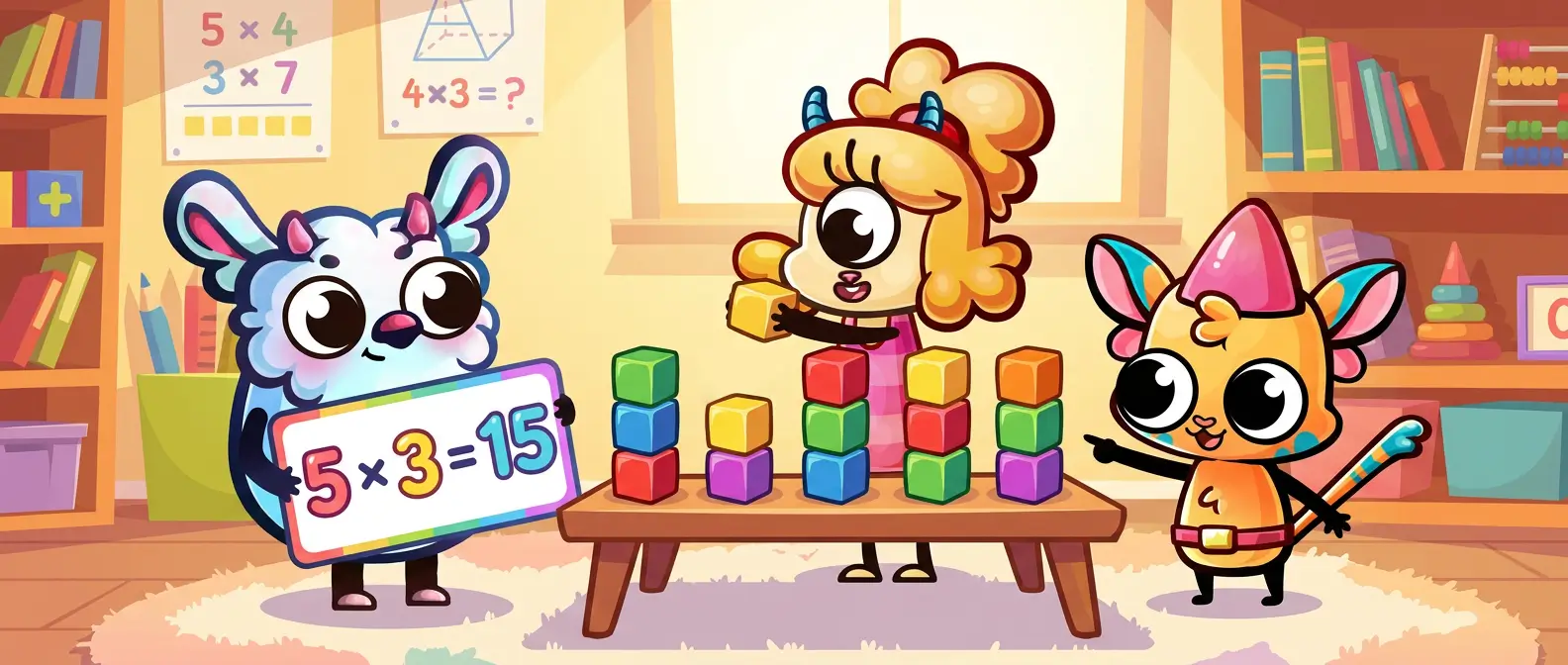
Short answer: Teach multiplication in this order: equal groups, repeated addition, arrays, the commutative property, fact fluency, word problems, and then multi digit multiplication. The strategies that work build conceptual understanding before memorization, and automatic multiplication facts support later work with the standard algorithm. In Common Core, the main progression runs from multiplication concepts and fact fluency in third grade, through multi-digit strategies in fourth grade, to the standard algorithm in fifth grade.
The full teaching sequence:
- Equal groups with physical objects
- Repeated addition
- The multiplication sentence and symbol
- Arrays and the area model
- Properties (commutative, identity, zero, associative, distributive)
- Multiplication facts from 1 × 1 to 10 × 10
- Multiplication word problems
- Multi digit multiplication with partial products
The multiplication chart goes up on the wall in September. By November, your students can chant the fives without blinking, but when you ask what 5 × 3 actually means, you get a blank stare and a guess.
That gap is the whole problem. Chanting isn't understanding. Understanding, by itself, isn't fluency. You need both and in that order, or everything falls apart the second the numbers get bigger. That interdependence is the central finding of the National Research Council's Adding It Up (2001), which treats conceptual understanding and procedural fluency as two strands of the same proficiency rather than a choice between them.
When to teach multiplication at each age
Multiplication develops in stages. Children first build the foundations through counting, grouping, and addition, then connect those ideas to multiplication before moving on to larger numbers and written methods. The timing varies from child to child, but the sequence is consistent.
Ages 5 to 6 (kindergarten and first grade)
No formal multiplication curriculum is needed yet. You're laying track. Kids count objects in equal groups, skip count by twos, fives and tens, double small quantities, and build solid addition facts.
Ages 7 to 8 (second and third grade)
This is where multiplication becomes formal. Children connect equal groups and repeated addition to products; in third grade they interpret products, use arrays and properties, solve word problems, and build fluency within 100. Common Core's specific end-of-year outcome is to know products of two one-digit numbers from memory.
Ages 9 to 10 (fourth grade)
Multi-digit multiplication: up to four-digit by one-digit, and two-digit by two-digit, worked through place value and the properties of operations, then explained with equations, rectangular arrays, and area models. Those are the strategies named in Common Core Grade 4 standard 4.NBT.B.5. Fluent use of the standard algorithm is a Grade 5 expectation, which puts it just past the top of this age range.
Check prior knowledge before you start
Three quick checks can show where to begin.
Addition facts should be reasonably fluent
If a student is still counting on fingers to get 6 + 6, adding the same number over and over creates extra load. Strengthen addition and doubling facts while introducing multiplication with small, concrete groups.
Skip counting by twos, fives and tens
A student who can rattle off 5, 10, 15, 20 is already partway into the five times tables. A number line taped to the desk gives the ones who lose the thread something to hop along.
A two-minute readiness check
Ask three things: count 12 buttons by twos, make three groups of four, and what is 4 + 4 + 4? A student who stalls on the second question needs more time with physical objects, not more worksheets.
Start with equal groups, not symbols
Before children memorize multiplication facts, they need to understand what multiplication represents. Common Core begins with interpreting a product as equal groups and then using equal groups, arrays, and measurement situations in word problems (3.OA.A.1–3).
Put physical objects on the table
Three plates. Four crackers on each plate. Ask how many crackers altogether — that's multiplication, and nobody has written anything down yet. Manipulatives can be any small objects lying around: buttons, coins, pasta, bottle caps, LEGO bricks.
Say it out loud, then write the sentence
Make students say the whole sentence: "Three groups of four is twelve." Every single time. Only once they can build and describe equal groups do you write 3 × 4 = 12, so the symbol arrives as shorthand for something they already understand.
Teach multiplication as repeated addition
Have students add 6 + 6 + 6 + 6 + 6 the long way. Let it drag. Then write 6 × 5 and let them watch the same result appear in a second. Multiplication is a shortcut for repeated addition, and students believe that a lot more when they've felt the long version first.
It builds meaning; it does not by itself build fluent recall. Reconstructing every product through repeated addition becomes inefficient as the numbers grow. Once students understand the concept, shift some practice toward retrieval while continuing to use models when a fact is unfamiliar.
Build understanding with arrays and the area model
Once children understand multiplication as equal groups, arrays give them a way to see those groups at a glance.
Build physical arrays first
Rows and columns — four rows of six counters, for example. Egg cartons are free arrays. So are ice cube trays, muffin tins and window panes.
Rotate the array
Turn it ninety degrees. Four rows of six becomes six rows of four. Same counters, same total, different fact. This does more work than any definition on the board.
Draw the area model when larger numbers arrive
When numbers get too big to build, students draw rectangles instead — six by eight, sketched on grid paper. The same array idea scales into multi-digit multiplication. Common Core connects arrays to multiplication in Grade 3 standard 3.OA.A.3, and area models to multiplication and the distributive property in 3.MD.C.7; both feed the multi-digit strategies of Grade 4.
Teach the properties as shortcuts, not vocabulary
Commutative property: half the work disappears
3 × 4 equals 4 × 3. Rotate the array and students see why. The 100 multiplication facts from 1×1 to 10×10 collapse into 55 unique ones — genuinely good news when you're eight years old.
Identity and zero properties
Any number multiplied by 1 equals itself. Any number times 0 equals 0. Show it with plates: one cracker on each, then none.
Associative property
2 × 3 × 5 works as (2 × 3) × 5 or 2 × (3 × 5). This lets students regroup factors to make a calculation easier.
Distributive property
Stuck on 7 × 8? Split it: 7 × 4 is 28, doubled is 56. Or take 8 × 7 as (8 × 5) + (8 × 2), which is 40 + 16. This is the property that makes multi digit multiplication possible later.
Teach multiplication facts in a strategic order
Standards define the outcome, not one required teaching order. One practical sequence is to start with facts children can derive from familiar patterns, then concentrate on the remaining facts:
- 2s (doubles, already known from addition)
- 10s and 5s (skip counting does the work)
- 0s and 1s (two rules, one minute)
- 4s (double the 2s)
- 3s
- 9s (ten times the number, minus the number)
- 6s, 7s and 8s (the leftovers)
By step seven, the commutative property has already covered most of the ground. Genuinely hard facts come down to six: 6×6, 6×7, 6×8, 7×7, 7×8 and 8×8. Name them out loud as the hard ones and go after them directly.
As a practical fluency check, look for accurate answers without rebuilding every fact from one. A three-second target can be useful for monitoring practice, but it is not an official Common Core benchmark and should not be used to judge a child.
Practice that doesn't make kids hate math
Games move more volume than worksheets
A card game can create many low-stakes opportunities to retrieve facts without making practice feel like a test. Try War with a deck of cards, where both players flip and the higher product wins, or use two dice and race up a multiplication chart. Rotate activities so practice doesn't go stale.
Timed drills and flash cards, in small doses
Keep them brief, give feedback, and score against a personal best rather than the fastest kid in the room. The What Works Clearinghouse includes timed activities as one evidence-based option for building fluency, alongside systematic instruction and concrete or semi-concrete representations (IES elementary mathematics practice guide). Pull the few facts a student is actually missing and practice those.
Digital practice for the reps
MathHero is a story-driven math game for ages 5 to 10 where solving short sets of facts is how kids move the adventure forward. You choose what they work on, down to a single table if a student only needs the sevens and nines. No ads. Free to play at five levels a day. It won't explain a concept from scratch — that's you or a teacher. What it does is turn the practice that follows into something that feels like play.
Switch on just the times tables your child is stuck on — MathHero lets you drill only what's missing.
See how it worksUse multiplication word problems early
Four shapes cover almost everything at this level:
- Equal groups: four bags with six apples in each
- Arrays: six rows of five chairs
- Comparison: Maya has three times as many stickers as Sam
- Area: a rug measuring 4 feet by 7 feet
Comparison problems can be less immediately recognizable because nothing in the sentence looks like groups. Teach that type explicitly. Before any calculation, students draw — circles with dots, tally marks, a quick array, or a bar — which forces them to decide what the numbers mean. Deliberate instruction in word problems is also a strong-evidence recommendation in the IES practice guide.
Move into multi-digit multiplication
Build reliable single-digit facts first
Every two-digit problem contains several single-digit products. Students do not need instant recall of every fact before seeing a multi-digit model, but reliable fact knowledge reduces the load and lets them focus on place value and the structure of the method.
Break numbers apart, then multiply the parts
Pull numbers apart out loud first. 23 is 20 and 3. 46 is 40 and 6. For example:
| 23 × 4 = | |
|---|---|
| 20 × 4 = | 80 |
| 3 × 4 = | 12 |
| 80 + 12 = | 92 |
Every step is a fact students already own. Nothing gets carried, nothing is hidden, and a student who makes an error can see exactly which piece went wrong.
Scale the model up for two-digit by two-digit
Draw a rectangle split into four boxes. 23 × 15 becomes 20×10, 20×5, 3×10 and 3×5. Each box holds one partial product. Add the four.
The standard algorithm comes later than you think
The standard algorithm is fast but compresses several place-value steps. Arrays and partial products make those steps visible first. Common Core asks fourth graders to multiply using place-value strategies and models, then asks fifth graders to fluently multiply multi-digit whole numbers using the standard algorithm.
Before a student is expected to use it fluently, they benefit from reliable multiplication facts, fluent addition, and a clear understanding of place value and partial products.
Connect multiplication to division and long division
Four facts, one array: 3×4=12, 4×3=12, 12÷3=4, 12÷4=3. Teach fact families together. Division is the same equal groups picture read backwards. Long division waits until fluency is real, because every step of it is a multiplication question in disguise.
Help students who are stuck
"Bad at math" is never a diagnosis. Give a two-minute check and find where it actually breaks: the concept of equal groups, one set of facts, place value, or reading the word problem. Then shrink the numbers — a student who can't touch 7×8 may handle 3×4 perfectly well.
Track progress across the year
Use brief checks every week or two on a narrow slice of facts, then revisit older facts after a delay. The IES learning and memory practice guide recommends spacing review over time and using active retrieval to strengthen long-term retention (Organizing Instruction and Study to Improve Student Learning). A 10 by 10 grid can show which facts are secure and which still need practice.
Evidence & Sources
Primary standards and evidence reviews behind the sequence and benchmarks in this guide.
- Common Core: Grade 3 Operations & Algebraic Thinking — supports equal groups, arrays, properties, multiplication word problems, fluency within 100, and the end-of-Grade-3 one-digit fact outcome.
- Common Core: Grade 3 Measurement & Data, standard 3.MD.C.7 — connects area models to multiplication and to the distributive property.
- Common Core: Grade 4 Number & Operations in Base Ten — supports multi-digit multiplication through place value, the properties of operations, equations, rectangular arrays, and area models.
- Common Core: Grade 5 Number & Operations in Base Ten — establishes fluent use of the standard multi-digit multiplication algorithm in Grade 5.
- National Research Council: Adding It Up: Helping Children Learn Mathematics (2001) — the evidence synthesis behind treating conceptual understanding and procedural fluency as interdependent strands rather than a sequence you can shortcut.
- What Works Clearinghouse: Assisting Students Struggling with Mathematics: Intervention in the Elementary Grades (2021) — evidence-based recommendations for systematic instruction, representations, word problems, and timed fluency activities.
- IES Practice Guide: Organizing Instruction and Study to Improve Student Learning (2007) — supports spaced review and retrieval practice for durable learning.
Common questions about teaching multiplication
What this sequence won't fix
Some students will follow every step here and still need substantially more time and support. Persistent difficulty can reflect an earlier knowledge gap, attention or working-memory demands, or a specific learning difficulty; it should not be treated as a lack of effort. Informal timing can help plan practice, but it should not be used to judge a child. A student who continues to struggle needs individualized support beyond a general lesson sequence.
Teach the meaning, practice the facts, and pause to reconnect an answer to a model whenever a student can recall the product but cannot explain what it represents.
