

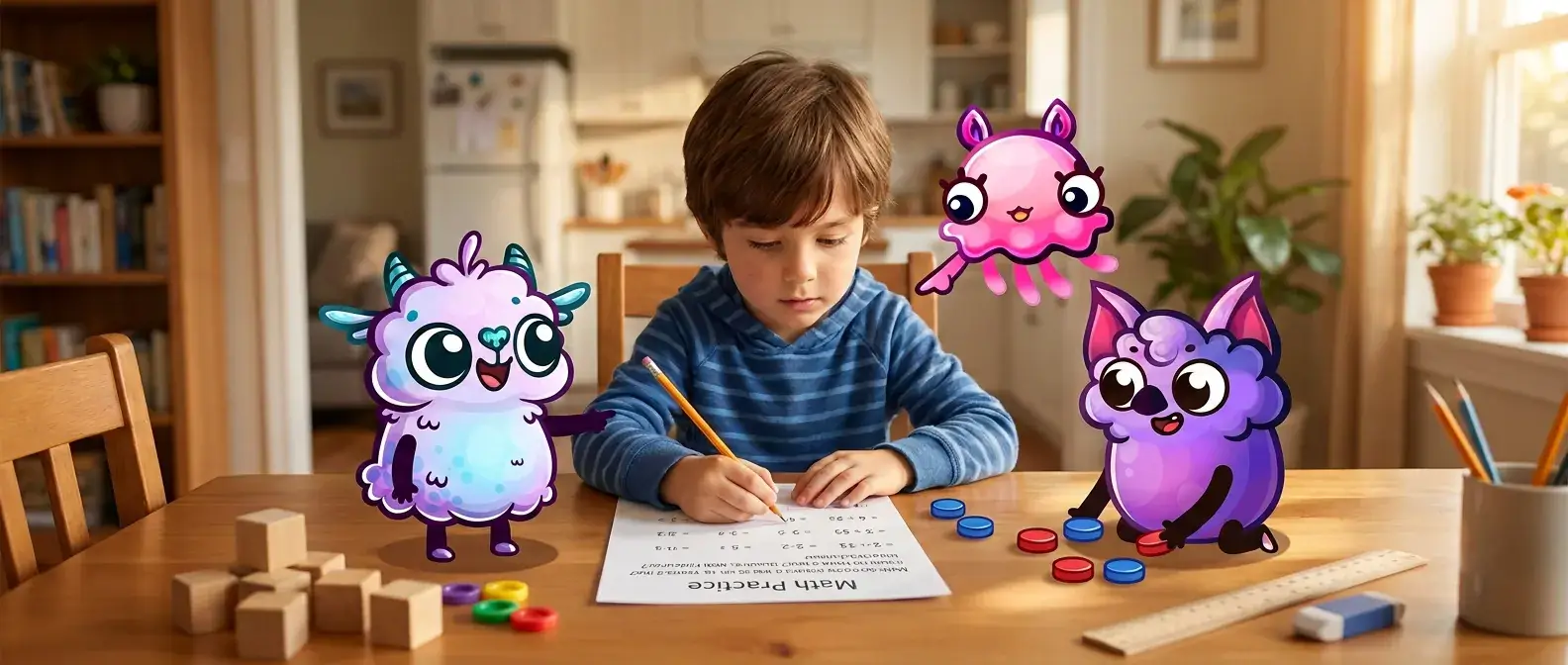
Your child is at the kitchen table with a pencil hovering over a worksheet that looks nothing like the math you remember from school. You know the right answer. You just can't figure out how the teacher wants it worked out.
Sound familiar?
As a teacher, here is one of the biggest things that I want parents to know: helping with math homework does not mean you need to reteach the entire lesson. You don't have to become your child's second math teacher. In fact, doing too much of the teaching can sometimes make homework harder for everyone.
Your job is much simpler: help your child think, stay calm when things get tricky, and know when it's time to ask your child's teacher for help.
What helping with math homework actually means
Homework can give a teacher valuable feedback. It shows what your child can do alone, tonight, without support. That means your goal isn't necessarily a perfectly completed worksheet. Your goal is for your child to do as much of the thinking as possible.
If you end up solving half the problems because you want to help, the teacher may see a page full of correct answers without realizing your child was struggling with the concept.
Instead, view yourself as a thinking partner for your child. You can help your child understand the question, talk through their thinking, find a mistake, or decide when they need to ask their teacher for clarification.
Sometimes the most helpful thing you can do is say, "I'm not sure either. Let's write a note to your teacher."
Set up homework time before the first math problem
Sometimes the hardest part of homework has absolutely nothing to do with math.
It's the missing pencil, the sibling watching TV, or the snack that suddenly becomes a requirement.
A little routine can make a big difference.
- Pick a consistent start time and stick to it as best as possible. Maybe it's after snack, after school activities, or before screens. When kids know when it's homework time, there's less negotiating about when homework starts.
- Have the supplies ready to use. Paper, sharpened pencils, eraser, assignment page, calculator if needed, and anything else your child will need. Not having a pencil ready to go can somehow turn into a ten-minute scavenger hunt.
- Reduce distractions. Turn off the TV, put the tablet away, and give your child your attention when they need it. They notice where our attention goes, too, so try to limit your own screen time too if possible!
- Help them see that there is an end in sight. Instead of saying, "Go do your homework," try, "Let's do these four problems, then we'll take a break." Knowing what "done" looks like can make a big task feel much more manageable.
Be a thinking partner, not an answering machine
This is probably the biggest shift you can make.
When your child gets stuck, your first instinct may be to explain. I get it! As teachers, we do this too. But before you explain, ask a question.
Ask your child to talk through the math problem
Start with something simple like: "Read the problem to me."
Having your child read the problem aloud does two really important things: it helps them slow down and make sure they have all of the information, and it helps you hear whether they're able to read and understand all of the words in the problem.
Then ask: "What is this problem asking you to find?"
Notice that I didn't say, "What do you do first?"
That question can accidentally turn you into the person directing every step. Instead, asking what the problem is actually asking them to find helps your child figure out what information matters and what they need to do with it.
Wait longer than feels comfortable
Giving students enough wait time is a challenging skill, even for teachers! When your child is staring at the paper, you may feel like you need to jump in with a hint.
Try waiting a little longer than feels comfortable.
Sometimes kids need a few seconds to process the question and decide what they want to try. If we jump in too quickly, we can accidentally interrupt the thinking they were just beginning to do.
Ask whether the answer makes sense
Three open-ended questions that work on almost any math problem:
- Does that answer seem reasonable to you?
- Why does that step make sense?
- What could you try instead if that doesn't seem right?
I love hearing students explain the reasoning behind why an answer might not be correct!
Based on the context of the problem, maybe an answer seems too large or too small. Or maybe a student realized that after subtracting two positive numbers they somehow got a larger answer.
When a child can notice that something doesn't make sense, they're doing much more than simply following a procedure.
Have them explain their reasoning out loud
If your child says, "I don't get it," try narrowing it down.
Ask: "Show me where you got stuck."
Maybe they understand the first two steps but aren't sure what to do next, maybe they don't understand what the question is asking, or maybe they do know the method they want to use but they made a mistake.
Those are very different problems.
When your child explains their thinking out loud, you get a much better picture of what they actually understand. Many times they will catch their own mistake just by explaining it out loud!
Acknowledge feelings before you fix the math
We've all seen it: the math problem isn't even necessarily that difficult, but big emotions have taken over. At that point, more explaining usually isn't going to help. Start with asking and thinking about how they are feeling.
Try:
- "That one is challenging. Want to skip it and come back?"
- "You've been working on this for a while, so it's okay to feel frustrated. Let's solve it together!"
- "Let's take a quick break, and then come back to it."
The break is not a reward for quitting. Sometimes a reset can do wonders for helping students start back over with a clear mind.
Some frustration is a completely normal part of learning! We don't want to teach kids that math should always feel easy. But we also don't want a difficult homework problem to turn into, "I'm just bad at math."
Instead of thinking they are not good with math, we want kids to learn: "This is hard right now, but I can keep working on it."
That's a much more useful belief to carry with them into not just math, but into other subjects and life in general!
What to do with wrong answers
Try not to turn homework into a hunt for everything your child did wrong.
If you see an incorrect answer, start with: "Walk me through how you got this."
You may be surprised how often your child finds the mistake while explaining it. Try to identify exactly where their error is occurring. Not all mistakes are the same!
A computation mistake
Maybe your child understands the concept but made a small calculation error.
They might have:
- miscounted
- copied a number incorrectly
- made a calculation mistake
- moved through the problem too quickly
That's different from not understanding the mathematical process.
A conceptual mistake
Sometimes the problem is bigger: your child doesn't understand why they're doing what they're doing. Maybe they don't know which operation makes sense or maybe they're applying a rule without understanding what it means.
That's when I would resist the urge to pile on more practice.
If the concept isn't there yet, doing twenty more problems the same way isn't necessarily going to fix it. That's information the teacher needs.
Give a hint instead of the answer
Try a small nudge:
- "What does this number represent?"
- "What are you trying to find?"
- "Go back and look at the ones' place."
- "Can you draw a picture to show the problem?"
- "Does that answer make sense?"
Have them write every step down. Written steps make the process visible to you and to your child. Students who work this way are often better able to catch their own errors, and your feedback can get really specific instead of vague. The ultimate goal is to give just enough support to get your child thinking again, but not enough to do the problem for them.
Talk to your child's teacher
If you're confused about how your child is being taught, ask their teacher! Math instruction has changed a lot over the years, and your child's teacher may be using a strategy that you never learned in school. That doesn't mean your way was wrong. It just means your child may be expected to show their thinking differently.
Here are three great questions to ask:
- Which method are students learning in class for solving this type of problem?
- Can you share examples of how this type of problem is taught or explained in class?
- Is what I'm seeing at home also happening in class?
That last question can be especially helpful! If your child understands the work at school but struggles to complete homework independently at home, you may be dealing with a homework routine or independence issue.
If your child is struggling both at school and at home, that's important information for the teacher, too. Don't feel bad about reaching out! Teachers would much rather know that your child is struggling than have everyone sit at home frustrated for weeks.
When homework help isn't the answer anymore
Sometimes the assignment itself is the problem. If every math assignment turns into a long, exhausting process, it's worth looking a little deeper.
For example, maybe your child understands the math concept they're learning in class, but basic math facts are taking so much mental energy that everything else feels difficult. Imagine trying to solve a multi-step problem while stopping to figure out every basic addition fact along the way.
That's where working on math fact fluency can be really beneficial!
Fluency doesn't mean memorizing everything overnight or racing through flash cards. It means developing enough familiarity with basic facts that your child can recall many of them efficiently, leaving more brainpower available for the actual math they're learning!
Fact fluency practice can be completed separate from homework time.
Build math skills somewhere other than the kitchen table
If math facts are the issue, you don't necessarily need to add another hour of worksheets to your child's day. Short, consistent practice is often much more manageable. Think about it like learning a song. You don't learn the whole thing perfectly in one sitting. You hear it, practice it, come back to it, and eventually the words become familiar. Math facts can work the same way.
That's the gap MathHero is built to fill. It's a story-driven adventure for kids ages 5 to 10, where solving short sets of math facts is how your child moves through the game: building, racing, rescuing characters, earning coins and gear. Math is the action, not a quiz between levels.
You pick the topic: addition and subtraction up to 10, 20, 100, or 1000, times tables (down to individual ones, if only 7s and 9s are the trouble), and division. Then choose open practice at a difficulty you set, or a guided step-by-step path.
The nice thing about this kind of practice is that it can happen separately from homework. Your child can get a little extra math-fact practice without you sitting at the kitchen table trying to explain another worksheet.
MathHero also has a free option, with a limit on how many levels can be completed each day. A subscription with a free trial removes that limit.
It's also important to know what MathHero doesn't do. It isn't designed to teach a brand-new math concept from scratch, and it isn't a replacement for classroom instruction. Your child needs to understand numbers and have some foundational math skills before using it.
What MathHero builds is a stronger foundation of math-fact recall and fluency through structured practice, so a child isn't spending all of their mental energy figuring out basic facts that can become more automatic with practice.
The goal is simple: practice that feels like play. When kids stop thinking about the fact that they're practicing math, they're much more likely to come back tomorrow! That consistency is where fluency and confidence can build over time.
For a bigger-picture look at supporting your child's math learning, check out The Best Ways to Learn Math. And if multiplication facts are the trouble spot, How to Teach Multiplication covers strategies your child's class may be using.
Pick the facts your child needs, from addition within 10 to the 7s and 9s, and let the practice happen away from the homework table.
Explore MathHeroWhen to get a tutor
Sometimes extra practice is enough, but sometimes your child will need more support.
A tutor may be helpful when a conceptual gap is getting in the way of new material, your child continues to fall behind, or their teacher recommends additional support.
Before jumping straight to tutoring, you can try a few things:
- Establish a consistent homework routine.
- Practice foundational skills separately from homework.
- Talk with the teacher about what you're seeing.
- Take a look at whether the struggle is with the concept, the computation, or simply getting started.
Then see how your child is doing and decide what support they need next.
And remember: your relationship with your child matters more than math!
If every night ends with tears, arguments, and frustration, it is okay to decide that homework doesn't need to be a parent-child battle. Sometimes getting another adult involved is the best thing for everyone.
Before paying for tutoring, you can always ask about free support at your child's school. Some schools offer homework clubs, tutoring programs, intervention groups, or other academic support that families may not realize is available.
Questions parents ask
Tonight
You don't have to become your child's math teacher. Pick a consistent time, clear the table, and put away the distractions.
When your child gets stuck, ask one question: "What is this problem asking you to find?"
Then give them a little time to think. You may be surprised by how often they can get there on their own. And if they can't? That's okay, too! That's what the teacher needs to know.
