
Addition and Subtraction Games for Kids
Play three free addition and subtraction games for kids, with plus and minus problems mixed in every game. Choose numbers up to 10, 20, 100 or 1,000, with a separate range for each operation. Pick an adventure to get started. No account or download needed, and no ads.
- Within 10, 20, 100 or 1,000
- Plus and minus mixed
- Grades K-3 · ages 5-9
- Free in the browser
- No account, no download
- No ads
- Phone, tablet and computer
Pick an Addition and Subtraction Game to Play
Choose a number range for each operation: 1-10, 1-20, 1-100 or 1-1000, or Off. Both start at 1-20.
Games for One Addition and Subtraction Skill
Each page below has games focused on a single number range, still with plus and minus mixed, and its own choices, strategies and table or worked example.
By range
Practice one operation
Next step
Get MathHero: The Full Adventure
Keep practicing in the MathHero app: a story-driven math game for ages 5-10, from first addition to division.
- Step-by-step learning programs: Addition & Subtraction up to 10, Addition up to 20, Subtraction up to 20, Addition up to 100 and Subtraction up to 100 add new facts a little at a time
- Custom Practice: addition and subtraction up to 10, 20, 100 or 1,000
- Typed answers or multiple choice, in Easy, Medium or Hard mode
Free at 5 levels a day, with no ads and nothing locked.

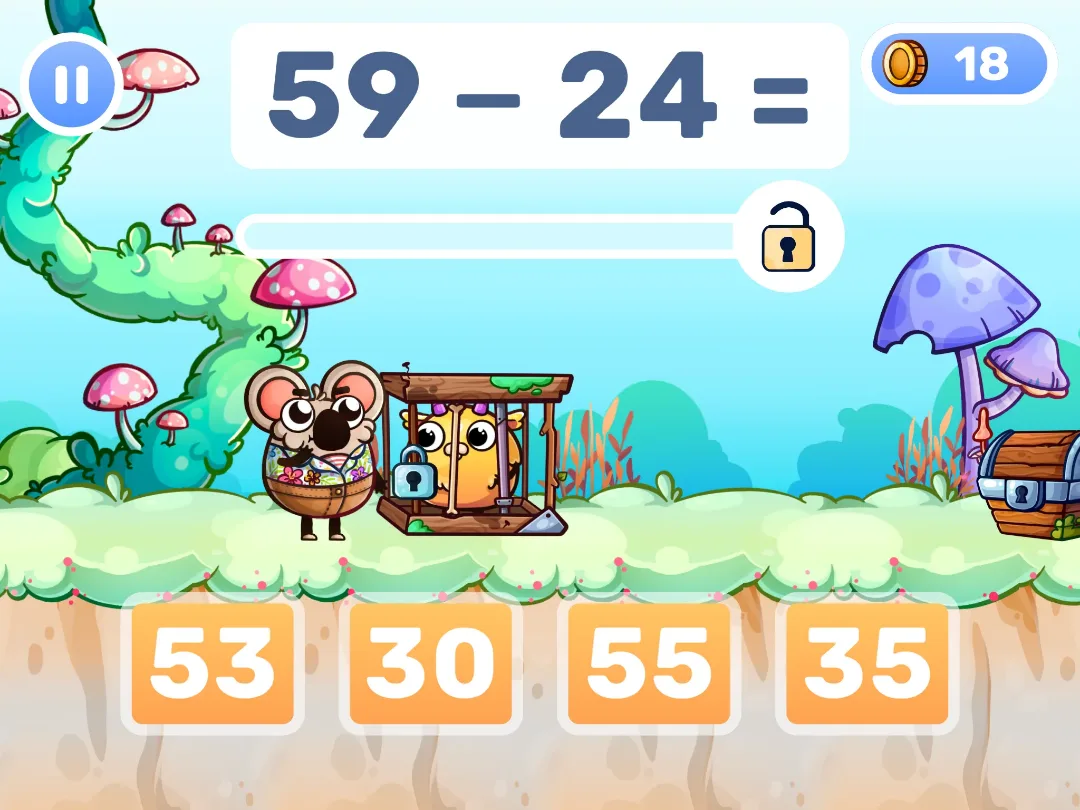
Why Mixed Addition and Subtraction Practice Helps
Mixed addition and subtraction practice makes your child read the sign on every problem, and it shows that the two operations use the same facts: 8 + 5 = 13 also gives 13 − 5 = 8. Bigger numbers reuse the same facts within 20, in the tens and in the ones.
1. Read the sign first
When every problem is addition, a child can stop looking at the sign and simply add the two numbers. Mixed practice keeps the sign in view: after 8 + 5 comes 13 − 5, and the same 5 needs a different answer. Reading the problem aloud, “thirteen minus five”, makes checking the sign part of every answer.
2. Facts come in families
Addition and subtraction undo each other. If 8 + 5 = 13, then 5 + 8 = 13, 13 − 5 = 8 and 13 − 8 = 5. The three numbers 5, 8 and 13 make a fact family. The table of related facts below lists more of them.
3. Subtract by thinking addition
For 13 − 5, ask: “5 plus what makes 13?” A child who knows 5 + 8 = 13 has the answer, 8, without counting back. Common Core standard 1.OA.B.4 describes subtraction this way, as an unknown-addend problem.
4. Check one with the other
Adding the answer back checks a subtraction: 52 − 28 = 24 is right because 24 + 28 = 52. Subtracting checks an addition the same way: 47 + 38 = 85, and 85 − 38 = 47. Children who practice both get used to checking their own answers.
How to choose a range
Start with the range your child is learning at school, or the one where they get most answers right, and move up when the answers come quickly:
- Within 10 (kindergarten and 1st grade): facts like 6 + 3 and 9 − 4. Practice them on the addition and subtraction within 10 games.
- Within 20 (1st and 2nd grade): facts like 8 + 5 and 13 − 5 that cross 10. Practice them on the addition and subtraction within 20 games.
- Within 100 (2nd grade): problems like 23 + 45 and 76 − 24, worked by tens and ones. Practice them on the addition and subtraction within 100 games.
- Within 1,000 (2nd and 3rd grade): problems like 234 + 152 and 586 − 234.
Common mistakes
- Adding when the sign says minus. A child who answers 18 for 13 − 5 added the numbers. Ask them to read the problem aloud before answering.
- Counting the start number. A child who finds 13 − 5 by saying 13, 12, 11, 10, 9 gets 9 instead of 8. The first number to say is one below the start: 12, 11, 10, 9, 8.
- Forgetting the ten. In 47 + 38, the ones make 15, and the new ten has to join the tens: 85, not 75. In 52 − 28, the ten broken into ones has to come off the tens: 24, not 34. Checking with the other operation catches both: 34 + 28 = 62, not 52.
For early number ideas to try at home, see our number sense activities and our guide to what math a 5 year old should know, and to see how school teaches the facts within 10 and 20, read about number bonds and making ten in our guide to new math.
What Grade Do Kids Learn Addition and Subtraction?
In the US, children learn addition and subtraction together from kindergarten to 3rd grade, usually at ages 5-9. Each year widens the range:
- Kindergarten: add and subtract within 10 with objects and drawings (K.OA.A.2) and add and subtract fluently within 5 (K.OA.A.5).
- 1st grade: add and subtract within 20, fluently within 10 (1.OA.C.6), with strategies like making ten and using the relationship between addition and subtraction.
- 2nd grade: add and subtract fluently within 20 and know all sums of two one-digit numbers from memory (2.OA.B.2), add and subtract fluently within 100 (2.NBT.B.5), and add and subtract within 1,000 with models and strategies (2.NBT.B.7).
- 3rd grade: add and subtract fluently within 1,000 (3.NBT.A.2).
In England, children in Year 1 use number bonds and related subtraction facts within 20 and add and subtract one-digit and two-digit numbers to 20. In Year 2 they recall addition and subtraction facts to 20 fluently and add and subtract two-digit numbers, and in Year 3 they add and subtract numbers with up to three digits using columnar addition and subtraction.
- Age
- 5-9
- US grade
- K-3
- Standard
- Common Core 1.OA.C.6, 2.OA.B.2
- England
- Years 1-3
Learn Addition and Subtraction with the MathHero App
How is the MathHero app different from the online games on this page?
The online games on this page are mini-games for short addition and subtraction practice. The MathHero app is a full math adventure with step-by-step learning programs, rewards for your hero and saved progress for each child. If your child enjoys these mini-games, try the app: you can play 5 levels a day for free, with no ads and nothing locked.
What Parents Say About the MathHero App
Verbatim from public App Store and Google Play reviews of the MathHero app, with spelling as written. Rated 4.7 on Google Play (48.2K reviews) and 4.6 on the App Store (12K ratings), checked .
“This game is rally helping my children and wen ever I ask her a addition or a subtraction problem she knows it right away. This is a 5 star game!”
“Since it builds on itself and gives you mixed addition, subtraction, multi, and division he’s learned all four MUCH faster and I don’t even think he realizes.”
“The game goes the range, of simple addition/subtraction to more difficult multiplication/division tables. Difficulty is fully adjustable.”
Addition and Subtraction Games: Common Questions
What are some fun addition and subtraction games?
What does within 10, 20 or 100 mean?
What grade do kids learn addition and subtraction?
How do I choose the right range?
Are these online addition and subtraction games free?
Do the online addition and subtraction games work on a phone or tablet?
About This Page
Last updated · App ratings checked
- MathHero on the App Store
- MathHero on Google Play
- Common Core: Kindergarten Operations and Algebraic Thinking
- Common Core: Grade 1 Operations and Algebraic Thinking
- Common Core: Grade 2 Operations and Algebraic Thinking
- Common Core: Grade 2 Number and Operations in Base Ten
- Common Core: Grade 3 Number and Operations in Base Ten
- National curriculum in England: mathematics programmes of study