
| Topic | What it looks like | Example | Standard |
|---|---|---|---|
| Facts within 20 | Quickly, with mental strategies; one-digit sums from memory | 8 + 5 = 13, 13 − 5 = 8 | 2.OA.B.2 |
| Word problems | One and two steps within 100 | 34 − 12, then + 25 | 2.OA.A.1 |
| Even and odd | Pair up to 20 objects | 14 = 7 + 7, even | 2.OA.C.3 |
| Arrays | Rows and columns added up | 3 rows of 4: 4 + 4 + 4 = 12 | 2.OA.C.4 |
| Place value | Hundreds, tens and ones to 1,000 | 305 = 3 hundreds, 0 tens, 5 ones | 2.NBT.A.1 |
| Skip counting | By 5s, 10s and 100s within 1,000 | 350, 355, 360 | 2.NBT.A.2 |
| Expanded form | Numerals, names and expanded form | 472 = 400 + 70 + 2 | 2.NBT.A.3 |
| Comparing | Three-digit numbers with >, = and < | 529 < 592 | 2.NBT.A.4 |
| Within 100 | Add and subtract fluently | 47 + 38 = 85, 52 − 28 = 24 | 2.NBT.B.5 |
| Four numbers | Add up to four two-digit numbers | 23 + 15 + 32 + 10 = 80 | 2.NBT.B.6 |
| Within 1,000 | Add and subtract with models | 365 + 248 = 613 | 2.NBT.B.7 |
| 10 and 100 more or less | In your head, from 100 to 900 | 307 − 10 = 297 | 2.NBT.B.8 |
| Length | Inches, feet, centimeters, meters; estimate first | A pencil is about 7 inches | 2.MD.A.1-4 |
| Number line | Length problems and jumps within 100 | 32 in − 22 in = 10 in | 2.MD.B.5-6 |
| Time | To the nearest 5 minutes, a.m. and p.m. | 3:25 p.m. | 2.MD.C.7 |
| Money | Dollar bills and coins | 2 quarters, 1 dime, 3 pennies = 63¢ | 2.MD.C.8 |
| Graphs | Picture graphs, bar graphs, line plots | How many more chose apples? | 2.MD.D.9-10 |
| Shapes | Sides, angles and faces | A pentagon has 5 sides and 5 angles | 2.G.A.1 |
| Rows and columns | Split a rectangle into squares | 3 rows of 4 squares = 12 | 2.G.A.2 |
| Equal shares | Halves, thirds and fourths | A pizza cut into fourths | 2.G.A.3 |
2nd Grade Math Games
Pick one of four free 2nd grade math games and play it right in your browser, with no account, download or ads. Then choose what to practice: addition, subtraction or both, within 20, 100 or 1,000.
- Grade 2 · ages 7-8
- Addition and subtraction to 1,000
- Free
- No account
- No ads
- Phone, tablet and computer
Pick a 2nd Grade Math Game to Play
Pick a game, then choose addition, subtraction or both: within 20 to warm up, within 100 for most of 2nd grade. Select “No regrouping” for easier problems like 43 + 25; within 20 it leaves out the facts that regroup, like 8 + 5 and 14 + 6.
Practice One 2nd Grade Skill
Facts to 20
Within 100
Within 1,000
Every range
Math Games by Grade
For parents


Get MathHero: The Full Adventure
Keep practicing in the MathHero app: a story-driven math game for ages 5-10, from first addition to division.
- Step-by-step learning programs: Addition & Subtraction up to 10, Addition up to 20, Subtraction up to 20, Addition up to 100 and Subtraction up to 100 add new facts a little at a time
- Custom Practice: addition and subtraction up to 10, 20, 100 or 1,000
- Typed answers or multiple choice, in Easy, Medium or Hard mode
Free at 5 levels a day, with no ads and nothing locked.
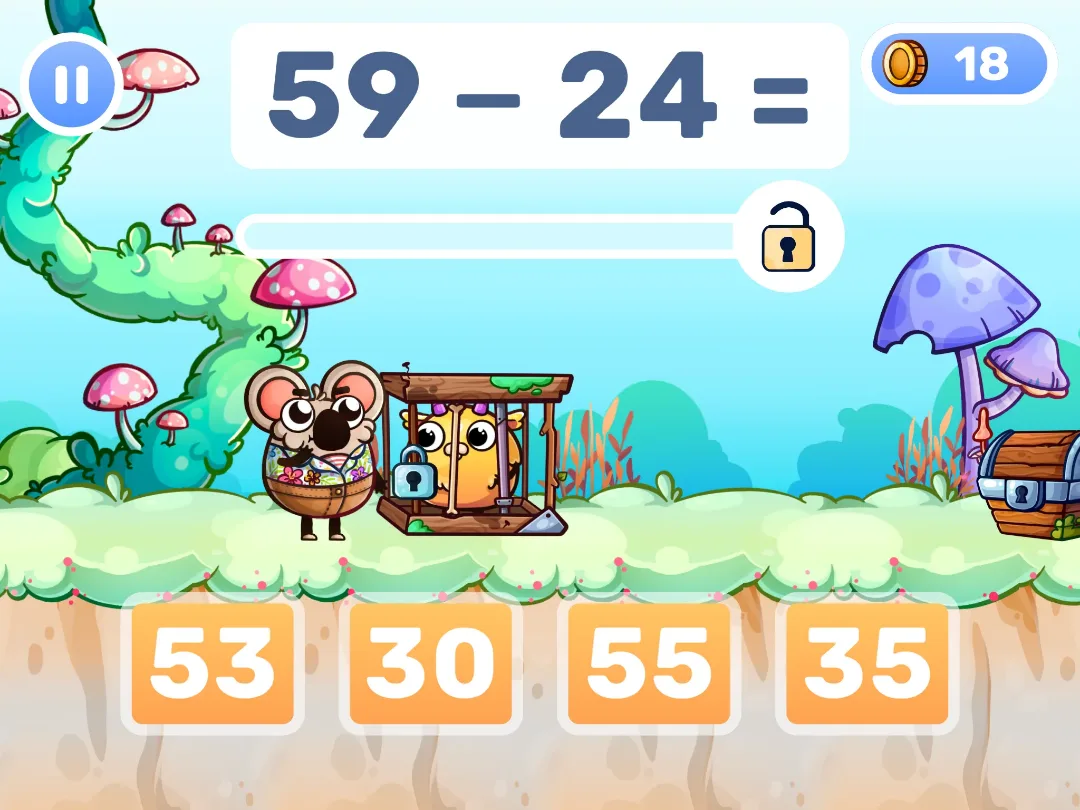
What Math Do 2nd Graders Learn?
In 2nd grade, children move from tens and ones to hundreds, from adding with objects to adding in their heads, and from counting to measuring with standard units like inches and centimeters. The Common Core State Standards name four main areas for the year: place value to 1,000, fluency with addition and subtraction, measuring with standard units, and describing shapes. This guide follows those standards and gives each one’s code, so you can match it to your child’s report card. Many states use them, some under their own name or with changes, so your school’s list can differ in details: Texas, for example, has its own standards (TEKS).
Operations and algebraic thinking (2.OA)
- Facts within 20 (2.OA.B.2). Children add and subtract within 20 fluently with mental strategies, like making ten (8 + 5 = 8 + 2 + 3 = 13), and by the end of the year they know all sums of two one-digit numbers from memory, from 0 + 0 to 9 + 9.
- Word problems within 100 (2.OA.A.1). One-step and two-step problems about adding to, taking from, putting together, taking apart and comparing, with the unknown number in any position. A two-step example: Maya has 34 stickers, gives away 12 and then gets 25 more. How many does she have now? 34 − 12 = 22, then 22 + 25 = 47.
- Even and odd (2.OA.C.3). Children decide whether a group of up to 20 objects is even or odd, by pairing them up or counting by 2s, and write an even number as a double: 14 = 7 + 7.
- Arrays (2.OA.C.4). Children find the total of objects arranged in up to 5 rows and 5 columns by adding: 3 rows of 4 is 4 + 4 + 4 = 12.
Do 2nd graders learn multiplication?
2nd grade builds the groundwork for multiplication: equal groups, arrays, repeated addition (2.OA.C.4) and skip counting by 5s, 10s and 100s. The multiplication facts come in 3rd grade, where Common Core asks children to know all products of two one-digit numbers from memory by the end of the year (3.OA.C.7), and the array of 3 rows of 4 becomes 3 × 4 = 12. When your child is ready for that step, the multiplication games are what comes next.
Number and operations in base ten (2.NBT)
- Place value to 1,000 (2.NBT.A.1). The three digits of a three-digit number are hundreds, tens and ones: 305 is 3 hundreds, 0 tens and 5 ones, and 100 is a bundle of ten tens.
- Counting and skip counting (2.NBT.A.2). Count within 1,000 and skip count by 5s (350, 355, 360), 10s (470, 480, 490) and 100s (120, 220, 320).
- Reading and writing numbers (2.NBT.A.3). Numerals, number names and expanded form: 472 is four hundred seventy-two, and 400 + 70 + 2.
- Comparing numbers (2.NBT.A.4). Compare two three-digit numbers by their hundreds, tens and ones and write the result with >, = or <: 529 < 592, because 2 tens are less than 9 tens.
- Adding and subtracting within 100 (2.NBT.B.5). Fluently, with strategies based on place value: 47 + 38 = 85 and 52 − 28 = 24. This is the main arithmetic of the year.
- Adding up to four two-digit numbers (2.NBT.B.6). 23 + 15 + 32 + 10 = 80, for example by adding the tens (20 + 10 + 30 + 10 = 70) and then the ones (3 + 5 + 2 = 10).
- Adding and subtracting within 1,000 (2.NBT.B.7). With base-ten blocks, drawings and strategies, linked to a written method: 365 + 248 = 613, 403 − 158 = 245. Children learn that hundreds go with hundreds, tens with tens and ones with ones, and that sometimes a ten or a hundred has to be composed or broken apart. Fluency within 1,000 is a 3rd grade goal (3.NBT.A.2).
- Adding or subtracting 10 and 100 in your head (2.NBT.B.8). For numbers from 100 to 900: 460 + 100 = 560, 307 − 10 = 297.
- Explaining why a strategy works (2.NBT.B.9), with place value and drawings or objects. This is why homework asks “show how you know”.
Measurement and data (2.MD)
- Length (2.MD.A.1-4). Measure with rulers, yardsticks, meter sticks and measuring tapes; measure the same object in two units and notice that it takes more of a smaller unit to measure the same length; estimate in inches, feet, centimeters and meters; find how much longer one object is than another.
- Length problems and the number line (2.MD.B.5-6). Word problems about lengths within 100, and sums and differences shown as jumps on a number line.
- Time (2.MD.C.7). Tell and write time from analog and digital clocks to the nearest five minutes, with a.m. and p.m.: the minute hand on the 5 means 25 minutes past, so 3:25 p.m. after school. 1st grade stopped at hours and half hours.
- Money (2.MD.C.8). Word problems with dollar bills, quarters, dimes, nickels and pennies, using $ and ¢: 2 quarters, 1 dime and 3 pennies make 63¢.
- Data (2.MD.D.9-10). Picture graphs and bar graphs with up to four categories, with questions like “how many more chose apples than pears?”, and line plots of measured lengths.
Geometry (2.G)
- Shapes by their attributes (2.G.A.1). Recognize and draw shapes with a given number of sides, angles or faces, and name triangles, quadrilaterals, pentagons, hexagons and cubes.
- Rows and columns (2.G.A.2). Split a rectangle into rows and columns of same-size squares and count them: 3 rows of 4 squares make 12, the same idea as an array.
- Equal shares (2.G.A.3). Split circles and rectangles into halves, thirds and fourths, and see that equal shares of the same whole can have different shapes. Fractions written as numbers, like 1/3, come in 3rd grade.
2nd Grade Math at a Glance
What Should a 2nd Grader Know at the Start and at the End of the Year?
Most 2nd graders are 7 at the start of the year and turn 8 during it. They arrive with what 1st grade covered and leave with the base for 3rd grade multiplication and fractions. The table compares the Common Core goals for the end of 1st grade, where a typical 2nd grader starts, with the goals for the end of 2nd grade.
From the start to the end of 2nd grade
| Skill | Coming in from 1st grade | By the end of 2nd grade |
|---|---|---|
| Facts | Add and subtract within 20, fluently within 10 (1.OA.C.6) | Fluently within 20; all sums of two one-digit numbers from memory (2.OA.B.2) |
| Bigger numbers | Add within 100 with models, like 34 + 5 or 34 + 20 (1.NBT.C.4) | Fluently within 100; within 1,000 with models (2.NBT.B.5, 2.NBT.B.7) |
| Place value | Tens and ones; count, read and write to 120 (1.NBT.A.1, 1.NBT.B.2) | Hundreds, tens and ones to 1,000; expanded form (2.NBT.A.1, 2.NBT.A.3) |
| Mental math | 10 more or 10 less than a two-digit number (1.NBT.C.5) | 10 or 100 more or less than a number from 100 to 900 (2.NBT.B.8) |
| Time | Hours and half hours (1.MD.B.3) | Nearest five minutes, a.m. and p.m. (2.MD.C.7) |
| Money | Not a 1st grade standard | Word problems with bills and coins (2.MD.C.8) |
| Length | Compare lengths, measure with same-size objects (1.MD.A.1-2) | Inches, feet, centimeters and meters with real tools (2.MD.A.1-4) |
| Equal shares | Halves and fourths (1.G.A.3) | Halves, thirds and fourths (2.G.A.3) |
End-of-year checklist for parents
By June, can your child:
- answer 9 + 7 and 15 − 8 without counting on fingers?
- solve 63 − 27 (36) and 47 + 38 (85), and explain the steps?
- read 608 aloud and write it as 600 + 8?
- skip count by 5s from 245, by 10s from 380 and by 100s from 60?
- say which is bigger, 437 or 473, and why?
- add or take away 10 and 100 in their head, like 560 + 100 or 402 − 10?
- solve a two-step word problem within 100?
- read 4:35 on an analog clock and say whether soccer practice after school is at 4:35 a.m. or p.m.?
- count 2 quarters, 2 dimes and a nickel (75¢)?
- measure a book in inches and in centimeters?
- split a rectangle into thirds and read a simple bar graph?
A few gaps in the spring are normal: the year’s topics keep coming back in 3rd grade. If several items are hard, our guide to whether a child is behind in math explains what to look for and when to talk to the teacher.
How Is 2nd Grade Math Tested and Graded?
Report cards by standard
Many elementary schools use standards-based report cards: instead of one grade for math, each skill (adding within 100, telling time, place value) gets its own mark. A common scale runs from 1 to 4, where 3 means your child meets the grade-level standard and 4 means they exceed it, as on the 2nd grade report card in Berkeley, California. A 3 is the goal, not a B, and some standards are marked only in the part of the year when they are taught.
Unit tests and classwork
Most of what the teacher knows comes from daily work: worksheets, math journals, quick checks on whiteboards and a short test at the end of each unit. These show how your child solves a problem, which matters as much as the answer in 2nd grade, because the standards ask children to explain why a strategy works (2.NBT.B.9).
Benchmark tests at the start, middle and end of the year
Many schools also give a computer test a few times a year to see where each child stands and how much they have grown. Two common ones are NWEA MAP Growth, which is taken up to three times a year, usually at the start of the school year, halfway through and near the end, and i-Ready, whose diagnostic is now called i-Ready Inform. Both are adaptive: the questions get harder or easier depending on your child’s answers, so a score is not a percentage correct. Ask the teacher what the score means and compare it with your child’s own earlier scores.
State tests start in 3rd grade
Federal law requires yearly state tests in math from 3rd grade through 8th grade, so most 2nd graders do not take the state math test yet. 2nd grade is when the skills those tests build on, like place value and fluency within 100, are laid down.
Timed fact checks and what fluency means
Some teachers give short timed sheets of addition and subtraction facts, sometimes called a “mad minute”. They connect to standard 2.OA.B.2, which asks children to add and subtract within 20 fluently and, by the end of 2nd grade, to know all sums of two one-digit numbers from memory. The standard sets no time limit. The Common Core introduction to grade 2 describes the methods children should develop as efficient, accurate and generalizable, and the National Council of Teachers of Mathematics defines fluency as using procedures efficiently, flexibly and accurately. Experts disagree on timed practice: NCTM advises against timed tests, while the federal What Works Clearinghouse recommends regular timed activities as one way to build fluency for students who struggle. Our article on math fact fluency and timed tests goes into the research.
What Do 2nd Graders Struggle With in Math?
Most 2nd grade sticking points come down to place value or to keeping track of more than one step. Here is what each one looks like on homework and one thing that helps.
1. Regrouping: 52 − 28
What it looks like: your child writes 36. In the ones, they took the smaller digit from the bigger one, 8 − 2 = 6, instead of trading a ten to find 12 − 8. What helps: build 52 as 5 tens and 2 ones with sticks, coins or drawings, and trade one ten for 10 ones. Now there are 4 tens and 12 ones: 12 − 8 = 4 and 4 tens − 2 tens = 2 tens, so 24. Checking with addition, 24 + 28 = 52, catches the mistake. Practice it on the 2-digit subtraction games.
2. Place value and zeros: 305
What it looks like: “three hundred five” gets written as 3005 or 35, because the child writes 300 and then 5, or skips the empty tens. Subtracting across a zero, like 305 − 128, is harder still. What helps: a place value chart with three columns, hundreds, tens and ones, and expanded form: 305 = 300 + 0 + 5. The 0 holds the tens place so the 3 still means 3 hundreds. For 305 − 128, trade 1 hundred for 10 tens first, then 1 of those tens for 10 ones.
3. Two-step word problems
What it looks like: 45 kids are on the bus; at the first stop 12 get off and 8 get on. How many are on the bus now? Your child stops after 45 − 12 = 33, or adds all three numbers. What helps: act it out or draw it, one step at a time: “What happened first? What happened next?” Then 33 + 8 = 41. A tape diagram (also called a bar model) shows which part is missing.
4. Telling time to five minutes
What it looks like: the minute hand points at the 5 and your child says “five” instead of 25 minutes. Or at 2:50, with the hour hand almost on the 3, they read 3:50. What helps: count by 5s around a clock with hands, and remember that the hour hand shows the hour it has passed, not the one it is heading to. Ask “what time is it?” at real moments of the day, like breakfast and bedtime.
5. Counting money
What it looks like: each coin is counted as one, or a nickel is taken to be worth more than a dime because it is bigger. What helps: sort the coins from the biggest value to the smallest and count on: a quarter, two dimes, a nickel and two pennies are 25, 35, 45, 50, 51, 52 cents. Let your child pay with real coins at the store.
How to Help Your 2nd Grader with Math at Home
- Facts to 20, a few minutes a day. Short, regular practice works better than a long session once a week. Start with the facts that cross 10, like 8 + 5 and 13 − 5: the making 10 games and the addition and subtraction within 20 games cover them, and every bigger problem in 2nd grade reuses them.
- Money in daily life. Let your child count the coins in a jar, pay at a store, or work out what two snacks cost together.
- Time on a clock with hands. Ask what time it is, and how many minutes until dinner at 6:00. An analog clock at home lets your child practice reading the hour and minute hands every day.
- Measure things. Guess first, then measure: how many inches is your shoe, how many feet is the couch?
- Count in the car. Skip count by 5s, 10s or 100s from any number, forwards and backwards: 230, 330, 430, then back.
- Ask how they got the answer. School teaches several strategies for 47 + 38, like adding tens and ones separately or jumping on a number line. Asking your child to explain keeps you on the same page as the teacher. Our guide to the methods your child brings home shows the common ones, and our mental math strategies article has more.
- Play. The games on this page practice addition and subtraction within 20, 100 or 1,000, and board games with dice or cards practice the same facts. For homework time, see how to help with math homework, and for apps, our list of the best math apps for 2nd graders.
Learn 2nd Grade Math with the MathHero App
How is the MathHero app different from the online games on this page?
The online games on this page are mini-games for short addition and subtraction practice. The MathHero app is a full math adventure with step-by-step learning programs, rewards for your hero and saved progress for each child. If your child enjoys these mini-games, try the app: you can play 5 levels a day for free, with no ads and nothing locked.
What Parents Say About the MathHero App
Verbatim from public App Store and Google Play reviews of the MathHero app, with spelling as written. Rated 4.7 on Google Play (48.2K reviews) and 4.6 on the App Store (12K ratings), checked .
“2nd grader loved this! It helped to solidify her math facts and she had fun practicing her math at the same time.”
“My 7 yr old loves this! She doesn't realize that she's learning at the same time!”
“Using this app is way more enjoyable for my child than math drills. It is a great way to practice math facts. I also love the fact that you can choose which skills you want your child to work on rather than working on all of them at once.”
2nd Grade Math: Common Questions
What math do 2nd graders learn?
Under the Common Core standards, 2nd grade math has four main parts: place value to 1,000, addition and subtraction (facts within 20 with mental strategies and one-digit sums from memory, fluently within 100, within 1,000 with models), measuring length in standard units, and shapes. Children also tell time to the nearest five minutes, solve money word problems, read picture graphs, bar graphs and line plots, sort numbers into even and odd, and use arrays as groundwork for multiplication.
What should a 2nd grader know by the end of the year?
By the end of 2nd grade, a child should know all sums of two one-digit numbers from memory, like 8 + 7 = 15, and add and subtract fluently within 100, like 52 − 28 = 24. They should read, write and compare numbers to 1,000, skip count by 5s, 10s and 100s, and add and subtract within 1,000 with models or drawings. They should also tell time to the nearest five minutes with a.m. and p.m., solve money word problems with coins and dollar bills, and measure in inches, feet, centimeters and meters.
Do 2nd graders learn multiplication?
2nd graders build the groundwork for multiplication, and the multiplication facts follow in 3rd grade. In 2nd grade, children find the total of an array with up to 5 rows and 5 columns by repeated addition, like 4 + 4 + 4 = 12 for 3 rows of 4 (Common Core standard 2.OA.C.4), skip count by 5s, 10s and 100s, and sort numbers into even and odd. In 3rd grade, Common Core asks them to know all products of two one-digit numbers from memory by the end of the year.
Is 2nd grade math hard?
2nd grade math is a big step up for many children: the numbers grow from 120 to 1,000, subtraction with regrouping arrives, and word problems can take two steps. Most of it builds on 1st grade, so a child who knows the facts within 20 well has an easier year, because every bigger problem reuses them. Short, regular practice and everyday math with money and clocks make the new parts feel familiar.
What do 2nd graders struggle with in math?
The usual sticking points are subtraction with regrouping (like 52 − 28), zeros in place value (like 305), two-step word problems, telling time to five minutes and counting mixed coins. Most of these come down to place value or to doing one step at a time, so base-ten blocks, real coins, an analog clock and drawing the problem help.
What math should a 7-year-old know?
Most 7-year-olds in the US are finishing 1st grade or in 2nd grade. 2nd grade math means quick facts within 20, with one-digit sums from memory, adding and subtracting within 100, place value to 1,000, time to the nearest five minutes, counting money and measuring length in inches and centimeters. A 7-year-old who is still working on facts within 20 or on tens and ones is often right where 1st grade leaves off.
How can I help my 2nd grader with math?
Practice the facts within 20 for a few minutes most days, ideally with a game, and use money, clocks and rulers in daily life: let your child count the coins, read the kitchen clock and measure things. When they solve a problem, ask how they got the answer, because school teaches several strategies and explaining one builds understanding. Talk with the teacher if one topic stays hard for several weeks.
Are timed math tests normal in 2nd grade?
Some 2nd grade teachers give short timed fact checks, sometimes called a mad minute, because the standard asks children to know all sums of two one-digit numbers from memory by the end of the year. The Common Core standard itself sets no time limit. Experts disagree about timed practice: the National Council of Teachers of Mathematics advises against timed tests, while the federal What Works Clearinghouse recommends regular timed activities as one way to build fluency for students who struggle.
What is regrouping in 2nd grade math?
Regrouping means trading 10 ones for a ten, or 10 tens for a hundred, when adding or subtracting place by place. In 47 + 38, the ones make 15, so 10 of them become a new ten and the answer is 85. In 52 − 28, a ten is traded for 10 ones to take away the 8: 12 − 8 = 4, then 4 tens − 2 tens = 2 tens, and the answer is 24. It used to be called carrying and borrowing.
What is an array in 2nd grade math?
An array is a set of objects arranged in equal rows and columns, like eggs in a carton or 3 rows of 4 stickers. 2nd graders find the total by repeated addition, 4 + 4 + 4 = 12, and write it as an equation; Common Core standard 2.OA.C.4 uses arrays with up to 5 rows and 5 columns. In 3rd grade, the same array becomes the multiplication fact 3 × 4 = 12.
What is the hardest 2nd grade math problem?
There is no single hardest problem, but subtraction within 1,000 that regroups across a zero, like 403 − 158 = 245, and two-step word problems within 100 are often the toughest. In 403 − 158, the tens place is empty, so a hundred becomes 10 tens first, and then one of those tens becomes 10 ones. Drawing the hundreds, tens and ones, or counting up from 158 to 200, then to 400 and 403, makes it manageable.
Are these online 2nd grade math games free?
Yes. The online games on this page are free to play in your browser on a phone, tablet or computer, with no account, no download and no ads. The MathHero app is free too, at 5 levels a day with nothing locked, and a subscription with a 7-day free trial removes the daily limit.
About This Page
Last updated · App ratings checked
- Common Core State Standards: Grade 2 Mathematics
- Common Core State Standards for Mathematics (full document, grades 1 to 3)
- Common Core State Standards: Grade 1 Mathematics
- Common Core State Standards: Grade 3 Mathematics
- Berkeley Unified School District: Family Guide for the 2nd Grade Report Card
- NWEA: MAP Growth 101, everything families need to know
- Curriculum Associates: i-Ready Inform announcement
- Congressional Research Service: Educational Assessment and the Elementary and Secondary Education Act
- NCTM: Procedural Fluency in Mathematics
- What Works Clearinghouse: Assisting Students Struggling with Mathematics (2021)
- MathHero on the App Store
- MathHero on Google Play