

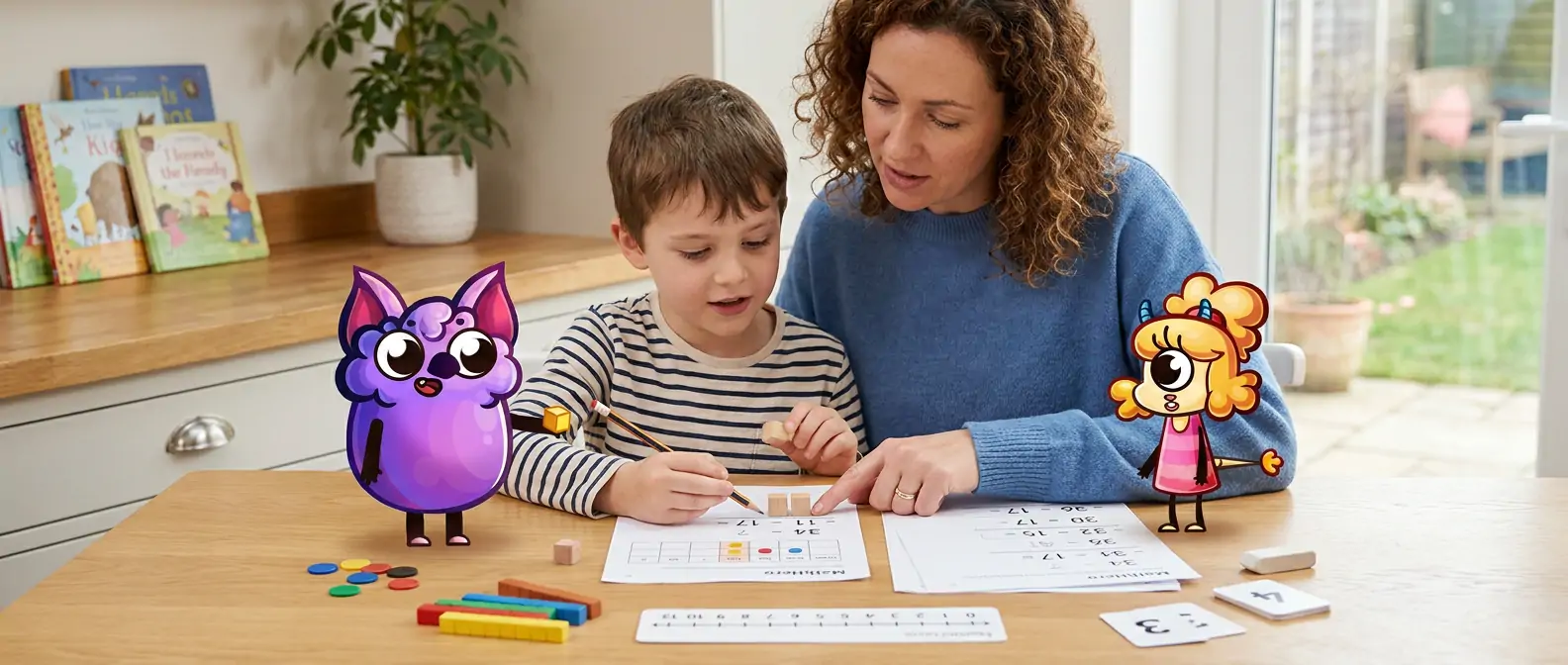
You're watching your kid stare at a math worksheet. Their pencil hasn't moved, frustration is building, and you start to wonder: Are they falling behind in math, or is this just a tough week? It's a question many parents have asked, and it's a fair one! But before we can determine whether a child is behind in math, we need to understand what they're expected to know at their grade level.
As a math teacher, I've seen how one missing skill can make learning new concepts feel so much more challenging than they should. But I have also seen what happens when we identify those gaps and give students the support they need.
Let's talk about what it actually means to be behind in math, some signs to look for, and what you can do to help build your child's mathematical confidence and understanding.
What "behind in math" actually means
When we say a child is "behind in math," we're usually talking about gaps in the skills and concepts they're expected to understand based on grade-level standards.
For example, second-grade math standards include adding and subtracting within 100 using strategies based on place value and number relationships. By the end of third grade, students are expected to know their single-digit multiplication facts from memory.
But here's something important: one difficult assignment or one skill your child hasn't mastered doesn't necessarily mean they're behind in math overall.
Math understanding develops over time, and students don't all learn at exactly the same pace. What we want to look for are patterns. Are there specific skills your child continues to struggle with? Are those difficulties making it harder for them to understand what they're learning now?
Math concepts build on one another. Understanding addition helps students make sense of multiplication. Multiplication and division support later work with fractions, ratios, and algebra. Think of it like building a house. If the foundation has a few weak spots, adding another floor isn't going to fix them.
Research has even found that students' understanding of fractions and division in elementary school is an important predictor of their later success in algebra and high school mathematics.
That's why identifying gaps early can be so helpful. Instead of continuing to pile new information on top of something a child doesn't understand, we can go back and strengthen the foundation.
Signs your child might be struggling in math
Sometimes the signs show up on a test or report card. Other times, you'll notice them at home long before you see a change in grades.
Here are a few things to watch for:
- Homework regularly ends in frustration. A child who becomes upset during math homework may be struggling to understand the material, not simply refusing to do the work.
- They avoid math whenever possible. Maybe they suddenly have a million reasons why they can't start their assignment. Avoidance can sometimes be connected to frustration or math anxiety.
- They struggle with number sense. Understanding quantities, comparing numbers, or recognizing number relationships may be difficult.
- Basic math facts require a lot of effort. They may still need to work through facts that are expected to become more automatic at their grade level.
- Word problems feel overwhelming. Your child may know how to calculate an answer but struggle to figure out what the problem is asking.
- Their math performance is changing. A pattern of declining grades or repeated difficulty with the same types of problems may be worth investigating.
Keep in mind that none of these signs, on its own, tells you exactly what's happening. A child who is struggling in math isn't necessarily a child who isn't trying. Sometimes they're working incredibly hard, but there's a missing piece that makes everything else feel difficult. Our job is to figure out what that missing piece might be!
When math facts aren't automatic
Math fact fluency is an important part of building a strong foundation. When students become more comfortable with basic addition, subtraction, multiplication, and division facts, they can focus more of their attention on solving complex problems.
Think about reading. When you recognize familiar words automatically, you can spend more energy understanding what you're reading instead of sounding out every word. Math fact fluency works in a similar way.
If your child is struggling with fact fluency, pay attention to how they're finding their answers. Are they using number relationships? Counting every object one at a time? Guessing? Those observations can tell you much more than simply timing how quickly they respond.
Early on, a child might solve 8 + 7 by thinking, "8 + 2 makes 10, and then I have 5 more, so the answer is 15." That's a great strategy! They're using their understanding of numbers to find the answer. Over time, with meaningful practice, many of those facts can become more automatic.
Here's something you can try at the kitchen table. Give your child a few math facts and ask them to explain how they're finding their answers. Are they using number relationships? Counting one by one? Trying to remember a fact they've practiced before?
Pay attention to their strategies and where they seem to get stuck. When students have to spend a lot of time working through basic math facts, it can leave less mental energy for understanding and solving more challenging problems. That's why building fact fluency is so important!
For practice, I recommend starting small. Five to ten minutes of focused practice can be a manageable way to build consistency without making math feel overwhelming. Over time, consistent practice can help students recall those facts more automatically, making it easier to focus on more challenging math concepts.
When new math concepts aren't making sense
Have you ever watched your child struggle with a new math topic and thought… I don't understand why this is so hard for them. Sometimes the difficulty isn't actually with the new concept. It's with something they learned before it.
For example, a student who struggles with multiplication facts may find long division especially challenging. A student who doesn't have a strong understanding of place value may struggle when learning to regroup during subtraction.
As a seventh-grade math teacher, I see this all the time. Students are expected to work with rational numbers, proportions, and algebraic expressions, but sometimes the difficulty comes from a foundational skill they learned years earlier. When this happens, I don't want to keep giving them harder problems and hoping something eventually clicks. I want to figure out what they already understand and build from there.
At home, you can do the same thing. Ask your child to show you how they're solving a problem. Listen to their explanation, even if their answer is incorrect. Sometimes their thinking will help you identify exactly where the confusion begins.
You don't necessarily have to stop learning new material altogether. A combination of reviewing foundational skills and continuing to work with current concepts can help your child make progress in both areas.
Look for patterns in your child's schoolwork
One of the easiest places to start is with the work your child has already completed. Look at a few recent assignments, quizzes, or tests and check for patterns.
Are they missing almost every subtraction problem that involves regrouping? Do they understand multiplication but struggle when it appears in a word problem? Are their mistakes related to calculation, or do they misunderstand what the question is asking?
Those are very different situations, and they may need different types of support. You can also look at your child's grade-level math standards to get a better understanding of what they're expected to learn.
Just remember that standards describe learning goals, not a guarantee that every student will master every skill on the same day. Your child's teacher can help you interpret their performance and decide which areas need the most attention.
How to assess whether your child is behind in math
If you're concerned about your child's math progress, I recommend gathering information from a few different places.
- Start with classroom assessments. Look at recent quizzes, tests, and assignments. Pay attention to the types of questions your child misses rather than focusing only on the overall grade.
- Consider a diagnostic assessment. Some schools and math programs use diagnostic assessments to identify students' strengths and areas for growth. These assessments can be helpful because they provide a more detailed picture of what a student understands and which skills may need additional instruction.
- Talk with your child's teacher. This might be the most important step! Teachers can help explain how your child is progressing toward grade-level expectations and whether the difficulties you're noticing at home are also showing up in the classroom.
You might ask your child's teacher:
- What math skills does my child seem to understand well?
- Are there specific skills they continue to struggle with?
- Are those gaps affecting their ability to learn current material?
- What can we practice at home that would be most helpful?
You don't have to figure everything out on your own. Working together with your child's teacher can help you create a plan that actually addresses what your child needs.
Make a list of the skills that need attention
Once you have a better understanding of where your child is struggling, make a short list of the specific skills they need to work on. I really do mean specific!
Instead of writing "needs help with math," try something like "needs help with":
- Understanding place value
- Subtracting with regrouping
- Multiplication facts for 6, 7, and 8
- Solving multiplication word problems
Now you have something you can work with. The next step is to think about which skills are connected. For example, if your child is struggling with subtraction with regrouping, it may help to revisit place value before practicing the subtraction algorithm. If long division is difficult, take a look at their understanding of multiplication and division facts.
We want to work on the skills that will help unlock other concepts, not simply go back and repeat everything they've ever learned. Remember, you don't have to fix every gap at once. Choose one or two areas to focus on and build from there.
Do you need to change your child's math curriculum?
Not necessarily!
If your child is struggling with math, it can be tempting to start searching for an entirely different curriculum. But sometimes the better solution is to provide additional instruction or practice in a specific area.
All kids learn differently, so you may need to try a few different strategies before one clicks with your child. There are different approaches to organizing math instruction. A mastery-based curriculum, such as Math-U-See, typically allows students to spend more time developing a particular skill before moving on. A spiral curriculum revisits concepts over time, giving students repeated opportunities to practice and build on what they've learned.
Both approaches can be helpful, depending on the child and how the instruction is implemented. But if your child is enrolled in school, changing the entire curriculum probably isn't the first step.
Instead, talk with their teacher about the specific skills that need attention. Supplemental instruction, hands-on activities, or targeted practice may be enough to help your child make progress while continuing with their regular classroom instruction.
Strategies for building math fact fluency
Once you've identified the skills your child needs to practice, the next question is usually, Okay, but how do I actually get them to practice? Because we all know that convincing a child to sit down and complete another worksheet after they've already spent the day at school isn't always easy. In fact, student motivation is one of the biggest challenges that teachers face!
Here are a few strategies I recommend:
- Keep practice short and consistent. Try five to ten minutes at a time instead of one long practice session.
- Focus on a small group of facts. If your child is only struggling with their 7s and 8s multiplication facts, you don't necessarily need to review all multiplication facts.
- Teach strategies, not just memorization. For example, if your child knows that 10 × 7 = 70, they can use that fact to find 9 × 7 by subtracting one group of 7.
- Use visual models when needed. Arrays, number lines, counters, and drawings can help connect the relationships between numbers.
- Celebrate growth! Maybe your child can now solve a fact using a strategy that confused them last week. That's progress worth recognizing!
Remember, the goal isn't to see how quickly your child can memorize a list of answers. We want them to understand how numbers work and become more confident using that understanding.
When math practice feels like play
One of the biggest challenges with helping a child who struggles in math is finding a way to make practice something they don't dread. That's where educational games can be helpful!
MathHero is designed to give children opportunities to practice arithmetic skills through a story-driven adventure. Instead of working through a traditional worksheet, children solve math problems to move through the game, rescue characters, and collect coins.
One feature I especially like is the ability for parents to customize the practice. For example, if your child needs help with their 7s and 8s multiplication facts, you can focus on those facts rather than having them practice every multiplication table. Parents can also adjust the difficulty, monster speed, and whether children type their answers or select from multiple-choice options. That flexibility can be useful when you're trying to target a specific skill.
MathHero focuses on core arithmetic skills, including addition, subtraction, multiplication, and division, and is designed primarily for children around ages 5–10.
MathHero is a practice tool, not a replacement for math instruction.
If your child doesn't understand what multiplication means, for example, they'll still need opportunities to explore equal groups, arrays, and other visual representations. Once they begin to understand the concept, a game like MathHero can give them another way to practice those skills.
The game also doesn't cover every elementary math topic. Fractions, geometry, and equations aren't part of its current arithmetic-focused content.
The full game can be completed for free, with a limit of five levels per day. A subscription, which includes a free trial, removes that daily limit. Families with multiple children can also create separate profiles with different topics and difficulty settings. For parents looking for a way to make short, consistent math practice feel a little more like play, it's an option worth exploring!
Know which facts your child needs? Set MathHero to just those facts and keep practice to a few minutes a day.
Explore MathHeroWhat if your child is significantly behind?
Sometimes a child needs more support than a few minutes of practice at home.
If your child is struggling across several math topics, has persistent gaps in foundational skills, or isn't making progress despite additional support, it's a good idea to talk with their teacher about next steps. Depending on your child's needs, that might include small-group instruction, targeted intervention, or tutoring.
Research has found that tutoring can have a meaningful positive impact on student learning, particularly when instruction is consistent and focused on students' needs. In some situations, the school may also recommend an evaluation to better understand whether a learning disability, attention-related difficulty, or another factor is affecting your child's progress.
An evaluation isn't about putting a label on a child. It's about understanding how they learn and identifying the support that may help them succeed. If additional support is needed, try setting small, measurable goals.
Instead of "get better at math," a goal might be "use a strategy to solve multiplication facts involving 6 and 7 with increasing accuracy and independence." That gives everyone something specific to work toward and a way to recognize progress.
Keep communicating with your child's teacher
I cannot emphasize this enough: you and your child's teacher are on the same team! As a teacher, I appreciate when parents reach out with questions about their child's learning.
You see things at home that I might not see in the classroom, and I see things during instruction that you might not notice during homework. When we share that information, we can get a much clearer picture of what a student needs.
Ask about specific skills, available interventions, and strategies you can use at home. Then check back in after a few weeks to see whether your child is making progress or whether the plan needs to change. And please don't feel like you have to become your child's full-time math teacher! Sometimes the most helpful thing you can do is provide encouragement, make time for a little practice, and keep communication open with their teacher.
Sources
- Duncan, G. J., et al. (2007). School readiness and later achievement. Developmental Psychology, 43(6), 1428–1446.
- Siegler, R. S., et al. (2012). Early predictors of high school mathematics achievement. Psychological Science, 23(7), 691–697.
- Common Core State Standards Initiative. Grade 2: Number & Operations in Base Ten, 2.NBT.B.5 (fluently add and subtract within 100).
- Common Core State Standards Initiative. Grade 2: Operations & Algebraic Thinking, 2.OA.A.1 (one- and two-step word problems within 100).
- Common Core State Standards Initiative. Grade 3: Operations & Algebraic Thinking, 3.OA.C.7 (fluently multiply and divide within 100).
- Nickow, A., Oreopoulos, P., & Quan, V. (2020). The impressive effects of tutoring on PreK-12 learning: A systematic review and meta-analysis of the experimental evidence. NBER Working Paper 27476.
- Math-U-See. Math-U-See curriculum.
