
2-Digit Addition Games for Kids
Practice two-digit addition within 100 with free MathHero adventure games for kids, right in your browser: adding tens like 40 + 30, then sums like 34 + 5 and 47 + 38, with or without regrouping. It all comes down to tens and ones: in 23 + 45, the tens make 20 + 40 = 60, the ones make 3 + 5 = 8, and 60 + 8 = 68. No account, no download, no ads.
- Sums up to 100
- With or without regrouping
- Grades 1-2 · ages 6-8
- Free in the browser
- No account, no download
- No ads
- Phone, tablet and computer
Pick a 2-Digit Addition Game to Play
Practice Another Addition Skill
Get MathHero: The Full Adventure
Keep practicing in the MathHero app: a story-driven math game for ages 5-10, from first addition to division.
- Step-by-step learning programs such as “Addition to 100” that add new problems a little at a time
- Custom Practice: addition and subtraction up to 10, 20, 100 or 1,000
- Typed answers or multiple choice, in Easy, Medium or Hard mode
Free at 5 levels a day, with no ads.

How the 2-Digit Addition Games Work
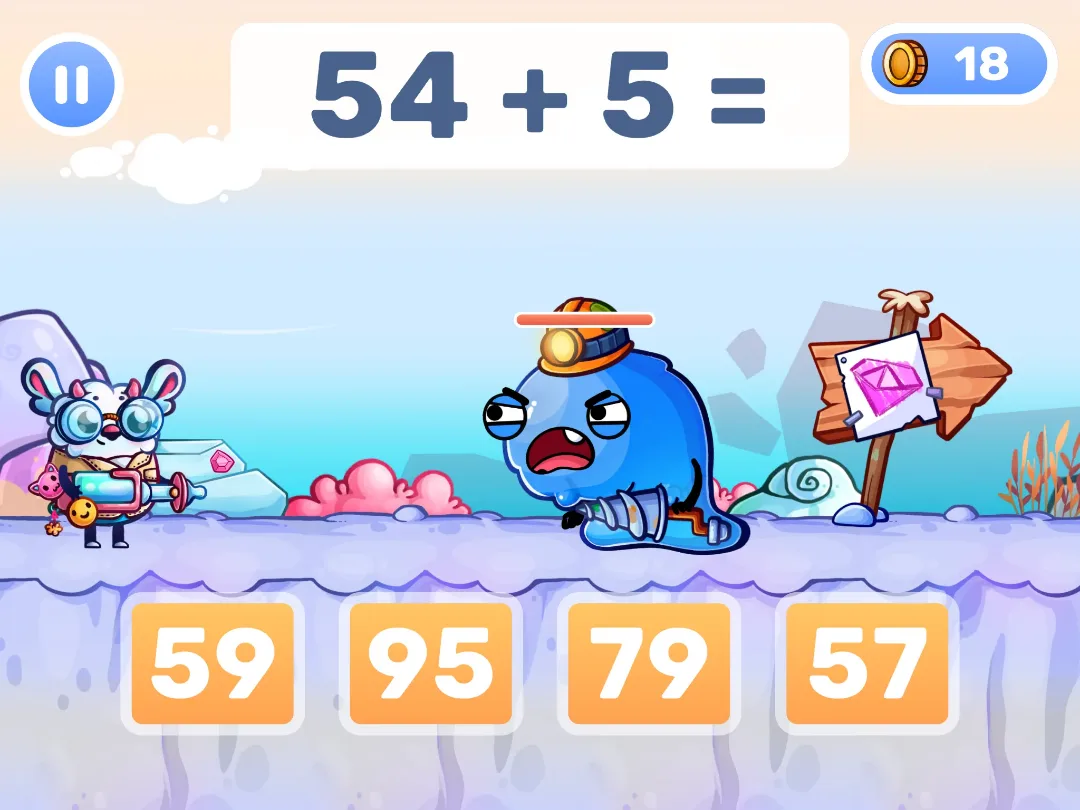
Every action in a MathHero adventure is an addition problem to solve, and every sum stays within 100. Before the first level, each game on this page opens an options screen, “Choose your problems”, with a list of three kinds of problem, all ticked to begin with:
- Adding tens: like 40 + 30 or 23 + 30, where only the tens change.
- 2-digit + 1-digit: like 34 + 5.
- 2-digit + 2-digit: like 23 + 45.
The kinds you pick come about equally often, and so do problems where the ones add up to less than 10, as in 23 + 45, and to 10 or more, as in 47 + 38. Under the list, a No regrouping checkbox, off to begin with, keeps only problems like 23 + 45, for a child who has not learned regrouping yet. It shows only while 2-digit + 1-digit or 2-digit + 2-digit is ticked, because adding tens leaves the ones as they are. Untick what your child doesn't need yet, then tap Play. The pick is remembered for the other adventures on this page and for your next visit.
No level gets harder over time: every level draws from the problems you picked. Your child taps one of four answers, and every right answer moves the adventure forward.
MathHero has no video lessons. It builds the skill through practice, so the games work best once your child knows what tens and ones are and the addition facts to 20 come quickly; practice those with our addition to 20 games. For a guided path, the “Addition to 100” learning program in the MathHero app adds new problems a little at a time.
How to Learn 2-Digit Addition
To add two-digit numbers, split each number into tens and ones, add the tens, add the ones, and put the two together. When the ones add up to 10 or more, regroup: 10 ones make 1 new ten. Every 2-digit sum hides a one-digit fact, like 7 + 8 inside 47 + 38, so the addition facts to 20 need to be quick first.
Tens and ones
Every two-digit number is made of tens and ones: 23 is 2 tens and 3 ones, and 45 is 4 tens and 5 ones. Add tens to tens and ones to ones: 2 tens + 4 tens = 6 tens, or 60, and 3 + 5 = 8. Together, 23 + 45 = 68. Base-ten blocks make this easy to see: a rod is a ten, and a cube is a one.
Add the tens first: 10 more
Adding tens is like adding ones, only with tens: 4 tens + 3 tens = 7 tens, so 40 + 30 = 70. Adding tens to any number changes only its tens digit: 10 more than 23 is 33, and 23 + 30 = 53. On the hundred chart below, every +10 is one row down. Being able to find 10 more in their head, without counting, is a 1st grade goal.
Add a one-digit number
In 34 + 5, the tens stay and only the ones change: 4 + 5 = 9, so 39. When the ones pass 10, the answer moves into the next ten. For 38 + 7, make a ten: 38 + 2 = 40, and 5 more is 45. It is the same make a ten your child uses for 8 + 7 = 15.
Regrouping, step by step: 47 + 38
Regrouping, also called carrying, is needed when the ones add up to 10 or more. Here is 47 + 38 the way it is written in columns:
- Add the ones: 7 + 8 = 15.
- 15 ones are 1 ten and 5 ones. Write the 5 in the ones place and carry the 1 ten over to the tens.
- Add the tens, with the carried ten: 4 + 3 + 1 = 8 tens.
- 8 tens and 5 ones make 85, so 47 + 38 = 85.
In the head, tens first works just as well: 40 + 30 = 70, 7 + 8 = 15, and 70 + 15 = 85. To check, round: 47 is close to 50 and 38 is close to 40, so the answer should be close to 90.
Common mistakes
- 715 for 47 + 38. Your child added the tens, 4 + 3 = 7, and the ones, 7 + 8 = 15, and wrote both down whole: 7 and 15 make 715. Only the 5 stays in the ones place; the 1 is a ten and goes to the tens. A quick check catches it: 47 + 38 is less than 50 + 50 = 100, so a three-digit answer can't be right.
- 75 for 47 + 38. Your child wrote the 5 but forgot the carried ten, so the tens came out as 4 + 3 = 7 instead of 4 + 3 + 1 = 8. A simple rule helps: when the ones make 10 or more, the tens get one extra. Rounding catches it too: the answer should be close to 50 + 40 = 90, and 85 is much closer than 75.
Wondering why your child's homework splits numbers into tens and ones? See expanded form in our guide to new math.
Hundred Chart 1-100
On a hundred chart, each row is one ten. One step right adds 1, and one row down adds 10: the number below has one more ten and the same ones digit. So 2-digit addition becomes a path. For 23 + 45, start at 23, go four rows down for the 4 tens (33, 43, 53, 63), then five steps right for the 5 ones (64 to 68).
Regrouping is the step where the ones pass 9 and make a new ten. For 47 + 38, go three rows down to 77 for the 3 tens, then eight steps right for the 8 ones: 78, 79, then 80, where the ones 7 + 3 have made a new ten, and 81 to 85 for the 5 ones left. The new ten is made at 80, in the step from 79, not where the row ends: on this chart the rows run from 1 to 10, 11 to 20 and on, so 80 closes its row and the next step, to 81, simply starts the row below.
| 1 | 2 | 3 | 4 | 5 | 6 | 7 | 8 | 9 | 10 |
| 11 | 12 | 13 | 14 | 15 | 16 | 17 | 18 | 19 | 20 |
| 21 | 22 | 23 | 24 | 25 | 26 | 27 | 28 | 29 | 30 |
| 31 | 32 | 33 | 34 | 35 | 36 | 37 | 38 | 39 | 40 |
| 41 | 42 | 43 | 44 | 45 | 46 | 47 | 48 | 49 | 50 |
| 51 | 52 | 53 | 54 | 55 | 56 | 57 | 58 | 59 | 60 |
| 61 | 62 | 63 | 64 | 65 | 66 | 67 | 68 | 69 | 70 |
| 71 | 72 | 73 | 74 | 75 | 76 | 77 | 78 | 79 | 80 |
| 81 | 82 | 83 | 84 | 85 | 86 | 87 | 88 | 89 | 90 |
| 91 | 92 | 93 | 94 | 95 | 96 | 97 | 98 | 99 | 100 |
Highlighted: the path for 23 + 45 = 68, four rows down and five steps right. All the numbers in a column end in the same digit, because +10 changes only the tens. The games on this page practice sums up to 100.
What Grade Learns 2-Digit Addition?
Two-digit addition starts in 1st grade in the US and becomes fluent in 2nd grade, usually at ages 6-8. Common Core standard 1.NBT.C.4 asks 1st graders to add within 100, including a two-digit number and a one-digit number, and a two-digit number and a multiple of 10, and 1.NBT.C.5 asks them to find 10 more or 10 less than a number in their head. Standard 2.NBT.B.5 asks 2nd graders to add and subtract within 100 fluently. In England, Year 2 children add a two-digit number and ones, a two-digit number and tens, and two two-digit numbers, and in Year 3 they move on to columnar addition with up to three digits.
- Age
- 6-8
- US grade
- Grades 1-2
- Standard
- Common Core 1.NBT.C.4, 2.NBT.B.5
- England
- Year 2
What Parents Say About MathHero
Verbatim from public App Store and Google Play reviews of the MathHero app, with spelling as written. Rated 4.7 on Google Play (48.2K reviews) and 4.6 on the App Store (12K ratings), checked .
“2nd grader loved this! It helped to solidify her math facts and she had fun practicing her math at the same time.”
“Using this app is way more enjoyable for my child than math drills. It is a great way to practice math facts. I also love the fact that you can choose which skills you want your child to work on rather than working on all of them at once.”
“Kids says it's fun and they can practice math facts and it's not boring. My daughter has to do homework and we use the game instead of flashcards.”
2-Digit Addition Games: Common Questions
What are the best free 2-digit addition games for kids?
How do you add two-digit numbers?
What is the difference between addition with and without regrouping?
What grade learns 2-digit addition?
Can my child practice only adding tens?
Are MathHero's 2-digit addition games free?
Do the 2-digit addition games work on a tablet or phone?
Does MathHero teach how to regroup?
About This Page
Last updated · App ratings checked