
Subtraction Within 20 Games for Kids
Practice subtraction facts to 20 with free MathHero adventure games for kids, right in your browser: all 190 facts within 20, like 17 − 4 and 13 − 5. When the ones run out, go down to 10 first: 13 − 5 = 13 − 3 − 2 = 8. Play all of them, or only the facts with or without crossing 10. No account, no download, no ads.
- All 190 facts within 20
- With or without crossing 10
- Grades 1-2 · ages 6-8
- Free in the browser
- No account, no download
- No ads
- Phone, tablet and computer
Pick a Subtraction Within 20 Game to Play
All facts to begin with. Pick “Without crossing 10” for facts like 17 − 4, or “Crossing 10 only” for facts like 13 − 5.
Practice Another Subtraction Skill
Start with facts within 10, move up to two-digit numbers, or practice the addition facts and pairs to 10 that make subtraction within 20 quick.
Get MathHero: The Full Adventure
Keep practicing in the MathHero app: a story-driven math game for ages 5-10, from first addition to division.
- Step-by-step learning programs: Addition & Subtraction up to 10, Subtraction up to 20 and Subtraction up to 100 add new facts a little at a time
- Custom Practice: addition and subtraction up to 10, 20, 100 or 1,000
- Typed answers or multiple choice, in Easy, Medium or Hard mode
Free at 5 levels a day, with no ads and nothing locked.

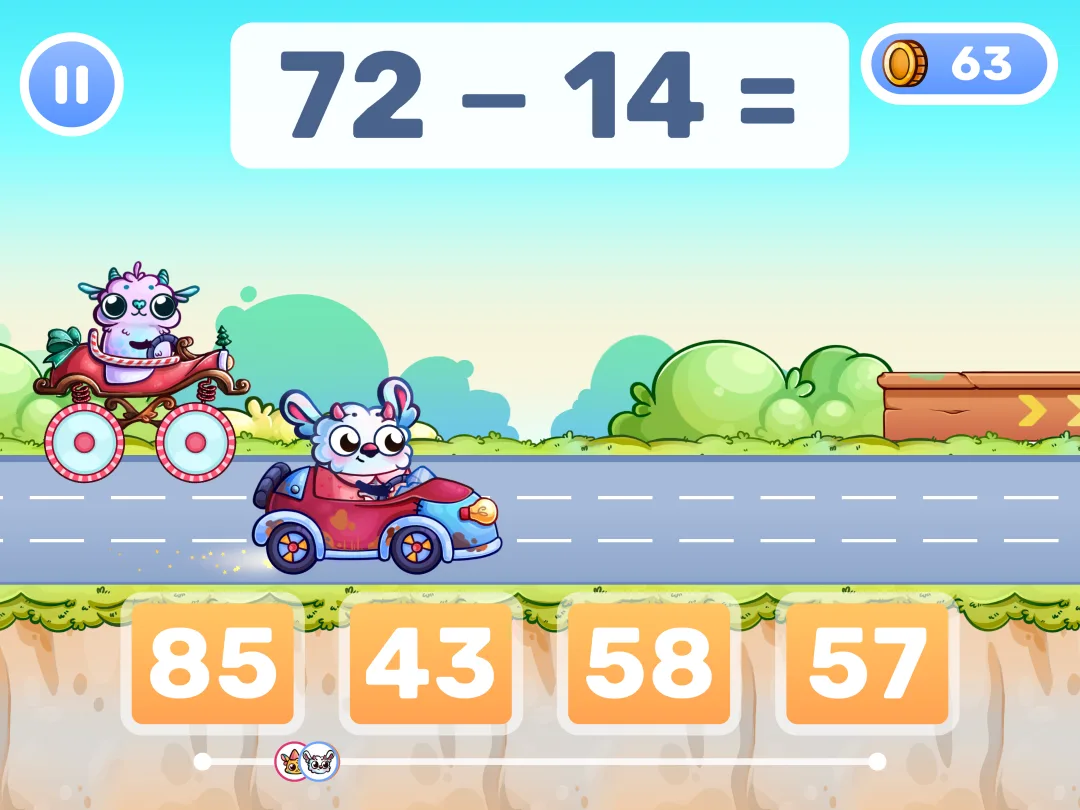
How to Learn Subtraction Facts to 20
To learn subtraction facts to 20, build them from the facts within 10 and the addition facts your child already knows, use a strategy for the ones that cross 10, then practice a little most days until the answers come from memory. Facts like 17 − 4 follow straight from 7 − 4. The real work is the facts that cross 10, like 13 − 5 and 15 − 8, and two strategies cover them: go down to 10 first, or think addition.
Use 10: go down to 10 first
For a teen number when the ones run out, use 10 as a stop on the way down. In 13 − 5, take away 3 to land on 10, then take away the 2 that are left: 13 − 3 = 10, and 10 − 2 = 8. In the same way, 14 − 6 = 14 − 4 − 2 = 8. This works for every teen fact that crosses 10, and it uses the same pairs to 10 practiced in our making 10 games and number bonds games.
Think addition
Every subtraction fact is an addition fact turned around. For 15 − 8, ask “8 plus what makes 15?”: 8 + 7 = 15, so 15 − 8 = 7. Common Core standard 1.OA.B.4 teaches subtraction this way, as an unknown-addend problem. A child who knows the sums in our addition to 20 games already has the answers to the subtraction facts to 20.
Use doubles
Doubles are among the easiest addition facts to remember, and each one gives a subtraction fact back: 12 − 6 = 6 because 6 + 6 = 12, 14 − 7 = 7, 16 − 8 = 8 and 18 − 9 = 9. A near double is one step away: since 8 + 8 = 16, 15 − 8 is one less than 8, which is 7.
Teen numbers without crossing 10
When a teen number has enough ones, the ten stays where it is. In 17 − 4, subtract the ones, 7 − 4 = 3, and keep the ten: 13. When both numbers are in the teens, like 18 − 13, the two tens cancel and only 8 − 3 = 5 is left; in 15 − 10, the ten comes off and 5 is left. This is the first step toward 2-digit subtraction, where tens and ones are subtracted by place.
Subtracting from 20
20 is two tens. Taking away a one-digit number breaks the second ten with a pair to 10, while the first ten stays: in 20 − 6, 10 − 6 = 4, so 20 − 6 = 14. Taking away a teen number leaves only the pair to 10 from the second ten: 20 − 16 = 4.
Common mistakes
- 12 for 13 − 5: taking the smaller ones digit from the bigger one. Seeing 3 and 5 in the ones place, a child does 5 − 3 = 2 and keeps the ten to get 12. Show that 13 is one whole pile: take 3 away to reach 10, then 2 more from the ten to land on 8.
- One off when counting back. Saying “13, 12, 11, 10, 9” for 13 − 5 counts the starting number 13 as the first step and lands on 9 instead of 8. Start the count on the number below, 12, 11, 10, 9, 8, or skip the count by going down to 10 first.
In the online games on this page, the wrong answers to the facts that cross 10 include this slip, like 12 for 13 − 5, so your child learns to spot it.
For how schools teach these strategies today, see number bonds and making ten in our guide to new math, and for the research on building recall, read math fact fluency.
Subtraction Facts to 20
This table shows the teen subtraction facts, starting from 11 to 18 and taking away 2 to 9. Find the starting number in the top row and the number you take away in the left column: the difference is where the column and the row meet. For 13 − 5, go down the column under 13 to row −5: 8. In every column, the answers of 10 or more stay in the second ten, and the highlighted cells below 10 are the 36 facts that cross 10.
| − | 11 | 12 | 13 | 14 | 15 | 16 | 17 | 18 |
|---|---|---|---|---|---|---|---|---|
| −2 | 9 | 10 | 11 | 12 | 13 | 14 | 15 | 16 |
| −3 | 8 | 9 | 10 | 11 | 12 | 13 | 14 | 15 |
| −4 | 7 | 8 | 9 | 10 | 11 | 12 | 13 | 14 |
| −5 | 6 | 7 | 8 | 9 | 10 | 11 | 12 | 13 |
| −6 | 5 | 6 | 7 | 8 | 9 | 10 | 11 | 12 |
| −7 | 4 | 5 | 6 | 7 | 8 | 9 | 10 | 11 |
| −8 | 3 | 4 | 5 | 6 | 7 | 8 | 9 | 10 |
| −9 | 2 | 3 | 4 | 5 | 6 | 7 | 8 | 9 |
Highlighted: the 36 teen facts that cross 10, from 11 − 2 = 9 to 18 − 9 = 9, which are the 36 single-digit sums over 10 worked backward. The 18 facts from 20, 20 − 1 to 20 − 9 and 20 − 11 to 20 − 19, also cross 10, as 20 has no ones and one of its tens has to be broken; the 45 facts within 10 (like 9 − 4) and teen facts like 18 − 13 and 15 − 10 do not. Together, the games on this page practice all 190 facts within 20.
What Grade Learns Subtraction Within 20?
Subtraction within 20 is a 1st and 2nd grade skill in the US, usually learned at ages 6-8. Common Core standard 1.OA.C.6 asks 1st graders to add and subtract within 20, fluently within 10, using strategies such as counting back, decomposing a number leading to a ten (13 − 4 = 13 − 3 − 1 = 9) and using the relationship between addition and subtraction, and 1.OA.B.4 asks them to understand subtraction as an unknown-addend problem. Standard 2.OA.B.2 asks 2nd graders to fluently add and subtract within 20 using mental strategies. In England, Year 1 children represent and use number bonds and related subtraction facts within 20, and Year 2 children recall and use addition and subtraction facts to 20 fluently.
- Age
- 6-8
- US grade
- Grades 1-2
- Standard
- Common Core 1.OA.C.6, 2.OA.B.2, 1.OA.B.4
- England
- Years 1-2
Learn Subtraction Within 20 with the MathHero App
How is the MathHero app different from the online games on this page?
The online games on this page are mini-games for short practice sessions on subtraction within 20. The MathHero app is a full math adventure with step-by-step learning programs, rewards for your hero and saved progress for each child. If your child enjoys these mini-games, try the app: you can play 5 levels a day for free, with no ads and nothing locked.
What Parents Say About the MathHero App
Verbatim from public App Store and Google Play reviews of the MathHero app, with spelling as written. Rated 4.7 on Google Play (48.2K reviews) and 4.6 on the App Store (12K ratings), checked .
“Very easy to use! My 1st grader gets excited about math facts and begs to play!”
“This is a fun game for kids from 1st grade and higher to practice the important basic mental calculations. There are settings to accomodate both slow and fast learners. My daughter enjoys slaying the funny monsters!”
“I love this app for my kids mastering their math facts. They have addition, subtraction, multiplication and division. They have the option to do slow or regular speed, which I like being able to choose slow to make it less stressful for my child.”
Subtraction Within 20 Games: Common Questions
What are some good games to practice subtraction within 20?
What are the subtraction facts to 20?
What does crossing 10 mean in subtraction?
How can my child learn subtraction facts to 20?
What grade learns subtraction within 20?
Can my child practice only facts that cross 10?
Are the online games free?
Do they work on a phone?
About This Page
Last updated · App ratings checked