

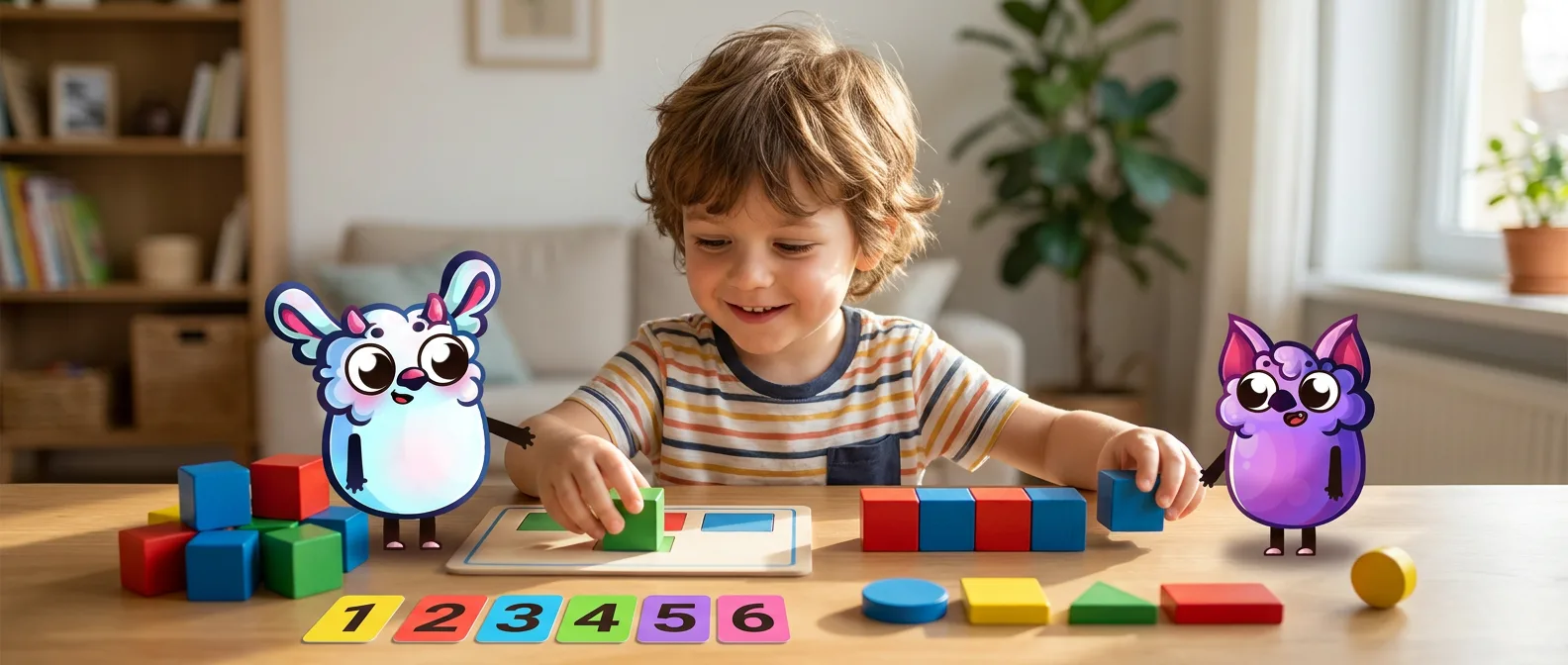
Your child rattles off numbers to twenty, then hands you four crackers when you asked for six. That gap is the whole story of math for 5-year-olds. Saying numbers is one skill. Understanding what they mean is another.
Wondering whether your 5-year-old is on track in math? This guide explains the key kindergarten math skills, what those skills look like in everyday life, easy ways to practise them at home, and when it's worth talking to your child's teacher.
Kindergarten math skills for 5-year-olds
By five, most children can count to 10 and recognize a few written numbers. But saying "one, two, three" is only part of it. Can your child hand you three crackers or tell which plate has more? Try naming familiar shapes and sorting toys by color or size, too.
By the end of kindergarten, Common Core counting goals include counting to 100 by ones and tens and writing numbers 0 to 20. In arithmetic, children work on addition and subtraction within 10 using objects or drawings, with fluency within 5.
Your five-year-old is not behind for not adding yet. Addition arrives during the year, not before it, and backwards 7s are normal well into first grade. Those are the skills kindergarten is built to add.
Counting and number sense
Counting out loud is a song. Counting objects is math. The difference is one-to-one correspondence: one number name, one object, no tapping the same block twice.
Another useful skill is subitizing: recognizing a small quantity without counting each item. Show two or three dots briefly and ask how many your child saw. Try four when they are comfortable.
Number sense is comparison too. Which row has more. Which group is smaller. Which numbers come after 7 when you start there instead of at 1.
First addition and subtraction
Try a story with toys: three ducks are in the bath and two more join them. How many now? Then start with five ducks and take two away. Let your child use toys, fingers, or a drawing to work it out.
Explore how numbers split into parts, too: five can be four and one, or three and two. These activities connect to the Common Core kindergarten arithmetic goals, including finding the missing part that makes 10.
Shapes and spatial awareness
Shapes arrive in two waves. Your child should name circles, squares, triangles, and rectangles first, then find those shapes out in the world. Wheels are circles. Windows are squares.
Explore solid shapes too: cubes, cones, cylinders, and spheres. Compare a cube-shaped block, a can, and a ball. Which stack? Which roll? Build with blocks and describe positions using words such as above, below, beside, and behind. These connect to the kindergarten geometry goals.
Patterns, sorting, and early logic
Red, blue, red, blue, what comes next? Patterns teach your child that math is predictable, a quiet foundation under everything else. Extend one, then let your child build patterns for you to read.
Sort the laundry by color. Sort socks by size. Line up toy cars shortest to longest. Sorting builds categories, and categories will later hold up place value, equal groups, and simple fractions.
Measurement and comparison
Rulers can wait. At this age, your child should measure with whatever is lying around. How many paperclips long is the toy car? How many cups of water fill the jug?
Words carry early measurement: long, short, tall, heavy, light, full, empty. Ask which toy has a greater length, then watch your child measure and compare the two by lining them up at one end. That last bit is the lesson: length only means something measured from the same starting place.
Sometimes, ask for an estimate before measuring: "How many paperclips do you think we'll need?" Then measure together and compare the result with the guess.
Equal groups: where multiplication quietly starts
Four plates, two crackers on each. How many crackers in total?
Equal groups, and the seed of multiplication. No plus sign, no times sign, no symbols at all. Your child needs one understanding: same-size groups count faster than one by one, and three rows of four stickers is a picture of that same relationship. Arrays, if you want the word for it.
What problem solving looks like at five
Not word problems on paper. Problem solving here is your child sharing seven grapes between two people and hitting that stubborn leftover one. It is trial and error with a shape sorter, a small experiment with a real answer at the end.
Two questions do most of the work. "How many do you think?" and "How can we check?"
Let a wrong answer sit a second before you jump in. Let them experiment. Ask them to say the thinking out loud, or draw it, or write the number they landed on. An error your child catches alone is worth more than your correction, and it costs their confidence nothing.
Math activities that fit a normal day
No lesson plan required. Try a few minutes of math play at a time, woven into your day. Keep going while your child is interested, and take a break when they seem tired or frustrated. Nothing has to be perfect.
- Count the stairs on the way up
- Set the table, one fork per person
- Bake something and measure the ingredients, where halves show up in a cup on their own
- Run a shape hunt around the house, naming the shapes you find
- Play board games with dice: ask how many dots your child sees, let them count if needed, then count the moves together
- Sort the change jar by size, then by money value
The best math activities in everyday life are the simple ones you were doing anyway. Fun is not a bonus here. A child who is interested keeps going. A bored child stops learning halfway through. For example, a shape hunt survives about four rooms before it needs a plot.
For more ideas sorted by skill, see our guides to math activities for preschoolers and counting activities for preschoolers.
Where MathHero picks up
Everyday activities build the foundation. Once your child understands simple addition, MathHero offers regular practice through play.
MathHero is a story-driven adventure for kids ages 5 to 10 where solving math is how you move. Build, race, battle, rescue characters, earn coins, buy gear. You pick the topic and how big the numbers get, either open practice or a guided path in small steps.
The game starts at addition within 10, which makes it the step after counting, not a substitute for it. If your child still isn't sure what six objects look like, stay with the blocks and the crackers a while longer.
The whole story can be finished for free, with no ads, capped at 5 levels a day. That cap is about the right dose of daily math practice at this age. A subscription with a free trial lifts it.
When counting turns into "what is three plus two," MathHero gives kids ages 5–10 that practice inside a story.
Try MathHeroIf your five-year-old seems behind
It's worth checking in with your child's teacher if your child consistently skips the same numbers when counting, shows little interest in quantity by age six, or still struggles to recognise small groups of objects after months of practice. Teachers would rather hear from you early. They can reassure you, suggest the next skills to work on, or recommend extra support if it's needed.
Usually it's timing. Understanding lands at different rates, and you'll find many early gaps close on their own.
FAQ
Count the crackers. Everything else is built on that.
This article is for educational purposes and does not replace professional advice. If you have concerns about your child's learning or development, talk to their teacher, a school psychologist, or a qualified specialist.
Sources
- Common Core: Kindergarten Counting & Cardinality
- Common Core: Kindergarten Operations & Algebraic Thinking
- Common Core: Kindergarten Geometry
- Common Core: Kindergarten Measurement & Data
- Common Core: Grade 2 Operations & Algebraic Thinking
- Common Core: Grade 2 Number & Operations in Base Ten
- CDC: Milestones by 5 Years
