
Making 10 Games for Kids
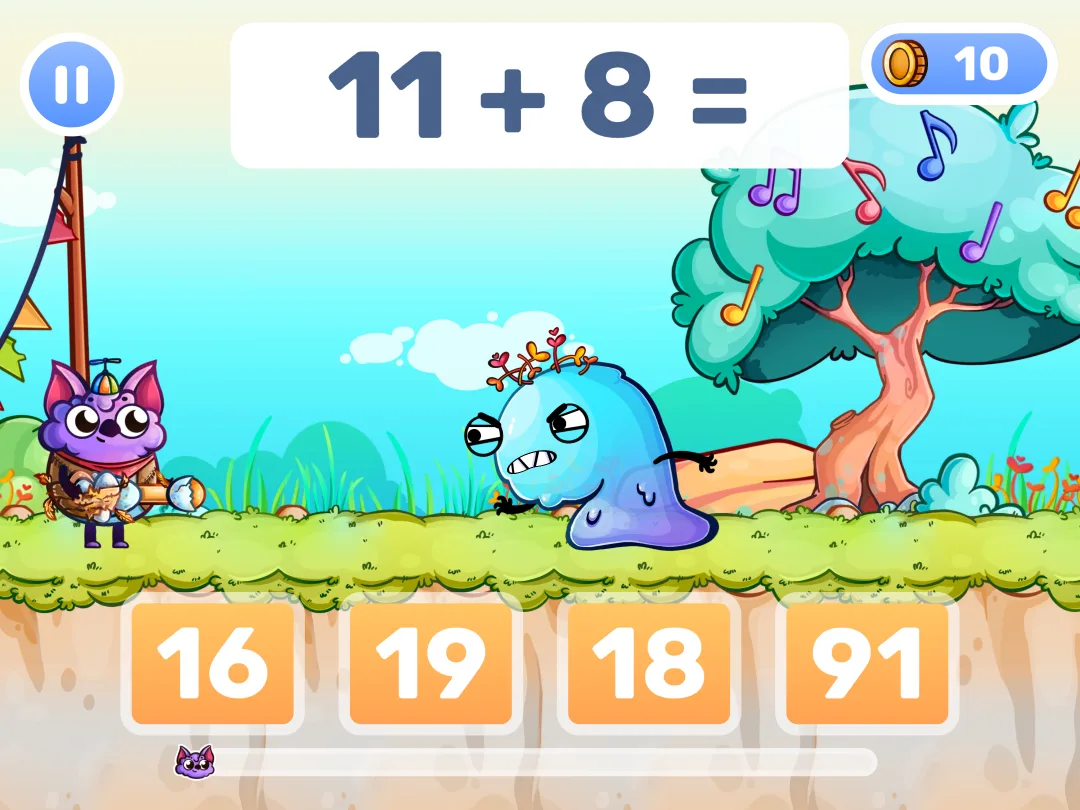
Practice making 10 with free MathHero adventure games for kids, right in your browser: find the pair that makes 10, like 7 + 3, then use the make a ten strategy to add over 10, like 8 + 5 = 10 + 3 = 13. No account, no download, no ads.
- Pairs to 10 and make a ten
- Grades K-1 · ages 5-7
- Free in the browser
- No account, no download
- No ads
- Phone, tablet and computer
Pick a Making 10 Game to Play
Then choose your practice: Pairs to 10, Make a ten or Add over 10.
Practice Another Addition Skill
Get MathHero: The Full Adventure
Keep practicing in the MathHero app: a story-driven math game for ages 5-10, from first addition to division.
- Step-by-step learning programs, like “Addition and Subtraction to 10” and “Addition to 20”, that add new facts a little at a time
- Custom Practice: addition and subtraction up to 10, 20, 100 or 1,000
- Typed answers or multiple choice, in Easy, Medium or Hard mode
Free at 5 levels a day, with no ads.

What Is Making 10?
Making 10 means two things, and children learn them in this order. In kindergarten, it means finding the number that makes 10 with another number: 7 and 3, 6 and 4. In 1st grade, it becomes a strategy for adding over 10, often called make a ten: fill a ten first, then add what is left, so 9 + 6 = 10 + 5 = 15. The pairs to 10 come first, because the strategy is built on them.
Pairs to 10
From 1 to 9, every number has one partner that makes 10: 1 and 9, 2 and 8, 3 and 7, 4 and 6, and 5 and 5. Two everyday tools make the pairs visible. Hold up 10 fingers and fold down 7: the 3 still up are the partner. Or fill 7 squares of a ten frame, two rows of five, and count the empty squares: 3.
Pairs to 10 are the number bonds for 10, the foundation of everything below. Our number bonds games practice them along with bonds to 5, 20 and 100.
The make a ten strategy in three steps
To add over 10, fill a ten first. For 8 + 5:
- How many does 8 need to make 10? 2.
- Split 5 into 2 and 3: the 2 fill the ten, and 3 are left.
- Add what is left to 10: 10 + 3 = 13.
The same three steps work for every fact that crosses 10. For 9 + 6, 9 needs 1, so 6 splits into 1 and 5, and 10 + 5 = 15. For 7 + 6, 7 needs 3, so 6 splits into 3 and 3, and 10 + 3 = 13. Start from the bigger number: 4 + 9 is easier as 9 + 4 = 10 + 3 = 13, because 9 needs only 1.
Patterns with 9 and 8
With 9, the answer is 10 plus one less than the number added: 9 + 7 = 10 + 6 = 16, and 9 + 4 = 13. With 8, it is 10 plus two less: 8 + 7 = 15, and 8 + 4 = 12. Your child does not need to memorize this as a rule. It falls out of the strategy: 9 takes 1 from the other number to make 10, and 8 takes 2.
Make a ten with three numbers
When three numbers are added, look for two that make 10 and add them first: 7 + 5 + 3 = 7 + 3 + 5 = 10 + 5 = 15. Common Core standard 1.OA.A.2 has 1st graders solve word problems that add three numbers, and spotting a pair to 10 makes many of them quick.
Common mistakes
- 15 instead of 13 for 8 + 5. The child makes the ten but then adds the whole 5 instead of the 3 that are left. To check, say what moved: 2 went into the ten, so 5 − 2 = 3 are left, and 10 + 3 = 13.
- 12 instead of 13 when counting on. Counting “8, 9, 10, 11, 12” on five fingers starts the count at 8 itself and lands one short. Making a ten avoids the count. To check a counted answer, start at the next number: 9, 10, 11, 12, 13.
- 17 for 7 + ? = 10. On a missing-number question, a child may add the two numbers shown. Read it as a question: 7 and what make 10? Fold down 7 of 10 fingers, and 3 are still up.
For all the facts within 20, with and without crossing 10, play our addition to 20 games. For ten frame play at home, try the ten frame fill activity, and to see why your child's class uses these methods, read what is new math.
| Number | Needs | Pair to 10 |
|---|---|---|
| 1 | 9 | 1 + 9 = 10 |
| 2 | 8 | 2 + 8 = 10 |
| 3 | 7 | 3 + 7 = 10 |
| 4 | 6 | 4 + 6 = 10 |
| 5 | 5 | 5 + 5 = 10 |
| 6 | 4 | 6 + 4 = 10 |
| 7 | 3 | 7 + 3 = 10 |
| 8 | 2 | 8 + 2 = 10 |
| 9 | 1 | 9 + 1 = 10 |
Highlighted: 6 to 9, the numbers that start the make a ten facts in the chart below. The games' Pairs to 10 questions use all nine pairs, with either number missing: 7 + ? = 10 or ? + 3 = 10.
Make a Ten Chart
The chart shows the make a ten step for every fact that starts with 9, 8, 7 or 6. Find the first number in the top row and the number you add in the left column: where they meet, the fact becomes 10 plus what is left, then the answer. For 8 + 5, column 8 and row + 5 give 10 + 3 = 13. Every fact that crosses 10 is in the chart, as it is or turned around: for 5 + 8, use 8 + 5.
| Start | 9 | 8 | 7 | 6 |
|---|---|---|---|---|
| + 1 | 10 | 9 | 8 | 7 |
| + 2 | 10 + 1 = 11 | 10 | 9 | 8 |
| + 3 | 10 + 2 = 12 | 10 + 1 = 11 | 10 | 9 |
| + 4 | 10 + 3 = 13 | 10 + 2 = 12 | 10 + 1 = 11 | 10 |
| + 5 | 10 + 4 = 14 | 10 + 3 = 13 | 10 + 2 = 12 | 10 + 1 = 11 |
| + 6 | 10 + 5 = 15 | 10 + 4 = 14 | 10 + 3 = 13 | 10 + 2 = 12 |
| + 7 | 10 + 6 = 16 | 10 + 5 = 15 | 10 + 4 = 14 | 10 + 3 = 13 |
| + 8 | 10 + 7 = 17 | 10 + 6 = 16 | 10 + 5 = 15 | 10 + 4 = 14 |
| + 9 | 10 + 8 = 18 | 10 + 7 = 17 | 10 + 6 = 16 | 10 + 5 = 15 |
Highlighted: the pairs that make exactly 10, 9 + 1, 8 + 2, 7 + 3 and 6 + 4. Above them the sum stays under 10; below them every fact crosses 10. In the games, Make a ten asks for the part after 10, like 8 + 5 = 10 + ?, and Add over 10 asks for the answer, 8 + 5 = ?.
How the Making 10 Games Work
Before the first level, every game on this page opens a “Choose your practice” screen with three kinds of questions, all ticked to begin with:
- Pairs to 10: the missing partner, like 7 + ? = 10 or ? + 4 = 10.
- Make a ten: the middle step of the strategy, like 8 + 5 = 10 + ?. The answer is what is left after filling the ten: 3.
- Add over 10: the whole fact, like 8 + 5 = ?.
Untick what your child does not need and press Play. The game remembers the choice for the other adventures on this page and for your next visit. Levels do not get harder over time: every level draws from the kinds you picked, and with more than one ticked, each comes up about equally often. Your child answers by tapping one of four choices.
A good order: a kindergartner starts with Pairs to 10 alone. In 1st grade, add Make a ten, and once the part after 10 comes quickly, add Add over 10 for the full fact.
What Grade Learns Making 10?
In the US, making 10 spans kindergarten and 1st grade. In kindergarten, at ages 5-6, Common Core standard K.OA.A.4 asks children to find the number that makes 10 when added to any number from 1 to 9. In 1st grade, at ages 6-7, standard 1.OA.C.6 asks for adding and subtracting within 20, with fluency within 10, and names making ten as one of the strategies, along with counting on and using known sums like doubles. By the end of 2nd grade, standard 2.OA.B.2 expects children to know all sums of two one-digit numbers from memory.
In England, pairs to 10 are number bonds. By the end of Reception, children should recall number bonds up to 5 and some number bonds to 10. In Year 1, they use number bonds and related subtraction facts within 20 and add one-digit and two-digit numbers to 20, and in Year 2 they recall addition facts to 20 fluently.
- Age
- 5-7
- US grade
- K-1
- Standard
- Common Core K.OA.A.4, 1.OA.C.6
- England
- Reception-Year 1
What Parents Say About MathHero
Verbatim from public App Store and Google Play reviews of the MathHero app, with spelling as written. Rated 4.7 on Google Play (48.2K reviews) and 4.6 on the App Store (12K ratings), checked .
“it's fun for my kids to play this game at the end of the school day and then they get practice with math facts. I like how you can customize the problems and the difficulty level.”
“I use this app to help my child review and better memorize the basics. I love that you can choose what you're working on and change it easily.”
“This is an excellent tool for kids to practice math drills! My kids all love the incentives and animations. I love that it allows me to select what they need to practice, adjust the level, difficulty, etc.”
Making 10 Games: Common Questions
What is the make a ten strategy?
Where can I play Make Ten games online for free?
How do the MathHero making 10 games work?
What grade learns making 10?
Is making 10 the same as number bonds?
Can my child practice only pairs to 10?
Do the making 10 games work on a tablet or phone?
Does MathHero teach making 10 with video lessons?
About This Page
Last updated · App ratings checked