
Number Bonds Games for Kids
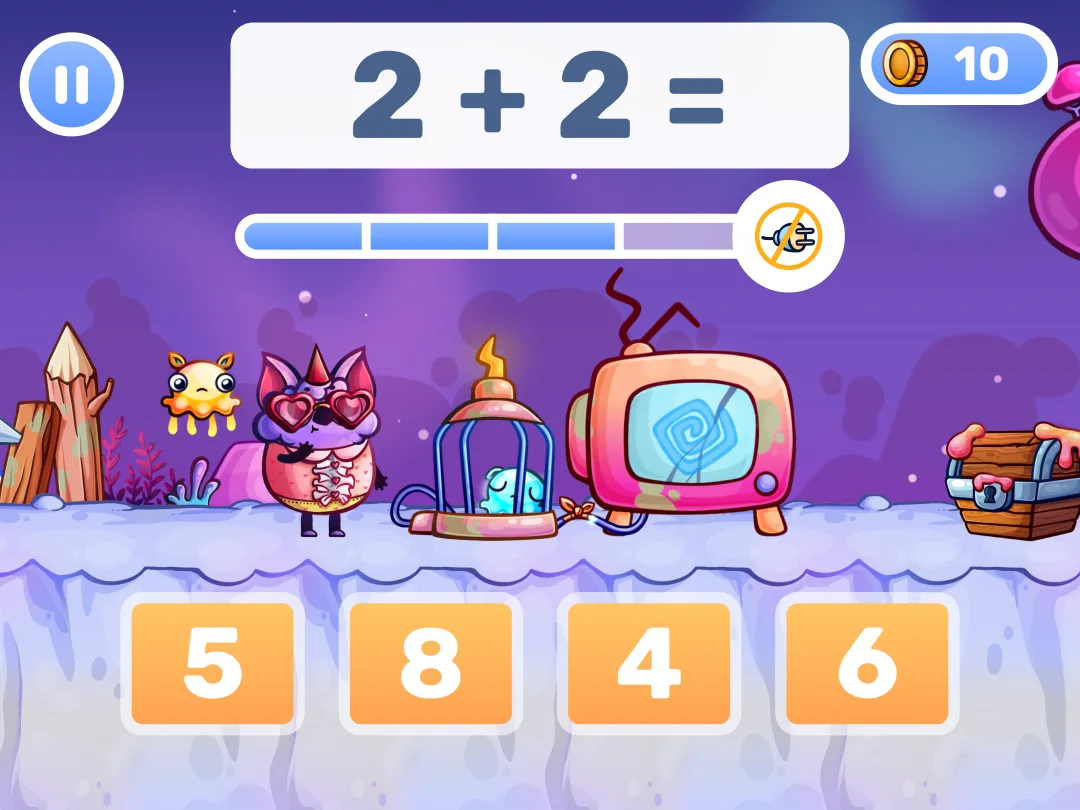
Practice number bonds to 5, 10, 20 and 100 with free MathHero adventure games for kids, right in your browser. A number bond is a pair of numbers that make a whole, like 7 and 3 for 10, and the games ask for the missing part: 7 + ? = 10. No account, no download, no ads.
- Bonds to 5, 10, 20 and 100
- Grades K-2 · ages 5-8
- Free in the browser
- No account, no download
- No ads
- Phone, tablet and computer
Pick a Number Bonds Game to Play
Then pick the whole: number bonds to 5, 10, 20 or 100.
Practice Another Addition Skill
Get MathHero: The Full Adventure
Keep practicing in the MathHero app: a story-driven math game for ages 5-10, from first addition to division.
- Step-by-step learning programs “Addition and Subtraction to 10”, “Addition to 20” and “Addition to 100”, which add new facts a little at a time
- Custom Practice: addition and subtraction up to 10, 20, 100 or 1,000
- Typed answers or multiple choice, in Easy, Medium or Hard mode
Free at 5 levels a day, with no ads.

What Are Number Bonds?
A number bond is a pair of numbers that make a whole number. 7 and 3 are a number bond for 10, because 7 + 3 = 10. The idea is part-part-whole: the whole, 10, splits into two parts, 7 and 3, and the two parts join back into the whole. Children usually draw a number bond as three circles, with the whole on top and its two parts below.
A number bond can be for any whole: 2 and 3 for 5, 13 and 7 for 20, 30 and 70 for 100. Schools start with bonds to 5 and 10, because adding over 10 and much of mental math are built on them.
How many number bonds for 10?
Counting both orders, there are 11 number bonds for 10, from 0 + 10 to 10 + 0. If order does not matter, there are 6: 0 and 10, 1 and 9, 2 and 8, 3 and 7, 4 and 6, and 5 and 5. Of those, 0 and 10 is easy and 5 and 5 is a double, so only four bonds take real work: 1 and 9, 2 and 8, 3 and 7, 4 and 6.
How to learn number bonds to 10
- Fingers. Hold up 10 fingers and fold down 7: the 3 still up are the other part. Your child always has this check at hand.
- A ten frame. Draw two rows of five squares, fill 7 with coins or beans, and count the empty squares: 3. Soon your child sees the 3 without counting. Try our ten frame fill activity.
- One bond, four facts. 3 + 7 and 7 + 3 are the same bond, and so are 10 − 7 and 10 − 3. Say the four facts together.
- Practice the missing part. 7 + ? = 10 is the question that builds quick recall, and it is the one the games on this page ask.
Common mistakes
- 17 or 10 for 7 + ? = 10. A child may add the two numbers shown, or give the whole. Read the question as: 7 and what make 10? Then fold down 7 fingers and look at the ones still up.
- 3 or 5 for 6 + ? = 10. Counting on from 6, it is easy to stop one early or one late. To check, join the parts back into the whole: 6 + 4 = 10.
For all the addition facts within 10, not only the ones that make 10, play our addition to 10 games. For the way number bonds are taught at school, see what is new math.
| Part | Part | Subtraction |
|---|---|---|
| 0 | 10 | 10 − 0 = 10 |
| 1 | 9 | 10 − 1 = 9 |
| 2 | 8 | 10 − 2 = 8 |
| 3 | 7 | 10 − 3 = 7 |
| 4 | 6 | 10 − 4 = 6 |
| 5 | 5 | 10 − 5 = 5 |
| 6 | 4 | 10 − 6 = 4 |
| 7 | 3 | 10 − 7 = 3 |
| 8 | 2 | 10 − 8 = 2 |
| 9 | 1 | 10 − 9 = 1 |
| 10 | 0 | 10 − 10 = 0 |
All 11 number bonds for 10, counting both orders. Highlighted: the 6 bonds when order does not matter; the rest are the same pairs turned around. The games on this page leave out 0 and ask for the missing part, like 7 + ? = 10.
Number Bonds of 5, 6, 7, 8 and 9
Homework often asks for the number bonds of a smaller number, like all the number bonds of 7. Counting 0 and both orders, every number has one more bond than itself, so 7 has 8: 0 + 7, 1 + 6, 2 + 5, 3 + 4 and the same four turned around. The table lists each pair once.
| Whole | Number bonds | ||||
|---|---|---|---|---|---|
| 5 | 0 + 5 | 1 + 4 | 2 + 3 | ||
| 6 | 0 + 6 | 1 + 5 | 2 + 4 | 3 + 3 | |
| 7 | 0 + 7 | 1 + 6 | 2 + 5 | 3 + 4 | |
| 8 | 0 + 8 | 1 + 7 | 2 + 6 | 3 + 5 | 4 + 4 |
| 9 | 0 + 9 | 1 + 8 | 2 + 7 | 3 + 6 | 4 + 5 |
Highlighted: the doubles, 3 + 3 and 4 + 4, which only even numbers have. The games on this page practice bonds to 5, 10, 20 and 100; this table covers the numbers in between.
Number Bonds to 20 and 100
Number bonds to 10 grow into bonds to 20 and 100 without new facts to learn. Add 10 to one part and the whole grows by 10: 3 + 7 = 10, so 13 + 7 = 20. Count in tens instead of ones and the whole becomes 100: 3 tens and 7 tens make 10 tens, so 30 + 70 = 100.
For a multiple of 5, like 35 + ? = 100, go to the next ten first: 35 + 5 = 40. Then use the tens bond, 40 + 60 = 100. The missing part is 5 + 60 = 65.
| Bond to 10 | Bond to 20 | Bond to 100 |
|---|---|---|
| 1 + 9 | 11 + 9 | 10 + 90 |
| 2 + 8 | 12 + 8 | 20 + 80 |
| 3 + 7 | 13 + 7 | 30 + 70 |
| 4 + 6 | 14 + 6 | 40 + 60 |
| 5 + 5 | 15 + 5 | 50 + 50 |
| 6 + 4 | 16 + 4 | 60 + 40 |
| 7 + 3 | 17 + 3 | 70 + 30 |
| 8 + 2 | 18 + 2 | 80 + 20 |
| 9 + 1 | 19 + 1 | 90 + 10 |
Each row starts from one bond to 10. Adding 10 to the first part gives a bond to 20; counting in tens gives a bond to 100. Highlighted: the example above, 3 + 7 to 13 + 7 and 30 + 70. Bonds to 20 also work with the 10 on the other part, like 3 + 17 = 20.
Why Number Bonds Matter
Number bonds to 10 carry a lot of early math, because so much is built on them:
- Adding over 10. To add 8 + 5, a child who knows that 8 needs 2 to make 10 splits 5 into 2 and 3: 10 + 3 = 13. This is the make a ten strategy, and our making 10 games practice it step by step.
- Subtraction. 10 − 7 = 3 is the same bond as 7 + 3 = 10, so a child who knows the bond does not need to count back.
- Bigger numbers. 47 + 3 = 50 uses the bond 7 + 3, and bonds to 100 are everyday money math: 35 cents needs 65 more to make a dollar. For sums up to 100, play our 2-digit addition games.
How the Number Bonds Games Work
Every question in the games on this page is a number bond with one part missing, like 7 + ? = 10 or ? + 4 = 10. Before the first level, a “Choose your number bonds” screen asks for one whole, under “Number bonds to”:
- 5: like 2 + ? = 5, for Reception and kindergarten.
- 10: like 7 + ? = 10, picked to begin with.
- 20: like 13 + ? = 20 or ? + 6 = 20.
- 100: multiples of 5, like 30 + ? = 100 or 35 + ? = 100.
Pick one and press Play. The game remembers the choice for the other adventures on this page and for your next visit. Levels do not get harder over time: every level draws from the bonds you picked. Your child answers by tapping one of four choices.
When Do Children Learn Number Bonds?
In England, number bonds is the main word for these facts at school. By the end of Reception, at age 5, children should automatically recall number bonds up to 5 and some number bonds to 10, including double facts like 5 + 5. In Year 1, they represent and use number bonds and related subtraction facts within 20. In Year 2, they recall addition and subtraction facts to 20 fluently and derive related facts up to 100, like 30 + 70 = 100 from 3 + 7 = 10.
In the US, the same skills are kindergarten and 1st grade work. Common Core standard K.OA.A.3 asks kindergartners, at ages 5-6, to split numbers up to 10 into pairs in more than one way, like 5 = 2 + 3 and 5 = 4 + 1. K.OA.A.4 asks them to find the number that makes 10 with any number from 1 to 9, and K.OA.A.5 to add and subtract within 5 fluently. In 1st grade, standard 1.OA.C.6 expects fluency within 10, and by the end of 2nd grade, 2.OA.B.2 expects children to know all sums of two one-digit numbers from memory.
- Age
- 5-8
- US grade
- K-2
- Standard
- Common Core K.OA.A.3, K.OA.A.4
- England
- Reception-Year 2
What Parents Say About MathHero
Verbatim from public App Store and Google Play reviews of the MathHero app, with spelling as written. Rated 4.7 on Google Play (48.2K reviews) and 4.6 on the App Store (12K ratings), checked .
“He asks to play every night. It’s helping his math skills and getting the practice he needs while having fun.”
“Fun for my 8 year old. Great help to learn in addition to flash cards . Love being able to select what he's working on and customize.”
“Good for general practice. I have my kids play when they're sitting in waiting rooms, in the car or have to keep quiet in certain settings.”
Number Bonds Games: Common Questions
What are number bonds?
How many number bonds for 10?
What age should children know number bonds to 10?
How do the MathHero number bonds games work?
Can my child practice number bonds to 20 or 100?
What is the difference between number bonds and fact families?
Are MathHero's number bonds games free?
Does MathHero teach counting?
About This Page
Last updated · App ratings checked