
Your child can rattle off "one, two, three, four, five" like a song. Then you hand them five buttons, ask how many, and they count two of them twice and land on seven. This gap has a name. That is number sense, and it is the quiet skill sitting under every bit of math that comes later.
Number sense is a feel for numbers as a concept: what they mean, how big they are, how they come apart and fit back together. Number sense activities are the small, hands-on games that build that feel through play with real things, cards, and a few minutes a day. No worksheets required. No math degree on your end either.
This guide covers what number sense is, why it matters from the beginning, before formal math starts, and a stack of number sense activities you can run at the kitchen table tonight. Most of these number sense activities work for children from pre-K and kindergarten through first grade, and a few stretch up into second grade.
What is number sense?
Number sense is an intuitive understanding of numbers, and how they relate to each other. A child with good number sense knows that seven is bigger than four, that six is one less than seven, and that eight can be split into five and three. They can hold a quantity in their head, compare it, and take it apart.
Think of number sense as the difference between reciting numbers and understanding them. Counting out loud is a start. Number sense is the deeper layer underneath: numbers as real amounts, not just a sequence of sounds. That deeper understanding is what makes math click instead of feeling like a pile of rules to memorize. Nail this concept early and later math skills have real understanding underneath them.
This kind of understanding grows through hands-on practice with real things, long before any worksheet shows up. Children build number sense by touching, grouping, and comparing what they can see and hold.
What are number sense activities?
Number sense activities are simple games and routines that help children explore numbers, quantities, and patterns through play. Most use everyday things: buttons, blocks, snacks, a deck of cards. They turn abstract math into something a child can hold in two hands.
Good number sense activities do three things. They ask your child to explore numbers as real quantities, not just symbols on a page. They stay short and playful, so practice feels like a game and not a lesson. And they let your child explain their thinking because saying it out loud is where the concept sticks.
You do not need a curriculum to teach number sense. You need ten minutes, a handful of small items, and a willingness to play along. The best number sense resources are already in your kitchen drawers. These games teach real math skills. The fun carries the learning, and each concept, from counting to decomposing numbers, gets stronger every time you play.
Why number sense matters before the worksheets start
Number sense is the foundation the rest of math is built on. Without it, children memorize steps they do not understand and hit a wall around the time math gets harder.
The research backs this up. In a study that followed children through first and third grade, early number sense predicted math achievement at both points, and the strength of that link did not fade as the children got older. Number sense was tied most closely to solving applied problems, the kind of math that shows up in real life.
Here is the plain version. A child with real understanding of what numbers mean learns addition faster, catches their own mistakes, and plays with math confidence when a new topic arrives. A child who only memorized the counting sequence has nothing to fall back on. Building number sense early helps your child master what comes next and skip that wall. A little practice each week, and the ability to reason with numbers grows.
The number sense skills your child is building
Number sense is not one skill. It is a bundle of related number sense skills that grow together throughout the early years. Here is what is actually developing while your child plays. Each of these number sense skills is quite simple to build at home, no kindergarten classroom required.
Counting with meaning
Counting with meaning is the ability to match one number word to one object, every time, and know that the last number said is the total. Plenty of children can chant to twenty but lose track when counting real things. Solid counting is where number sense begins, and these counting skills are the beginning of everything else. Watch a kindergarten child count a group of blocks and you can see number sense forming in real time. For games built specifically on this skill, see counting activities for preschoolers.
Subitizing
Subitizing is recognizing how many are in a small group at a glance, without counting one by one. Show three dots and your child just says "three." That instant recognition, studied for decades by researchers including Douglas Clements, is one of the core skills of early number sense and a big help later when children start to add.
Number recognition and formation
Number recognition is naming a written numeral on sight. Number formation is writing it. Recognizing numbers and matching a numeral to a quantity are different skills, and both need practice. When you start writing numbers, you write the shape last, once the concept means something. Writing numbers well is a motor skill as much as a math one, and it pairs with number words. Number identification like this is easy to fold into a game.
Comparing and ordering
Comparing is deciding which group has more and which has less. Ordering, or sequencing numbers, is putting them in the right number sequence. These skills give your child a sense of magnitude, of where a number sits next to its neighbors, including the numbers that trip kids up.
Decomposing numbers
Decomposing numbers means breaking a number into smaller parts: seeing that seven is three and four, or five and two. This is the heart of early number sense and the thing that makes basic operations like addition and subtraction click. Number bonds are just a visual representation of the same idea, a way to represent how numbers come apart.
Place value
Place value is understanding that the 2 in 24 means two tens, not two ones. Place value comes later than the rest, usually around first grade, but the groundwork for place value starts early when children group things into tens. Once place value lands, bigger math gets a lot easier, so early place value play pays off.
Number patterns
Number patterns are the regularities in our number system: counting by twos, by fives, by tens, and spotting what comes next. Pattern recognition trains children to see structure, so they can reason instead of memorizing every fact. Number patterns also feed skip counting and mental math, which, in turn, feed multiplication down the road. Let your child explore numbers this way, and the structure starts to feel obvious.
Number sense activities you can do at home
Here is the good part. These number sense activities need almost nothing: a few things and a few minutes. Pick two or three and rotate. Short and regular beats long and rare. These are hands-on activities, real hands-on games, so keep those hands busy and the mood fun.
Count everything
Count the stairs on the way up. Count the grapes on the plate, the red cars on the drive, the socks coming out of the dryer. Counting real objects all day, out loud, is the simplest way to build number sense, and it costs nothing. Point to each thing as you count so one word lands on one object. Counting a real group of things beats any worksheet for early math.
Dot card flashes
Make a dot card set by drawing one to six dots on index cards in different arrangements. Flash one for a second, then hide it, and ask how many. This builds subitizing, that at a glance recognition. Start with small numbers, then mix in patterns like dice faces so your child learns to see a group instead of counting it. This ability, spotting a quantity fast, is pure fun for kids and powerful, too.
Ten frame fill
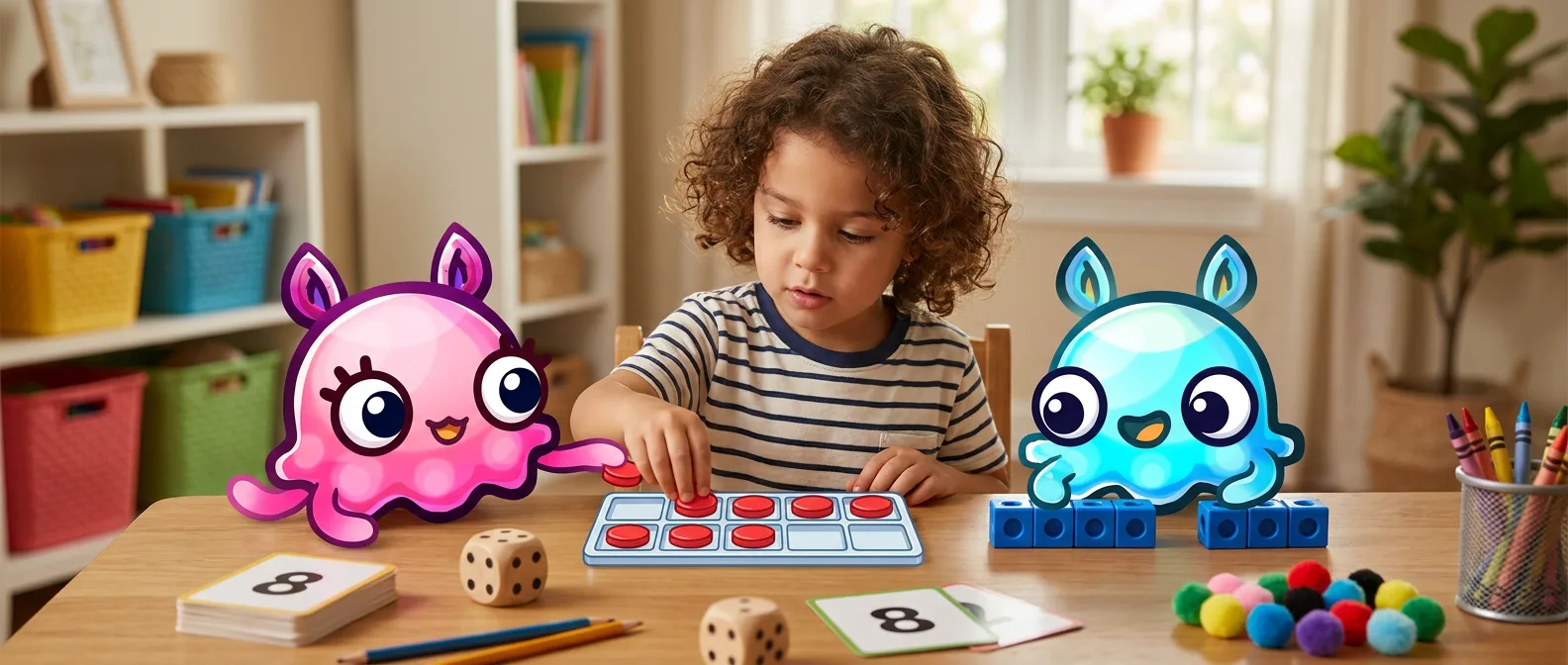
Draw a ten frame, two rows of five boxes, and grab some small items like beans or mini erasers. Ask your child to show you six, then seven. A ten frame gives numbers a shape and shows how each one sits next to ten. It is one of the best hands-on tools for number sense there is, and it doubles as an early mental math trainer.
Number scavenger hunt
Send your child hunting for numbers around the house: on the microwave, the clock, the remote, the mailbox. Matching number cards to the numerals they find turns number recognition into a game. This one is pure number identification practice, and it is genuinely fun. Children love the chase, and a fun surprise at the last number keeps them going.
Greater than, less than war
Play war with a deck of cards. Each player flips the top card, and whoever has a higher number wins the pair, adding to their group. Your child compares two numbers on every single turn. No prep, no worksheets, just a fast game that drills comparing larger and smaller numbers.
Build it with blocks
Grab snap cubes or any blocks, the classic math manipulatives. Call out a number and have your child build a tower with that many cubes. Then break the tower into two parts and count each. Building and breaking is decomposing numbers in physical form, and it shows number bonds in a way a page never can.
Number line hop
Tape a number line on the floor, zero to ten or twenty. Call out a number and your child hops to it. Then hop forward three, backward two. Physical movement ties numbers to distance and direction, and it turns skip counting into a game your child plays with their whole body.
The estimation jar
Fill a clear jar with things: marbles, pom-poms, whatever you have. Invite children to guess how many, then count together to check. The estimation jar builds a feel for quantity and gets children comfortable with the idea that a smart guess is a real math skill. Estimating is mental math with training wheels, and it takes practice.
Show it multiple ways
Pick a number, say eight. Ask your child to represent it in as many different ways as they can: eight fingers, eight blocks, four and four, six and two, tally marks, a drawing. Showing one number in different ways is decomposing numbers plus flexibility. Ask your child to represent it, then represent it again another way, and you will watch strong number sense and real mathematical thinking take shape.
Write and trace numbers
Once your child recognizes numerals, let them write. Write in sand. Write in shaving cream, or with a finger on foggy glass. Number formation sticks better when you write messy and hands on, not a row of boxes to complete. Do not make them complete a whole page. Matching number words to numerals ("seven" to 7) fits here too.
Once numbers mean something, arithmetic is the next step. MathHero turns that practice into a story-driven game for ages 5–10.
Try MathHero freeHow much practice is enough?
Short and daily. That is the whole answer. Five or ten minutes of number sense activities a day, short and fun, does far more than a long weekend cram session. Daily practice, playful games, that is the recipe. Young children tend to do well with small doses of practice, lots of repetition, and lots of play. The learning compounds, day after day.
You do not need to schedule it. Fold counting into a walk to the car. Run a quick game while dinner cooks. Play war before bed. The best number sense routines are the ones that hide inside your day, so nobody feels like they are doing math.
Keep it light. The second it feels like a drill, the learning risks stopping. If your child wants more practice, follow their lead and finish while they still want more. Rotate a few games, keep it fun, and every math concept from counting to place value gets more practice than a worksheet could force. Small skills, stacked daily. The games do the work, so keep the games coming and the mood light.
Number sense routines: making it a habit
A routine is just an activity you do often enough that it runs on autopilot. That is the goal. You want number sense to be a thread through the week, not an event.
Try anchoring number sense activities to things you already do. Counting during snack. A comparing game in the car. A dot card round in the waiting room. When the practice rides along with real life, it stays consistent, and that consistency is how you teach number sense so it lasts. This is how you teach number sense without it ever feeling like a class, and how children build the confidence to master new topics.
Rotate the games so nobody gets bored. Two or three at a time, swapped out when interest dips. Keep a small kit ready: a deck of cards, a set of dot cards, a ten frame, a jar. That is your whole number sense toolbox, and it doubles as your free number sense resources shelf. Cheap number sense resources, sitting in a drawer.
Common questions from parents
Sources
- Jordan, N. C., Glutting, J., & Ramineni, C. (2010). The importance of number sense to mathematics achievement in first and third grades. Learning and Individual Differences, 20(2), 82–88.
- Clements, D. H., Sarama, J., & MacDonald, B. L. (2019). Subitizing: The Neglected Quantifier. In A. Norton & M. W. Alibali (Eds.), Constructing Number: Merging Perspectives from Psychology and Mathematics Education (pp. 13–45). Springer.
- Common Core State Standards Initiative. Kindergarten: Number & Operations in Base Ten, K.NBT.A.1.
- Common Core State Standards Initiative. Grade 1: Number & Operations in Base Ten, 1.NBT.B.2.
Start with the stairs tonight. Count them on the way up.
