

Most people use mental math every single day, often without even realizing it! Whether we're figuring out how much change we should get back at the store, doubling a recipe, or calculating a tip, if we're doing math in our heads, we're using mental math strategies.
But here's something I always remind parents: mental math isn't just about solving problems quickly. It's about understanding numbers and recognizing relationships that make calculations easier.
Making tens, doubles, compensation, decomposition, and fact families are the strategies you'll hear teachers name most often. Your child doesn't need every one of them. They need a handful they truly understand, and the confidence to choose the right strategy for the problem in front of them.
When your child sees 8 + 5 and thinks "add 2 to make 10, then 3 more," that's number sense at work. Over time, it turns into something they don't even notice, and small calculations stop feeling like math at all.
As a seventh-grade math teacher, I see firsthand how important number sense is as students move into more challenging math concepts. Those skills begin developing long before middle school! Let's look at some of my favorite strategies and simple ways you can practice them at home.
What are mental math strategies?
Mental math strategies are efficient ways to solve math problems in your head, using number sense and the relationships between operations instead of the standard written algorithm. Adults use them dozens of times a day (some without even realizing it): figuring out a sale price, deciding which product is the better buy, halving a recipe. In elementary school, students use mental math to build confidence across addition, subtraction, multiplication, and division.
Mental math helps children develop number sense, flexibility, and confidence when working with numbers. It's also an important part of elementary math instruction. The Common Core State Standards expect students to fluently add and subtract within 20 using mental strategies by the end of second grade. By the end of third grade, students are expected to fluently multiply and divide within 100 and know from memory all products of two one-digit numbers. Developing mental math strategies helps students build the understanding and fact fluency they need as they move through elementary school.
Remember, fluency isn't just about speed! We want students to solve problems accurately and efficiently while understanding the relationships between numbers.
Mental math strategies for addition and subtraction
There are several mental math strategies that can help students become more flexible when adding and subtracting. I recommend introducing one strategy at a time and giving your child opportunities to explain how they're thinking.
Counting on and making tens
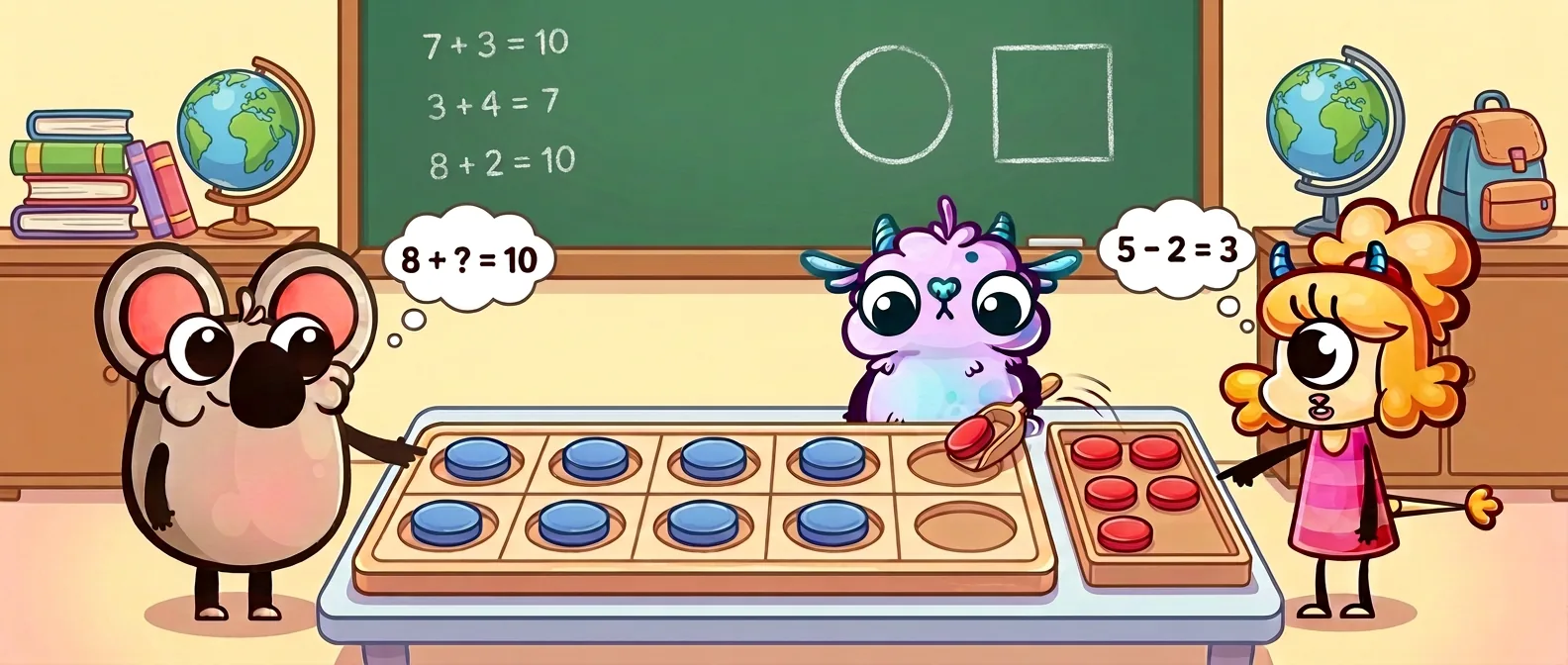
Counting on is one of the first mental math strategies many children develop. For 7 + 3, they start at 7 and count "8, 9, 10." Once counting on feels easy, you can help them make the process leaner. For 8 + 5, they break the 5 into 2 + 3, add 2 to reach 10, then add 3 more: 13.
This is making tens, a strategy students start learning in kindergarten, when they find the number that makes 10 with any number from 1 to 9. It works because ten is the anchor point of the base-ten number system. As children become more comfortable making tens, they can begin adding in larger chunks instead of counting one at a time.
You'll notice they answer before they've had time to count, because they know that 8 needs 2 to make 10. If they still use their fingers on some problems, that's fine. They're using a tool that works!
Try: "You had 8 crayons, and I gave you 5 more. What if you moved 2 crayons into the first pile first?" Visual models like this, or a ten frame with counters, help children understand the strategy before they try it mentally.
Doubles and near-doubles
Doubles like 6 + 6 or 8 + 8 are quick for many kids to memorize. Once your child knows the doubles, near-doubles are pretty easy to figure out. For example, 6 + 7 is 6 + 6 plus 1, and 8 + 9 is 8 + 8 plus 1. This is often called doubles plus one.
Doubles are a small set of number facts, and each one helps a child work out nearby facts. Instead of treating every addition fact as something new to memorize, they learn a handful of anchors and then figure out the rest.
Once the doubles facts are solid, near-doubles start to feel instant. They stop being "hard problems" and turn into two-step problems where the first step is already automatic.
Try: "You know 7 + 7. So what's 7 + 8?" Encourage your child to explain their thinking instead of simply giving you the answer, and praise whatever strategy they use. There is more than one way to solve a math problem!
Compensation with friendly numbers
Compensation means changing one number to a friendly number, then making up for the change at the end. Friendly numbers are usually multiples of ten. For 48 + 19, your child treats the 19 as 20, adds to get 68, then subtracts the extra 1. The final answer is 67.
Treating 19 as 20 makes the problem easier to work out, with just a tiny adjustment at the end. The same idea works for subtraction, too: for 63 − 29, your child subtracts 30 and then adds 1 back to get 34.
This is a great way to help students recognize how numbers are related. Try asking your child, "How could we make 38 + 27 easier to solve?" If they get stuck, ask, "What if we changed 27 to 30? What would we need to do afterward?"
Decomposition: breaking numbers apart
Decomposition is one of the mental math strategies students learn earliest. It splits numbers into manageable parts using place value, so one big calculation becomes two easy ones. For 24 + 39, we can break 24 into 20 + 4 and 39 into 30 + 9. Then we add the tens and the ones separately: 20 + 30 = 50, and 4 + 9 = 13, so 50 + 13 = 63.
It moves the child from "24 is a number" to "24 is 2 tens and 4 ones," which is the foundation of the base-ten system. Once they understand place value, they're ready to tackle bigger calculations, from multi-digit addition and subtraction to multiplication and beyond.
This strategy is also called "partial sums," and it works for larger numbers as well. For 381 + 243, add the hundreds first, 300 + 200 = 500, then the tens, 80 + 40 = 120, and then the ones, 1 + 3 = 4. So, 500 + 120 + 4 = 624.
Try asking your child to break 46 into tens and ones. Then do the same with 28. See if they can use those parts to find 46 + 28.
Left-to-right addition
Left-to-right addition is closely related to decomposition, with one small difference. Instead of adding the tens and the ones separately and combining them at the end, students keep a running total as they add each place-value part. For 23 + 35, start with 23. Add the three tens from 35: 23 + 30 = 53. Then add the five ones: 53 + 5 = 58. So, 23 + 35 = 58.
This is different from the traditional written addition algorithm, where students usually begin with the ones place. With mental math, students can begin with the larger place values and work their way through the number.
Try asking your child to solve 42 + 26 by starting with 42, adding 20, and then adding 6.
Fact families for subtraction
A fact family links three numbers with two addition and two subtraction equations. For example, if 4 + 3 = 7, then 3 + 4 = 7, 7 − 3 = 4, and 7 − 4 = 3.
Once your child sees the family, subtraction problems stop feeling like a whole new operation and turn into a question about addition, using knowledge they already have.
Addition and subtraction are inverse operations, which means they undo each other. Once children understand that relationship, they can use the addition facts they already know to solve subtraction problems. You may hear your child say, "Wait, that's the same as 4 plus 3!" That's the moment the concept clicked.
Try: "You know 4 plus 3 is 7. So what's 7 minus 3?" The same idea works for multiplication and division: three numbers can form a family of four related equations.
Our free addition and subtraction games mix plus and minus problems in one game, so your child keeps using what they know about one to answer the other.
Counting on for subtraction
To solve a problem such as 25 − 17, students can start at 17 and count up (18, 19, 20…) until they reach 25. They'll see that they counted up 8 numbers to get from 17 to 25, so 25 − 17 = 8. A number line is helpful for teaching this strategy, and it can help students make sense of operations with negative numbers in later grades.
Estimation
Adults use estimation much more than they realize. But when we teach it in school, students sometimes ask, "Why not just find the exact answer?" For a problem such as 198 + 303, we can estimate by thinking 200 + 300 = 500. That gives us a reasonable estimate before we calculate the exact answer of 501.
Estimating and thinking about whether an answer is reasonable is a really important life skill. For example, if my students and I were solving a problem about how many people could fit in an elevator and we arrived at an answer like 359, we would realize that we did something wrong! So, especially with word problems, I always encourage my students to think about what the problem is asking. We talk about imagining how the actual situation would look. Then, sometimes before solving anything, we make a guess about what a reasonable answer would be.
Mental math strategies for multiplication and division
As students begin learning multiplication and division, they can use many of the same number relationships they've already explored with addition and subtraction. This is where a strong number sense really pays off!
Doubling and halving
Doubling is a great strategy for multiplication, especially when students are learning their 4s and 8s. For 4 × 7, your child doubles 7 to get 14, then doubles 14 to get 28. For 8 × 6, they double 6 to 12, then to 24, then to 48.
Doubling is one of the earliest mental skills children develop. If they've already got their doubles for addition down, they can use the same kind of thinking for the times tables. Now it doesn't feel like you're asking them to learn a completely new operation. They're just using what they know from one operation to help them with another.
Try: "Double 7. Now double it again. That's the same answer as 4 times 7."
Multiplying by five
Here's another strategy that connects multiplication to something students already know! To multiply a number by five, we can multiply by ten and then divide the product by two.
Multiplying by ten is easy in our base-ten system, which makes it a handy step before halving, which, in turn, is one of the earliest number moves children learn. Between the two, the five times table becomes something they can build rather than memorize.
For example, for 5 × 8, first multiply by ten: 10 × 8 = 80. Then find half of 80: 80 ÷ 2 = 40. So, 5 × 8 = 40.
This works because five is half of ten. I love this strategy because it encourages students to think about the relationships between multiplication facts instead of memorizing each one separately.
Try asking: "If 10 × 6 = 60, what would 5 × 6 be?"
Multiplying in parts
Some multiplication facts are harder to remember than others. That's okay! Instead of guessing, students can break a challenging multiplication problem into smaller, more familiar facts.
Let's look at 7 × 8. If your child knows 7 × 4 = 28, they can use that fact twice: 28 + 28 = 56. So, 7 × 8 = 56.
Another option is to break seven into five and two: 5 × 8 = 40, 2 × 8 = 16, and 40 + 16 = 56. Both strategies give us the same answer!
This is an example of the distributive property of multiplication. Students don't need to know the name of the property right away, but they can begin using the relationship to solve problems. This property shows up again in algebraic expressions and equations in middle school!
Try asking your child how they could solve 6 × 7 using a multiplication fact they already know. For more ways to work through the times tables, see How to Make Learning Times Tables Easy.
Fact families for division
Just like addition and subtraction, multiplication and division are opposites, or inverse operations. If your child knows 6 × 4 = 24, they can connect that to 24 ÷ 4 = 6 and 24 ÷ 6 = 4.
Try asking: "What times 3 gets you to 27?" It's the same question as 27 divided by 3, but it lets your child think about it a different way. Our free multiplication and division games mix both kinds of facts in one game.
How to practice mental math at home
You don't need to sit down for a full math lesson every evening to help your child develop mental math skills! As a teacher and a mom, I know how busy evenings can get. Sometimes a few minutes of meaningful practice is much more manageable than trying to squeeze in another worksheet after a long day. Research supports spaced practice, which means spreading learning across several shorter sessions rather than trying to learn everything at once. In one study, students who split their daily math fact practice into short sessions spread across the day improved faster than students who did the same practice all at once. For many families, five to ten minutes is a great place to start.
Weave mental math into everyday moments
Everyday life gives you the best practice prompts. Cooking, shopping, walks, and car trips all involve small calculations your child can work out. Bonus points if you set it up as a quick game! A few examples:
- At the store: "This is $3.60. If I hand the cashier a five, how much change should I get back?"
- In the kitchen: "This recipe needs 12 tablespoons of an ingredient, but we're making half the recipe. How many tablespoons do we need?"
- On a car trip: "We're at mile 47. The exit is at mile 63. How many miles do we have left?"
You don't have to turn every moment into a math lesson, but you can show your child that mental math is a real tool people use every day to solve problems! For more everyday ideas, see Number Sense Activities for Young Kids.
Play games instead of drilling
Games are another great way to practice mental math! Grab a deck of cards, a pair of dice, or a board game you already have at home. For example, you can play a simple card game where each player flips over two cards and adds the numbers together. The player with the greater sum wins! You can also roll two dice and multiply the numbers. If your child is still learning addition, stick with addition. If they're ready for multiplication, adjust the game to match what they're practicing. The goal is to give children opportunities to use their math skills in a way that feels engaging and manageable.
Don't underestimate the power of letting your child beat you. A little competition can make practice much more memorable! As a math teacher, I use math games almost daily to engage students in their learning.
Use worksheets sparingly
Worksheets can absolutely be helpful! They give students opportunities to practice skills and develop accuracy. But I don't want worksheets to be the only way children experience math. Students also need opportunities to explore strategies, explain their thinking, and recognize relationships between numbers. A combination of meaningful practice, discussion, and games helps children develop a stronger understanding of mental math.
What if my child struggles with mental math?
First, remember that every child learns at a different pace. Some students recognize number patterns quickly, while others need more time, visual models, or repeated practice before a strategy makes sense. As a middle school math teacher, I've worked with students who still struggle with foundational skills that were introduced years earlier. When that happens, I don't want to just give them more problems and hope something eventually clicks. I want to figure out what they already understand and build from there.
Ask your child to explain their thinking
One of my favorite questions to ask students is: "Can you show me how you got that answer?" Even when their answer is incorrect, their explanation can tell us so much about what they understand. If they struggle to explain their thinking, ask them to show you how they solved the problem. Are they counting one number at a time? Are they using a known fact? Are they breaking numbers apart? Their strategy can help us identify what they need next.
Encourage progress, not just correct answers
Sometimes the way we respond to a child's mistakes can make a big difference. Instead of saying, "That's wrong," try: "Let's look at how you solved that." Instead of saying, "This is easy," try: "Take your time. Let's figure it out together."
Here's something that is so important to me: instead of telling your child you were never good at math, remind them that math is something we can keep learning and improving with practice.
Math anxiety can start early. A study of first and second graders found that children who felt more anxious about math tended to score lower in math, especially children with stronger working memory. If your child regularly becomes very upset or anxious about math, consider talking with their teacher about what you're noticing and what support might help. We want children to feel comfortable trying different strategies, making mistakes, and learning from them. For more on this, see Helping a Child Who Struggles With Math.
Where MathHero fits in
MathHero is a math game for kids ages 5 to 10, and mental math is what it practices. Your child solves short sets of addition, subtraction, multiplication, or division problems to move a story-driven adventure forward. As a teacher AND a mom, I know that getting kids excited about extra math practice isn't always easy! But MathHero gets kids excited about practicing math!
Instead of completing a traditional worksheet, children solve math problems to move through the adventure. Parents can customize the practice to what their child needs, from addition within 10 for kindergarten to the times tables and three-digit calculations for older students.
Parents can also adjust the difficulty, monster speed, and whether children type their answers or choose from multiple-choice options. Families with multiple children can create separate profiles with different settings. MathHero can be played for free with a limit of five levels per day. A subscription with a free trial removes that daily limit.
Of course, MathHero is a practice tool, not a replacement for math instruction. If your child doesn't understand a strategy yet, they'll still need opportunities to explore it through visual models, hands-on activities, and conversations. But once they begin developing that understanding, a game like MathHero can be another way to practice their mental math skills in a fun and engaging way!
Short, regular practice is what turns strategies into instant answers. Set MathHero to the skill your child is working on, from addition within 10 to the times tables.
Explore MathHeroCommon questions about mental math strategies
Where to start next week
If you feel overwhelmed by all of these different math strategies, start small! Mental math is an important part of developing strong number sense, but it isn't something children have to master overnight. As a teacher, I want students to understand why a strategy works, not just memorize a shortcut. Start with one strategy, practice a little at a time, and encourage your child to explain their thinking.
Remember, you don't have to be a math expert to help your child succeed! Sometimes the most helpful thing you can do is ask a question, listen to their explanation, and remind them that there are different ways to solve a problem. Those small moments can make a big difference in how children approach math!
Sources
- Common Core State Standards Initiative. Kindergarten: Operations & Algebraic Thinking, K.OA.A.4 (find the number that makes 10 when added to any number from 1 to 9).
- Common Core State Standards Initiative. Grade 2: Operations & Algebraic Thinking, 2.OA.B.2 (fluently add and subtract within 20 using mental strategies).
- Common Core State Standards Initiative. Grade 3: Operations & Algebraic Thinking, 3.OA.C.7 (fluently multiply and divide within 100).
- Schutte, G. M., Duhon, G. J., Solomon, B. G., Poncy, B. C., Moore, K., & Story, B. (2015). A comparative analysis of massed vs. distributed practice on basic math fact fluency growth rates. Journal of School Psychology, 53(2), 149–159.
- Ramirez, G., Gunderson, E. A., Levine, S. C., & Beilock, S. L. (2013). Math anxiety, working memory, and math achievement in early elementary school. Journal of Cognition and Development, 14(2), 187–202.
