
Addition to 10 Games for Kids
Practice addition within 10 with free MathHero adventure games for kids, right in your browser: every addition fact to 10, like 6 + 3. Start at 6 and count on 3 more, 7, 8, 9, so 6 + 3 = 9. No account, no download, no ads.
- 45 facts, sums up to 10
- Grades K-1 · ages 5-7
- Free in the browser
- No account, no download
- No ads
- Phone, tablet and computer
Pick an Addition to 10 Game to Play
Choose your facts first: +1 to +5, all ticked to begin with.
Practice Another Addition Skill
Get MathHero: The Full Adventure
Keep practicing in the MathHero app: a story-driven math game for ages 5-10, from first addition to division.
- Step-by-step learning program: Addition and Subtraction to 10 adds new facts a little at a time
- Custom Practice: addition and subtraction up to 10, 20, 100 or 1,000
- Typed answers or multiple choice, in Easy, Medium or Hard mode
Free at 5 levels a day, with no ads.

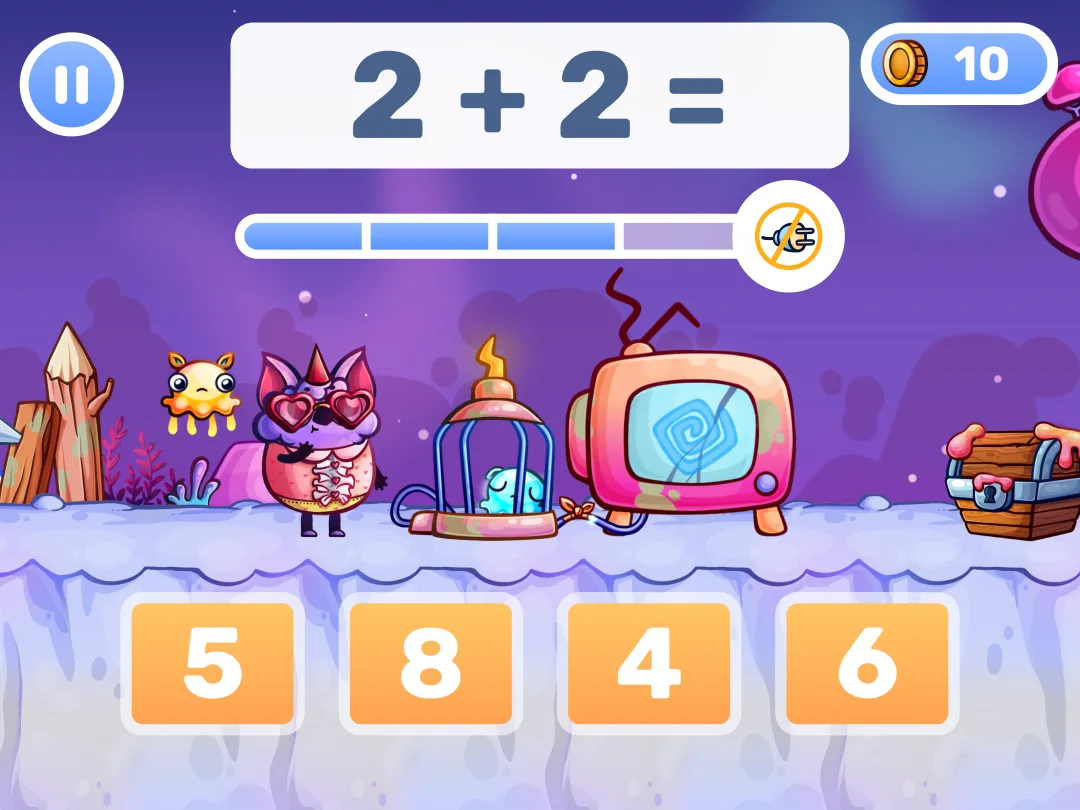
How to Learn Addition Facts to 10
To learn the addition facts to 10, start with +1, count on from the bigger number, and learn the pairs that make 10 and the doubles by heart. Then practice a little most days until the answers come without counting. In the games, the +1 to +5 choices let your child practice one step at a time.
+1 is the next number
Adding 1 gives the next number in counting: 4 + 1 = 5, 7 + 1 = 8 and 9 + 1 = 10. A child who can count to 10 already knows these. Every fact also works the other way around, so 1 + 7 is the same as 7 + 1 = 8. +2 is two counts on: for 6 + 2, say 7, 8.
Count on from the bigger number
For +2, +3 and +4, start at the bigger number and count on. For 6 + 3, say 6 and count three more: 7, 8, 9. A number line shows it as hops: start on 6, make 3 hops, and land on the answer.
When the smaller number comes first, swap them. 2 + 7 is the same as 7 + 2, and counting 8, 9 is quicker than counting seven steps from 2. Counting on is a step, not the goal: once a fact comes up again and again, your child starts to know it without counting.
Learn the pairs to 10
Five pairs make 10: 1 + 9, 2 + 8, 3 + 7, 4 + 6 and 5 + 5, and the same pairs turned around. Fingers show them well: hold up 7 fingers, and the 3 fingers that are down make the pair to 10. These pairs are worth knowing by heart, because they are the key to sums over 10 later, like 8 + 5 = 8 + 2 + 3 = 13. Our number bonds games and making 10 games practice them with a missing number, like 7 + ? = 10.
Know the doubles up to 5 + 5
1 + 1 = 2, 2 + 2 = 4, 3 + 3 = 6, 4 + 4 = 8 and 5 + 5 = 10. Doubles stick quickly because they are easy to see: two hands of 5 fingers make 10. A double also gives its neighbor: 4 + 5 is one more than 4 + 4, so it is 9, and 3 + 4 is one more than 3 + 3, so it is 7.
Common mistakes
- Counting the start number. For 5 + 3, a child counts “5, 6, 7” and says 7. The start number is not one of the hops: say 5, then count three more, 6, 7, 8. So 5 + 3 = 8. Raising one finger for each count, starting with the 6, helps.
- Starting from the smaller number. For 2 + 7, counting on seven times from 2 is slow, and it is easy to lose count. Swap the numbers and start from 7: 8, 9. So 2 + 7 = 9.
When the facts to 10 come quickly, move on to our addition to 20 games, where the pairs to 10 help with sums like 8 + 5. All the ranges, up to 1,000, are on the addition games page. For ideas away from the screen, see our counting activities and our guide to what math a 5 year old should know.
Addition Facts to 10
The table shows all the addition facts to 10, with one column for each choice in the games, from +1 to +5. Find the first number on the left, then go across to the column you are practicing: 6 + 3 = 9 is in row 6 under +3. Every fact with a 6, 7, 8 or 9 as the second number is here too, turned around: 3 + 6 is the same as 6 + 3.
| +1 | +2 | +3 | +4 | +5 | Pair to 10 | |
|---|---|---|---|---|---|---|
| 1 | 2 | 3 | 4 | 5 | 6 | 9 |
| 2 | 3 | 4 | 5 | 6 | 7 | 8 |
| 3 | 4 | 5 | 6 | 7 | 8 | 7 |
| 4 | 5 | 6 | 7 | 8 | 9 | 6 |
| 5 | 6 | 7 | 8 | 9 | 10 | 5 |
| 6 | 7 | 8 | 9 | 10 | 4 | |
| 7 | 8 | 9 | 10 | 3 | ||
| 8 | 9 | 10 | 2 | |||
| 9 | 10 | 1 |
Highlighted: the pairs to 10. In the +1 to +5 columns they are the sums of 10; the last column gives the pair to 10 for each number on the left, like 3 and 7. The games on this page ask all 45 facts in this table, both ways round, with sums from 2 to 10.
What Grade Learns Addition to 10?
Addition within 10 is a kindergarten and 1st grade skill in the US, usually learned at ages 5-7. In kindergarten, children split numbers up to 10 into pairs in more than one way (K.OA.A.3), find the number that makes 10 with any number from 1 to 9 (K.OA.A.4) and add fluently within 5 (K.OA.A.5). In 1st grade, Common Core standard 1.OA.C.6 expects fluency within 10, with strategies like counting on and doubles, as children start adding within 20. In England, children recall number bonds up to 5 and some number bonds to 10, including double facts, by the end of Reception, and use number bonds within 20 in Year 1.
- Age
- 5-7
- US grade
- K-1
- Standard
- Common Core 1.OA.C.6
- England
- Reception-Year 1
What Parents Say About MathHero
Verbatim from public App Store and Google Play reviews of the MathHero app, with spelling as written. Rated 4.7 on Google Play (48.2K reviews) and 4.6 on the App Store (12K ratings), checked .
“My 6 year old loves it. Really simple but good game for practicing basic maths. You can adjust the difficulty from very simple addition through to large number division.”
“This game is rally helping my children and wen ever I ask her a addition or a subtraction problem she knows it right away. This is a 5 star game!”
“My son loves this game. We were working on math facts with flashcards, but he was too bored to work for more than a few minutes. With this game he enjoys it enough that I can use time to play as a reward. His recall of the answers has improved significantly in a short time.”
Addition to 10 Games: Common Questions
What are the best free games for addition to 10?
What are the addition facts to 10?
How many addition facts to 10 are there?
Can my child practice only +1 and +2?
What grade learns addition within 10?
Are MathHero's addition to 10 games free?
Do the addition to 10 games work on a tablet or phone?
Does MathHero teach counting?
About This Page
Last updated · App ratings checked