
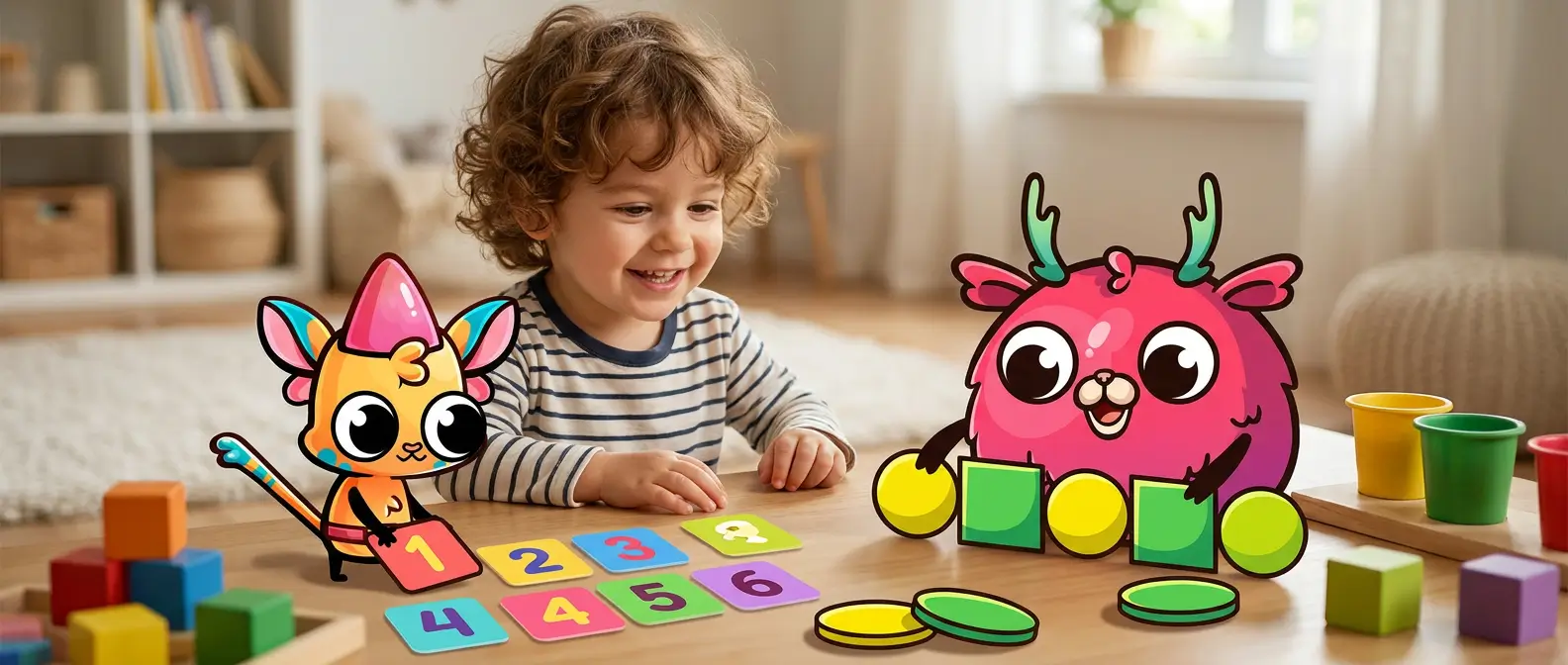
Your preschooler already does math. Counting crackers. Splitting a banana in half. Sorting socks into piles because the stripey ones "go together." You just haven't called it math yet.
The math activities for preschoolers that actually stick are the ones folded into snack time, bath time, and the walk to the car. No worksheets. Below are 24 preschool math activities built from what's already in your kitchen drawer, grouped by skill.
What Preschool Math Actually Covers: 5 Key Math Concepts
Preschool math comes down to five math concepts: number recognition, counting, sorting, shapes, and patterns. Addition, measurement, and spatial awareness build on them.
What children can do at each young age
Children can learn to recognize shapes by age 3. Counting develops on a long runway: a three-year-old manages a few objects, and by five or six many children count well past twenty. Plenty of four-year-olds skip numbers or lose track partway, and that's fine.
Why hands on learning wins with young children
Preschoolers learn math best through play and everyday experiences. Fun activities that let children touch, sort, build, and explore develop basic math skills faster than flashcards, because "four" means nothing to young children until it's four blocks in their hand.
Fun Math Activities for Counting
Real counting means one object, one number, one finger touch — one-to-one correspondence — not the sing-song chant from one to ten.
Count the stairs
You'll need: stairs. Every trip up, count out loud together. Every trip down, count backward. Two weeks and your child counts to twelve without noticing they learned anything.
The snack count
You'll need: crackers, grapes, whatever's on the plate. Have your child count each piece by touching it, one poke per number. Then ask how many are left after they eat two.
Pom poms and paper bags
You'll need: pom poms, paper bags, a marker. Write a number on each of five bags. Your child drops the corresponding number of pom poms into each bag, then dumps them out and starts over.
The toy cars parking lot
You'll need: toy cars, painter's tape. Tape numbered parking spots on the floor. Each spot gets the corresponding number of cars: space 3 gets three, space 5 gets five.
Number Recognition Activities
Number recognition is the bridge between saying "seven" and knowing what seven means.
Number scavenger hunt
You'll need: the house you live in. Numbers live on the microwave, the remote, the mailbox. Call one out and your child finds it.
Play doh numbers
You'll need: play doh. Roll a snake, bend it into a 2. Then a 5. Then their age. Builds fine motor skills at the same time.
Clothespin number match
You'll need: clothespins, index cards, a marker. Write numbers 1 to 10 on cards. Your child clips the matching number of clothespins onto each card.
Salt tray tracing
You'll need: a baking tray, salt or sugar. Show children how to write numbers with one finger, then shake the tray to erase. Mistakes vanish instantly.
Number Puzzles and Number Sequence Games
The missing number craft sticks puzzle
You'll need: craft sticks, clothespins, a marker. Write a sequence with one gap: 1, 2, _, 4, 5. Write missing numbers on clothespins for your child to clip into the gap.
Number line hop
You'll need: painter's tape. Tape a number line 1 to 10 on the floor. Call a number, children jump to it. Later, call "one more than three" and let them work it out with their feet.
Our guide to parent-proven learning strategies goes deeper on math practice at home.
Read the guideShape Activities: Identify Shapes and Create Shapes
Most kids learn circle and square early, then stall on triangles and rectangles. Rotate the shapes on purpose so a triangle standing on its point still reads as a triangle.
I Spy a Shape
You'll need: nothing. "I spy something shaped like a circle." Clocks, plates, wheels, the top of a cup.
Pipe cleaner shapes
You'll need: pipe cleaners. Bends into a triangle in four seconds and holds its form. Count the corners as you bend: three for a triangle, four for a square.
Shape scavenger hunt
You'll need: paper and a marker. Draw five shapes on a page. Your child hunts the house and tallies every match.
Large shapes on the floor
You'll need: painter's tape. Tape large shapes on the floor: hop into the triangle, tiptoe around the square.
Pattern Activities That Build Reasoning Skills
When children recognize patterns, they start predicting what comes next, which is problem solving in miniature. Say it out loud with them — "what comes next?", "why is that a pattern?" — and start with AB (red, blue, red, blue) before anything fancier.
Cereal loop necklaces
You'll need: cereal loops, string. String the loops in a repeating color pattern. Two colors first, three once they've got it.
Nature patterns
You'll need: a walk outside. Collect leaves, stones, and flowers, then lay them out in a repeating line.
Block patterns
You'll need: building blocks in two colors. Start a pattern with four blocks, then ask what comes next.
Sorting, Size, and Early Measurement
Laundry sorting
You'll need: laundry. Socks by color, shirts by size — categorization and logical thinking in action.
The apple test
You'll need: two or three apples. Which is biggest? Which is heaviest? Hand them over and let children decide by holding them.
Shortest to longest
You'll need: spoons, shoes, or craft sticks cut to different sizes. Line them up shortest to longest.
First Addition and Basic Math Skills
Mealtime math
You'll need: dinner. "You have four green beans. Here are two more." Then eat one and ask again.
Hide one
You'll need: five small toys, a cup. Count together, cover, secretly remove one, uncover. How many now?
Movement, Spatial Awareness, and Math Skills
Indoor obstacle course
You'll need: couch cushions, chairs, a blanket. Under the chair, over the cushion, around the table, through the tunnel.
Simon Says, position edition
You'll need: nothing. "Simon says put your hands above your head. Simon says stand behind the chair."
A 10-Minute Pre K Math Routine
- Warm up, 2 minutes. Count something. Stairs, steps to the kitchen, fingers.
- Main activity, 6 minutes. One activity from above. Just one.
- Reflection, 2 minutes. Ask one open question: "How did you know that was five?"
Three sessions a week is plenty for most children. Stop the second they're done, even if it's been four minutes.
Materials and Safety
Pom poms, cereal loops, and other small pieces are choking hazards for young children. Supervise every activity that uses them. The necklace activity needs one extra rule: keep the string short, stay in the room, and take it off as soon as play stops.
Making It Easier or Harder
If children are still learning to count objects one at a time, drop to numbers 1 through 5 and use bigger items they can grip. If they're already counting past 20, have them add one more and predict the total, or write the numbers instead of matching them.
Where a Math App Fits
Honest answer: for a 3-year-old, mostly it doesn't. Hands-on learning wins at that age, and no tablet replaces holding five blocks in two hands.
Around age 5, children learn to work with written numbers and structured problems, and that's where an app earns its place. MathHero is built for exactly that stage, ages 5 to 10. Its Early Steps track begins with addition and subtraction within 10. Kids play story-driven missions and can practice independently in short sessions, with no third-party ads. There's a free option limited to five levels a day.
Evidence & Sources
Key references behind the developmental claims in this guide.
- NAEYC and NCTM: Early Childhood Mathematics, Promoting Good Beginnings — the joint position statement behind the age expectations here, including the learning paths for children ages 3 to 6.
- National Association for the Education of Young Children (NAEYC): Math — supports the emphasis on hands-on, play-based early math learning over worksheets.
- Common Core State Standards, Kindergarten Mathematics — the counting, shape and sorting benchmarks children work toward across the kindergarten year.
Common Questions About Preschool Math Activities
The Short Version
Math at this age isn't a subject you sit down and teach. It's the counting, sorting, and shape-spotting already happening in your kitchen, made slightly more deliberate. So pick one activity, run it for five to ten minutes, three times a week, and stop while children still want more.
Count the stairs tomorrow morning. That's the whole starting line.
