

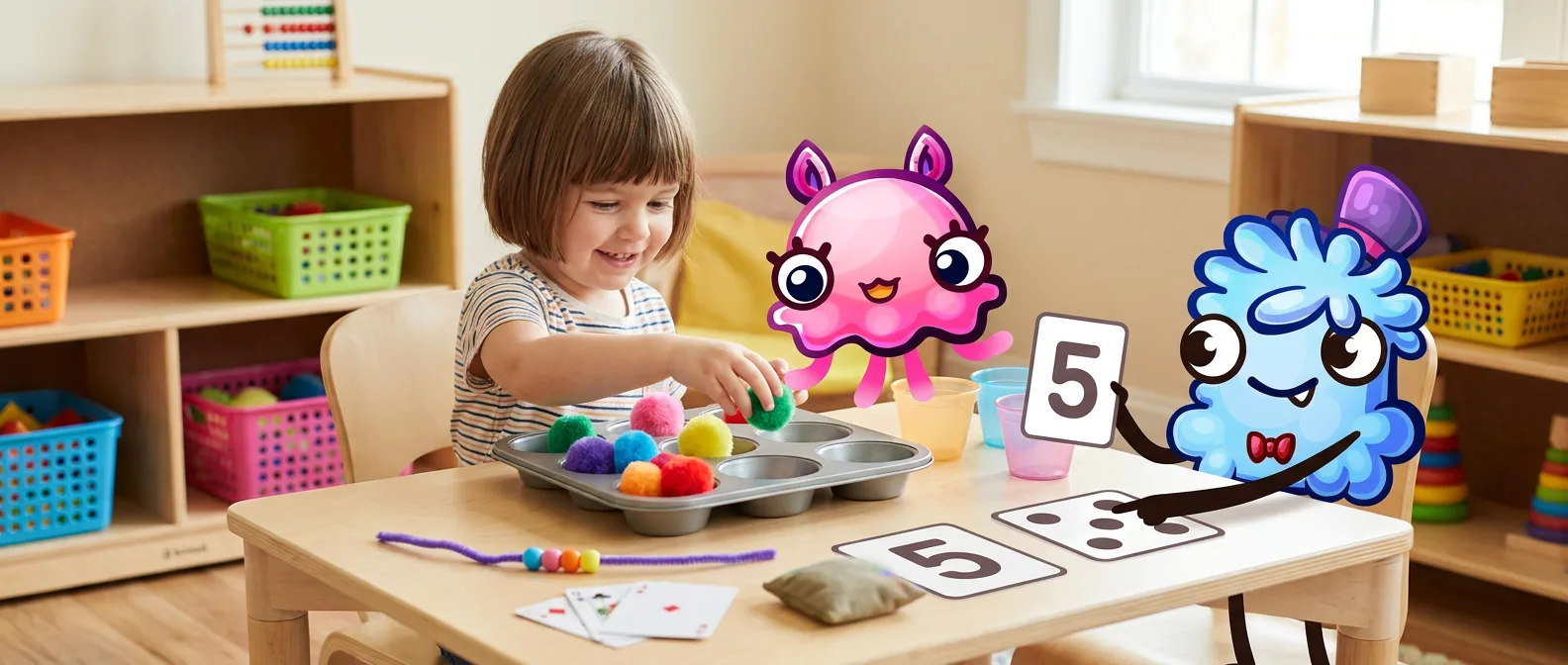
Counting activities for preschoolers work best when they feel like play, not a lesson. Your preschooler learns to count by moving objects, singing, tossing a bean bag, or sorting counters into cups. Give your child lots of hands-on counting practice, keep it fun, and the numbers stick on their own.
This guide covers what counting activities actually build, how to set up short counting practice sessions at home, and gives you a stack of hands-on counting activities you can run today with things already in your kitchen drawer. Real counting. No worksheets.
For games involving shapes, sorting, and patterns, explore our broader guide to math activities for preschoolers.
What counting activities build
Counting is not just reciting "one, two, three." Real counting rests on a few ideas your child has to grip one at a time. The big one is one-to-one correspondence: touching each object and giving it exactly one number word, no skips, no doubles. That skill, plus knowing the last number word you say is the total, gives your child two key counting principles that later arithmetic is built on.
Two more skills grow next to it. Number recognition, where your child sees a written numeral "5" and knows its name. And number sense, the loose feel for how much a number is, whether seven is bigger than four, what "a few" looks like next to "a lot." Counting builds number sense, and strong number sense is what lets children reason about quantities instead of just chanting them. That is where problem solving starts.
Why bother this early? Because early math skills matter. In a study across six long-term data sets, children's math skills at the start of school were the strongest predictor of later reading and math achievement, ahead of early reading and attention skills. Preschool counting is where those foundational math skills begin. Give children a strong foundation now, and later math comes easier.
When your preschooler is ready
A lot of children start building number recognition and counting somewhere between ages three and six. Around the pre-K years, many children start with a small range, one to five, then stretch toward ten and beyond as they get comfortable. These are early learners, so short and playful beats long and serious.
Keep the range honest to where your child is. A three-year-old counting three toy cars is doing real math. A five-year-old heading into kindergarten may be able to count objects to ten or twenty, match written numerals, and start counting backward from five. Some children focus best in tiny bursts, and that is fine.
How to set up counting practice at home
Short and often wins. Try five to ten minutes of counting play at a time, stopping sooner if your child loses interest. Pick one number range, gather your materials, and say the rules in one sentence a child can repeat. Keep it stress-free.
Model first. Count slowly out loud, touching each item, so your child hears and sees one-to-one correspondence in action. Then hand it over. When they miscount, do not correct hard. Just count it again together. This is how children learn, by trying and going again without any fear of getting it wrong. Counting alongside a parent gives them a model to copy.
Materials you probably already have
You do not need a kit. An egg carton, some pom-poms, a handful of pipe cleaners, a few index cards, a bean bag or a rolled sock. That covers most of the counting activities below.
Here is a quick materials checklist:
- Number cards, one through ten, on index cards, construction paper, or sticky notes
- Pom-poms in various colors, dried beans, or other small objects to count
- A muffin tin or an egg carton for sorting
- Pipe cleaners and beads for threading
- A bean bag, or a balled-up sock
- A deck of playing cards
- Tape for a floor number line, plus ten frames if you have them
- Play dough and toy animals or other age-appropriate figures
- Bowls for tossing, plus a shallow container and shredded paper for a sensory bin
Small pieces such as beads, dried beans, buttons, and pom-poms can be choking hazards. Supervise these activities closely, follow age labels, and choose objects too large to fit in your child's mouth if they still mouth things.
Hands-on counting activities to try this week
Rotate these hands-on counting activities so they stay fun. Start each new one in the one to five range, then push to ten once your child has it. Mix a physical game with a quiet sorting task, and you will hold their focus longer. These hands-on activities all share one idea: your child moves or touches while they count.
Counting scavenger hunt
Send your child around the house to find a set number of things. "Bring me four spoons." "Find three round objects." A counting scavenger hunt turns the whole room into counting practice, and the hunt itself is the fun part. Children chase the fun and count without noticing. Bump the total number up as they get quick.
Sort pom-poms into a muffin tin
Label each cup of a muffin tin with a number using sticky notes or dot stickers. Your child drops the correct number of pom-poms into each cup. One pom-pom, two pom-poms, and up. This pairs number recognition with one-to-one correspondence, and squishy pom-poms make it a hands-on favorite. To keep it fresh, swap the pom-poms for dried beans or buttons.
Number card match
Make two sets of number cards: one with numerals, one with dots. Lay them face up and have your child match each numeral to the corresponding number of dots. Matching numbers this way is a simple way to practice number recognition. Many children find matching easier than writing, so this builds confidence. Add number words later for a harder round. It is a simple number recognition activity that works both directions: numeral to quantity and back.
Flip and count with playing cards
Start with playing cards numbered 2 to 5, adding cards up to 10 when your child is ready. Place the selected cards face down in a pile. Your child flips the top card, names the number shown, and counts out the correct number of claps or hops. Two players? Each one flips, and if both cards show the same number, the children cheer. Playing cards like this sneak in turn taking next to number recognition. For another round, choose one card of each number and help your child arrange them from smallest to largest.
Bean bag toss counting
Set out buckets or bowls labeled with numbers. Your child tosses a bean bag, lands it in a bucket, and counts out that many jumping jacks or claps. Have your child stand a few steps back for a real toss. Active counting like this helps the numbers land because children remember what they do with their bodies. No bean bag? A rolled sock works. Loud and fun.
Pipe cleaner bead threading
Give your child pipe cleaners and a pile of beads. Call out a number, and they thread that many beads onto the pipe cleaners. "How many beads is that? Count them for me." Pipe cleaners are easier to handle than loose string, so this doubles as fine motor practice while your child counts.
Play dough number formation
Roll play dough into snakes and shape each numeral. Number formation like this helps your child connect written numerals to their names and build more control when writing numbers later. Trace each finished number with a finger and say it out loud. Then press the corresponding number of dough balls next to each numeral for a quick count.
Sensory bin number dig
Hide number cards in a bin of rice, dried pasta, or shredded construction paper. Your child digs one out, names the number, and counts that many small objects into a pile. The digging keeps it playful, and it helps reinforce number recognition without feeling like a drill.
Barnyard count
Line up plastic animals, or any small figurines, on the table. Call a number, and your child marches that many across to a "barn" you have drawn. It is a tiny story, so children stay in it.
Painter's tape number line
Run a strip of painter's tape across the floor and mark numbers one to ten along it. Your child hops from number to number, counting each jump. Call "jump to five" to practice number recognition, or "hop back down" for a countdown. A floor number line makes counting a whole-body game and gives your child practice with number order.
Counting songs and rhymes
Sing number songs. "Five Little Ducks," "Ten in the Bed," anything with a countdown that runs backward. Number songs slip the number sequence into memory, and most children join in before they can even read the numerals. Add finger motions so each number links to a quantity your child can see.
Everyday counting
The best counting practice hides in your day. Count the stairs as you climb. Count grapes onto the plate. Count how many red cars you pass on the walk to the park. Everyday activities are an easy way to practice counting, and when children count real things the numbers mean something.
Teaching tips that make counting stick
A few small habits turn scattered counting into steady hands-on learning, and they make these activities work harder.
Count with your child, not at them. Point and touch together so one-to-one correspondence becomes a shared move. Praise the effort, not just the right answer: "You touched every single one, nice." Repeat the same activities across several days because a game children already know lets them focus on the counting instead of the rules.
Keep the number range where your child wins most of the time. Counting should feel like something they are good at. For example, if ten feels shaky, drop back to five for a week. Children who feel good at counting ask to do more of it.
From preschool to kindergarten: what changes
The jump from preschool to kindergarten is mostly about range and independence. Counting activities for preschool and kindergarten use the same games, you just raise the numbers and step back a little. A pre-K child might count to ten with your help. By the end of kindergarten, the Common Core counting goals include counting aloud to 100 by ones and tens, and counting up to 20 objects arranged in a line, rectangle, or circle. Children also practice comparing quantities and connecting them with written numerals. The same math activities grow right along with them. For a fuller picture of that year, see what math a 5-year-old should know.
Ten frames help here. Line up counters in a ten frame, and children start to see five and ten as anchor amounts. For example, three counters plus two more makes five, and your child can see the five as a complete group without recounting. That grows their number sense fast, and it is where counting activities for preschool learners start to introduce concepts that point toward addition.
What comes after counting
Here is the honest part. Once your child counts objects confidently, can recognize numbers on sight, and has a feel for which is more, you can start shifting from counting practice to early addition, turning those counted quantities into real math facts.
That is the stage MathHero is built for. MathHero does not teach counting from scratch, and it will not replace the sorting games above. It picks up once your child already knows their numbers, taking them from first addition through subtraction, times tables, and division inside a story-driven game where solving math is how you play. It is designed for kids ages 5 to 10, roughly kindergarten through grade four.
Your child can complete the whole game for free, with no ads, at five levels a day. The free version includes all game content. A subscription (with a free trial) lifts the daily cap when your child wants more.
You pick the topic, the difficulty, and whether answers are typed or multiple choice, so it fits the child in front of you. You can create a separate profile for each child, with their own settings and progress.
So do the counting first. When "one, two, three" turns into "what is two plus three," you will know they are ready for the MathHero adventure.
Counting solid? MathHero takes it from first addition through division, for kids ages 5–10.
Try MathHero freeFrequently asked questions
Sources
- Duncan, G. J., et al. (2007). School Readiness and Later Achievement. Developmental Psychology, 43(6), 1428–1446. Examines associations between school-entry skills and later reading and math achievement across six longitudinal datasets.
- Stock, P., Desoete, A., & Roeyers, H. (2009). Mastery of the counting principles in toddlers: A crucial step in the development of budding arithmetic abilities? Learning and Individual Differences, 19(4), 419–422. Examines how mastery of counting principles in kindergarten predicts arithmetic performance in first grade.
- Common Core State Standards Initiative. Kindergarten: Counting & Cardinality. Describes kindergarten learning goals for number sequences, counting objects, and connecting numbers with quantities.
