
2-Digit Subtraction Games for Kids
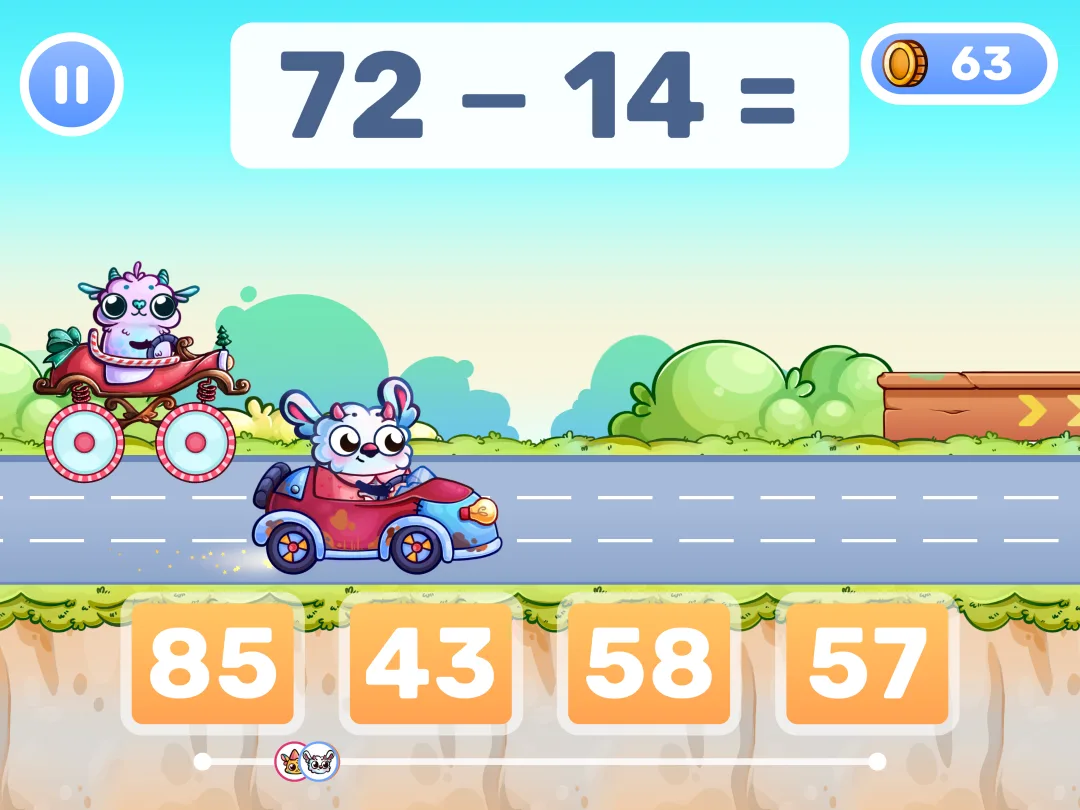
Practice two-digit subtraction, also called double-digit subtraction, within 100 with free MathHero adventure games for kids. Take away tens, like 70 − 30, a one-digit number, like 48 − 3, or another two-digit number, like 52 − 28, with or without regrouping. No account, no download, no ads.
- Numbers up to 100
- With or without regrouping
- Grades 1-2 · ages 6-8
- Free in the browser
- No account, no download
- No ads
- Phone, tablet and computer
Pick a 2-Digit Subtraction Game to Play
All three kinds of problems are ticked to begin with. Tick “No regrouping” for problems like 76 − 24.
Practice Another Subtraction Skill
Smaller facts come first. Two-digit addition uses the same tens and ones from the other direction.
Get MathHero: The Full Adventure
Keep practicing in the MathHero app: a story-driven math game for ages 5-10, from first addition to division.
- Step-by-step learning programs: Addition & Subtraction up to 10, Subtraction up to 20 and Subtraction up to 100 add new facts a little at a time
- Custom Practice: addition and subtraction up to 10, 20, 100 or 1,000
- Typed answers or multiple choice, in Easy, Medium or Hard mode
Free at 5 levels a day, with no ads and nothing locked.

How to Learn 2-Digit Subtraction
To subtract two-digit numbers, split each number into tens and ones, subtract the tens, subtract the ones, and put the two together. When there are not enough ones, regroup: 1 ten makes 10 ones. Every 2-digit difference hides a one-digit fact, like 12 − 8 inside 52 − 28, so the subtraction facts within 20 need to be quick first.
Tens and ones
Every two-digit number is made of tens and ones: 76 is 7 tens and 6 ones, and 24 is 2 tens and 4 ones. Take tens from tens and ones from ones: 7 tens − 2 tens = 5 tens, or 50, and 6 − 4 = 2. Together, 76 − 24 = 52. Base-ten blocks make this easy to see: a rod is a ten, and a cube is a one.
Subtract the tens
Subtracting tens is like subtracting ones, only with tens: 7 tens − 3 tens = 4 tens, so 70 − 30 = 40. Taking 10 from a 2-digit number changes only its tens digit: 10 less than 56 is 46, and 56 − 20 = 36. On the hundred chart below, every −10 is one row up. Finding 10 less in their head, without counting, is a 1st grade goal.
Subtract a one-digit number
In 48 − 3, the tens stay and only the ones change: 8 − 3 = 5, so 45. When there are not enough ones, the answer moves into the previous ten. For 43 − 5, break a ten: 13 − 5 = 8, and the tens go from 4 to 3, so 38. It is the same fact your child uses for 13 − 5 = 8.
Regrouping, step by step: 52 − 28
Regrouping, also called borrowing, is needed when the ones you have are fewer than the ones you take away. Here is 52 − 28 the way it is written in columns:
- Look at the ones: 2 is smaller than 8, so regroup. Break 1 ten into 10 ones. 5 tens and 2 ones become 4 tens and 12 ones.
- Subtract the ones: 12 − 8 = 4. Write 4 in the ones place.
- Subtract the tens, after the broken ten is gone: 4 − 2 = 2 tens.
- 2 tens and 4 ones make 24, so 52 − 28 = 24.
Check by adding the answer back to the number you took away: 24 + 28 = 52. If the sum is the number you started with, the subtraction is right. The same check works without regrouping: 52 + 24 = 76 confirms 76 − 24.
Common mistakes
- 36 for 52 − 28. Your child took the smaller digit from the bigger one in each place: 5 − 2 = 3 and 8 − 2 = 6, and wrote 36. The ones were swapped instead of regrouped. 2 cannot take away 8 until a ten is broken.
- 34 for 52 − 28. Your child did regroup the ones, 12 − 8 = 4, but left the tens at 5, so 5 − 2 = 3. The ten that was broken has to come off the tens. Adding back catches it: 34 + 28 = 62, not 52.
The online games on this page put both slips among the answers: for 52 − 28, your child sees 36 and 34 next to 24 and learns to tell them apart.
Wondering why your child's homework splits numbers into tens and ones? See expanded form in our guide to new math. The matching addition, including how a new ten is made, is on the 2-digit addition games.
Hundred Chart 1-100
On a hundred chart, each row is one ten. One step left takes away 1, and one row up takes away 10: the number above has one fewer ten and the same ones digit. So 2-digit subtraction becomes a path. For 76 − 24, start at 76, go two rows up for the 2 tens (66, then 56), then four steps left for the 4 ones (55, 54, 53, 52).
Regrouping is the step where the tens digit goes down. For 52 − 28, two rows up from 52 lands on 32. Eight steps left then go 31, 30 and on down to 24. The ten is broken on the step from 30 to 29: 30 is still 3 tens, and 29 is 2 tens and 9 ones. On this chart the rows run from 1 to 10, 11 to 20 and on, so 30 ends the row above 31, and the tens digit changes one step after the path moves up a row.
| 1 | 2 | 3 | 4 | 5 | 6 | 7 | 8 | 9 | 10 |
| 11 | 12 | 13 | 14 | 15 | 16 | 17 | 18 | 19 | 20 |
| 21 | 22 | 23 | 24 | 25 | 26 | 27 | 28 | 29 | 30 |
| 31 | 32 | 33 | 34 | 35 | 36 | 37 | 38 | 39 | 40 |
| 41 | 42 | 43 | 44 | 45 | 46 | 47 | 48 | 49 | 50 |
| 51 | 52 | 53 | 54 | 55 | 56 | 57 | 58 | 59 | 60 |
| 61 | 62 | 63 | 64 | 65 | 66 | 67 | 68 | 69 | 70 |
| 71 | 72 | 73 | 74 | 75 | 76 | 77 | 78 | 79 | 80 |
| 81 | 82 | 83 | 84 | 85 | 86 | 87 | 88 | 89 | 90 |
| 91 | 92 | 93 | 94 | 95 | 96 | 97 | 98 | 99 | 100 |
Highlighted: the path for 76 − 24 = 52, two rows up and four steps left. Taking away 10 moves one row up, and taking away 1 moves one step left. All the numbers in a column end in the same digit, because −10 changes only the tens.
What Grade Learns 2-Digit Subtraction?
Two-digit subtraction starts in 1st grade in the US and becomes fluent in 2nd grade, usually at ages 6-8. Common Core standard 1.NBT.C.6 asks 1st graders to subtract multiples of 10, such as 70 − 30, using place value or the relationship with addition. Standard 2.NBT.B.5 asks 2nd graders to add and subtract within 100 fluently, including a two-digit number minus a one-digit number and two two-digit numbers, with and without regrouping.
In England, Year 2 children subtract a two-digit number and ones, a two-digit number and tens, and two two-digit numbers. In Year 3 they move on to column subtraction, including exchanging.
- Age
- 6-8
- US grade
- Grades 1-2
- Standard
- Common Core 1.NBT.C.6, 2.NBT.B.5
- England
- Years 2-3
Learn 2-Digit Subtraction with the MathHero App
How is the MathHero app different from the online games on this page?
The online games on this page are mini-games for short 2-digit subtraction practice. The MathHero app is a full math adventure with step-by-step learning programs, rewards for your hero and saved progress for each child. If your child enjoys these mini-games, try the app: you can play 5 levels a day for free, with no ads and nothing locked.
What Parents Say About the MathHero App
Verbatim from public App Store and Google Play reviews of the MathHero app, with spelling as written. Rated 4.7 on Google Play (48.2K reviews) and 4.6 on the App Store (12K ratings), checked .
“Very easy to use! My 1st grader gets excited about math facts and begs to play!”
“This is a fun game for kids from 1st grade and higher to practice the important basic mental calculations. There are settings to accomodate both slow and fast learners. My daughter enjoys slaying the funny monsters!”
“I love this app for my kids mastering their math facts. They have addition, subtraction, multiplication and division. They have the option to do slow or regular speed, which I like being able to choose slow to make it less stressful for my child.”
2-Digit Subtraction Games: Common Questions
What are the best free 2-digit subtraction games?
How do you subtract two-digit numbers?
What is the difference between subtraction with and without regrouping?
What grade learns 2-digit subtraction?
Can my child practice only subtracting tens?
Are the online games free?
About This Page
Last updated · App ratings checked