
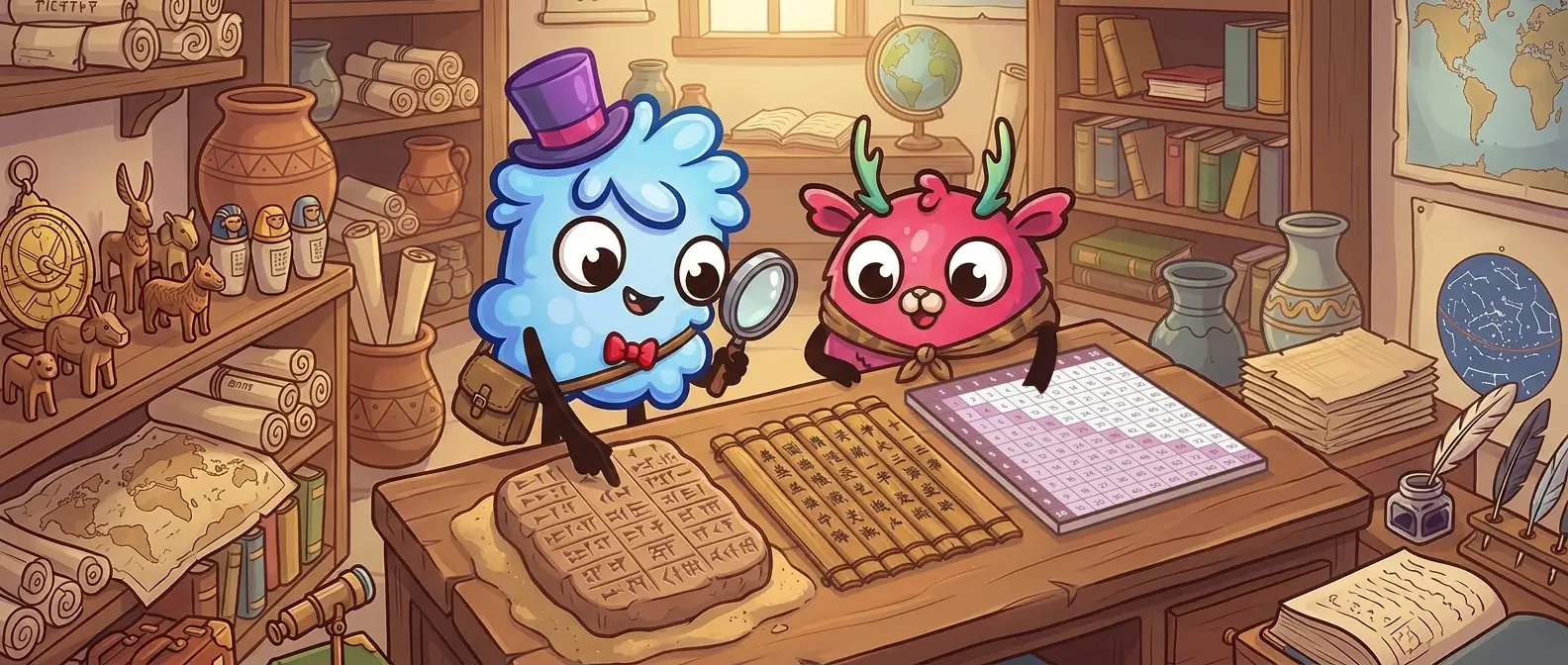
Quick answer: No single inventor is known. Babylonian scribes were using multiplication tables around 4,000 years ago, in a base-60 number system. The oldest known decimal multiplication table is a Chinese example from about 305 BC, written in ink on 21 bamboo strips.
Ancient Egyptians, Greeks and Romans built their own multiplication tables. The neat 10 by 10 grid people learn in school today is a much later European habit. It was shaped over centuries by teachers, printers and mathematics reformers.
Why there is no single inventor
Search "who invented times tables". You will find people arguing about the ancient Greeks, the ancient Chinese and the Babylonians. Here is the honest answer. Multiplication is one of those ideas people keep bumping into on their own, like the wheel or bread.
Whenever a culture starts trading, building or taxing, someone needed a way to perform addition faster and wrote down a shortcut. That shortcut is what a multiplication table really is: rows and columns of numbers so you never have to add the same figure to itself again and again.
To define a multiplication table another way: it is a compact form for looking up products at a glance. Different cultures across the ancient world discovered the same tool at different times, on different materials, in different number systems. So the real question is not who invented times tables. It is which multiplication tables survived long enough for people to find them again.
Time to explore who left the receipts. Each ancient culture answered the same practical question about mathematics: how do we multiply large numbers fast?
Ancient Babylon: multiplication on clay tablets
The oldest surviving multiplication tables come from ancient Babylon, in what is now southern Iraq, from around 4,000 years ago. Babylonian scribes pressed wedge-shaped marks (called cuneiform) into small clay tablets. Hundreds of thousands of these tablets survived; about a thousand are about mathematics.
Here is the twist. The Babylonians did not count in base 10. They used sixty as their main unit. That is why traces of their system still show up in 60 seconds in a minute and 360 degrees in a circle. But they did not memorize a giant 60-by-60 table. Instead, Babylonian scribes used tables for selected numbers and broke harder calculations into smaller pieces.
Picture having a whole library of multiplication shortcuts instead of one neat 10-by-10 grid. That was elementary-school math in Babylon.
China: the world's oldest decimal times table
In 2008, Tsinghua University received about 2,500 ancient bamboo strips. According to the report on the discovery, they probably came from an illegally excavated tomb. The strips were mixed together, and researchers had to work out how they fitted.
When researchers rearranged 21 of them, they realized what they were looking at: the world's oldest known decimal multiplication table, dated to about 305 BC, during China's Warring States period. Over 2,300 years ago.
The top row and right-hand column each list 19 numbers: 0.5, 1 through 9, and 10 through 90 in steps of 10. The entries show their products, much like a modern chart, but written in ink on bamboo. Guinness recognizes it as the oldest decimal multiplication table.
Fun fact: this bamboo table could be used to multiply any whole or half-integer value between 0.5 and 99.5. Serious range for something 23 centuries old.
In Chinese culture, the multiplication tables also live as poetry. Students chanted a rhyming version called the "nine-nine song," with 81 short verses. Japan adopted the same tradition; children there still learn multiplication by chanting the kuku ("nine nines"). Same 81 products, different language, same beat.
Ancient Egypt: multiplying by doubling
The Egyptians took a different route. Around 1650 BC a scribe named Ahmes copied a math scroll now called the Rhind Mathematical Papyrus, kept in the British Museum.
Instead of a grid, the Egyptians used a doubling method. Want 41 × 59? Write 59, double it (118), double again (236), keep going. Then pick the doublings that add up to 41 and add those products. Clever, fast, and it needed almost no memorization. You mostly just needed to be quick with addition and know your powers of 2.
You could argue the Egyptians never really needed multiplication tables at all because their method turned every multiplication into a stack of sums. Different tool, same job.
Greece and the "Table of Pythagoras"
You may have heard the multiplication table called the "Table of Pythagoras." In French, Italian and Russian, that name is still standard, and it shows up in English too. Why?
The credit goes to the Greek mathematician Pythagoras (roughly 570 to 495 BC), the same person famous for the theorem about right triangles. There is no solid proof he actually invented it. But a later Greek writer named Nicomachus, who followed his ideas, put a full multiplication table in his book Introduction to Arithmetic around 100 AD. The oldest surviving Greek example itself is a wax tablet from the 1st century AD, sitting in the British Museum.
The name stuck. In this corner of math history, mathematics often gets named after the most famous person nearby.
From clay tablets to your classroom
In the fifth century AD, Victorius of Aquitaine compiled extensive calculation tables. His Calculus used Roman numerals and covered whole numbers and fractions. Its 98 columns made it a detailed reference for arithmetic.
For centuries, multiplication tables lived in handwritten arithmetic manuscripts. Then came the printing press in the 1400s. Suddenly the same clean grid could be reproduced over and over without having to hand-copy every single one. That helped standardize the picture people recognize today: a neat square with rows and columns of numbers running from 1 up to 10 or 12.
By the 1700s and 1800s, memorizing the times tables by rote (chanting "6 times 7 is 42, 7 times 7 is 49") had become a standard part of school life across Europe and North America. Every generation of students added its own tricks, songs and rhymes to help kids remember.
Cool patterns hiding in the multiplication table
The multiplication table is not just a list to memorize. It is stuffed with patterns that jump out easily once you know where to look. Ideas to explore with a pencil, in the compact form of a grid:
- Trace the diagonal from the top left to the bottom right. Those are the square numbers: 1, 4, 9, 16, 25, and so on. Each one is a number multiplied by itself.
- Look at the 9 times table. From 9 × 1 through 9 × 10, the digits of every answer add up to 9. Try it. Every time.
- Products in the 5 times table end in 5 or 0. Products in the 10 times table always end in 0.
- Any two matching cells on opposite sides of the diagonal are equal. One example: 3 × 7 and 7 × 3 both give 21. That is the commutative property, and it means the whole picture is a mirror.
- Add any two rows together, cell by cell, and you get another multiplication row. For example, add the 3s and 4s, and you get the 7s.
Kids who discover patterns like these stop treating the multiplication table as a stack of random facts. They start seeing a picture, and the more they explore, the more the picture holds together. For the teaching sequence that puts those patterns to work, see how to teach multiplication.
MathHero lets you focus practice on the tables your child needs — the 7s and 8s, say — inside a story-driven game.
Try it freeAre times tables still taught?
Yes. Times tables are still a standard part of primary math in many school systems around the world. But how much rote practice is expected has shifted a lot over time. Especially in the last 40 years. Learning the multiplication tables can take many forms.
In 1989, the US-based National Council of Teachers of Mathematics published new standards that recommended less rote memorization and more reasoning and problem solving. Around the same time, cheap calculators arrived in classrooms, which made the question of what students still needed to memorize an active area of debate. Many US states followed the new standards. For a time, drill lost ground.
Then the pendulum swung back. Newer research (and worried parents) argued that when children do not know 7 × 8 by heart, everything harder gets slower. Fractions, long division, and algebra all get easier when basic products come to mind quickly.
California offers a recent example. Its 2023 Mathematics Framework prompted debate about the place of memorization in math lessons. In a 2025 commentary in The Well News, David Margulies argued that the framework gave too little emphasis to memorizing multiplication facts. The framework provides teaching guidance, while the state's Grade 3 standard still requires children to recall all products of two one-digit numbers from memory.
Short version: times tables are still taught worldwide. The style keeps changing.
Why does the times table go up to 12 × 12?
The 12 by 12 grid is a British and American habit, not a mathematical rule. Most of the rest of the world stops at 9 × 9 or 10 × 10. The English-speaking answer to this question comes from measurements and money built on dozens rather than tens: twelve inches to a foot, and, until 15 February 1971, twelve pence to a shilling in British currency (Bank of England, The National Archives). A child who knew the twelve times table could quickly work out shop prices and imperial numbers in their head, without a pencil.
In a Historical Association article, Karin Doull recalls needing her twelve times table to calculate prices before Britain adopted decimal money in 1971. Today, England's national curriculum expects children to recall multiplication and division facts up to 12 × 12 by the end of Year 4. The money has changed, but the table remains part of school learning.
Turning practice into play
From clay tablets to games, the tools for practicing multiplication have changed. Today, families can fit that practice into a short daily adventure.
MathHero is a story-driven math game for children ages 5–10. Children solve math problems to help characters, earn rewards and move through the story. Parents can focus practice on the tables their child needs, such as the 7s and 8s, and adjust the difficulty and pace. Each child can have their own profile.
The whole game can be completed for free, with a limit of five levels per day and no ads. A subscription, with a free trial, removes the daily limit.
Common questions
Some questions come up over and over on this topic. Here is where you find fast answers, in the words most people ask them in.
Sources
- Phillips, Tony (2012). Old Babylonian Multiplication and Reciprocal Tables. Stony Brook University / American Mathematical Society. Babylonian clay tablets, base 60 and multiplication lists.
- Qiu, Jane (2014). Ancient Times Table Hidden in Chinese Bamboo Strips. Scientific American / Nature. The discovery, dating and use of the Chinese bamboo table.
- Guinness World Records. Oldest decimal multiplication table. The record held by the 21 Tsinghua bamboo strips.
- Chinese multiplication table. Wikipedia. The nine-nine tradition and its different versions.
- Encyclopædia Britannica. Rhind papyrus. The Egyptian mathematical manuscript and its historical context.
- Multiplication table. Wikipedia. The Table of Pythagoras and the history of multiplication tables.
- O'Connor, J. J., and Robertson, E. F. Nicomachus of Gerasa. MacTutor, University of St Andrews. Nicomachus's arithmetic text and its multiplication table.
- Turner, J. Hilton (1951). Roman Elementary Mathematics. The Classical Journal 47. Victorius and Roman arithmetic tables.
- Katz, Victor J., ed. (2016). Sourcebook in the Mathematics of Medieval Europe, p. 13. Princeton University Press. The 98-column tables in Victorius's Calculus.
- Foster, Tony, and Venkatesh, Sai (2022). The powers of the multiplication table. Plus. Mathematical patterns in multiplication tables.
- California Department of Education (2023). California Approves Revised Math Framework. The adoption and aims of California's teaching framework.
- Margulies, David (2025). Poor Guidance From Influential Math Educators Is Impairing Students. The Well News, commentary, May 22. A critique of the framework's approach to memorizing math facts.
- California Department of Education. California Common Core State Standards: Mathematics, Grade 3, 3.OA.7. The requirement to recall products of one-digit numbers from memory.
- Bank of England. Shillings to pounds converter. Pre-decimal British currency and decimalisation.
- Doull, Karin (2021). Fifty years ago we lost the need to know our twelve times tables. Historical Association. A personal account of learning times tables and calculating with pre-decimal money.
- Department for Education. National curriculum in England: mathematics programmes of study. Year 4 expectations for multiplication and division facts.
