

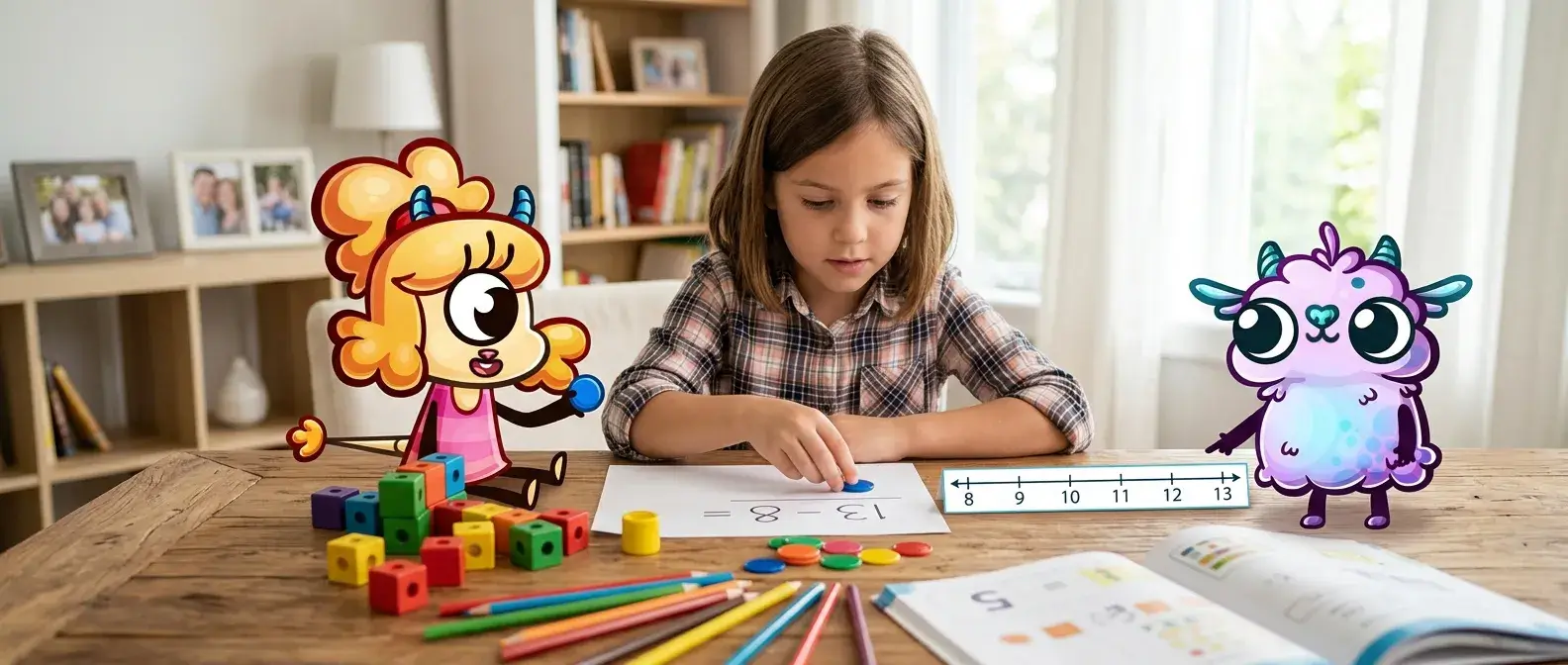
Your child is sitting at the kitchen table, staring at a math problem you know they should be able to do. Maybe you've seen this before. Homework turns into a battle. Your child gets frustrated before they even start. Maybe their report card wasn't what you expected or maybe they've looked at you and said the sentence that makes every teacher-parent's heart hurt: "I just can't do math."
Take a breath.
A child struggling with math does not mean something is wrong with your child, and it doesn't mean you've done something wrong as a parent.
In 2024, only 39% of U.S. fourth graders performed at or above the "Proficient" level on the national math assessment, and "Proficient" on that assessment isn't exactly the same thing as simply being on grade level. Struggling with math is common.
The good news is that there is usually a reason a child is struggling. Once you understand what that reason is, you can start figuring out what kind of support they need.
This guide is for parents of children roughly ages 5–10, from kindergarten through about fourth grade, when kids are building the foundations they will use for addition, subtraction, multiplication, and division. We'll talk about what struggling with math can look like, some of the reasons kids struggle, what you can try at home, and when it might be time to bring the teacher or school into the conversation.
Because when a child is struggling with math, the answer isn't always more practice. Sometimes we need to figure out what they're missing.
What struggling with math looks like
A child struggling with math doesn't always come home with a bad grade. The signs can sometimes be much smaller.
You might notice that your child:
- still counts on their fingers for basic facts long after they've been introduced to them
- makes the same math mistakes over and over
- can complete straightforward computation but gets stuck on word problems
- says "I don't get it" before they've even really started
- takes a very long time to complete simple problems
- avoids math whenever possible
- becomes unusually frustrated, anxious, or upset during math
- suddenly needs a drink, a snack, a bathroom break, or anything else that gets them away from the math homework
Of course, one of these things by itself doesn't necessarily mean there is a problem.
Kids have bad days. They might be tired or burnt out from school or life in general. They may not connect with a particular teaching style. They may simply need more time with a new concept. If the same struggle keeps showing up week after week, across different math topics, then it's probably time to take a closer look.
Here's a simple thing you can do at home: keep a quick math log.
For a week or two, jot down:
- the type of problem they got stuck on
- what your child did
- the mistake they made
- anything you noticed about how they approached it
You might discover that your child understands the basics of addition but consistently struggles when regrouping is involved. They may not struggle with computation at all, but word problems might be where they are having trouble comprehending.
That little bit of information can turn "My child is struggling with math" into something much more specific. When you can identify specific problems, it's much easier to find solutions that work.
Why kids struggle with math
There usually isn't one single reason kids struggle with math. A child may have a gap in an earlier skill or they may not have automatic math facts yet. Some students struggle with anxiety that is specific to math. Other times, there may be a specific learning disability affecting the way the student is learning and understanding mathematics.
The important thing is figuring out which problem you're actually trying to solve. Because the solution for a child who doesn't understand place value is very different from the solution for a child who understands how to solve math problems but freezes during a test.
Let's look at some of the most common possibilities.
A gap in the building blocks
Math builds like a staircase. New skills often depend on the ones underneath them. For example, understanding number relationships helps hold up the multiplication tables.
Sometimes what looks like a problem with the new skill is actually a gap in an older one. A child who is struggling with subtraction may not really have a subtraction problem. They may have a place-value problem.
If you can find that missing piece and work on it, the newer math can suddenly start making much more sense. That's why I don't recommend simply giving a struggling child more and more worksheets on the topic they're having trouble with. First, figure out what is getting in the way.
Math facts that haven't become automatic
Here is something that surprises a lot of parents. A child can understand a math concept and still struggle because the basic math facts that support it aren't automatic yet. When they have to stop and think through every basic fact, that takes attention away from the bigger problem they're trying to solve.
Imagine a fourth grader working on a multi-step multiplication problem. If they have to stop and use most of their mental energy figuring out 7 × 8 = 56, they have less mental energy available for the rest of the problem.
The issue isn't necessarily that they don't understand multiplication. They may simply need more practice building fact fluency. That's why fact fluency still matters.
I also want to make an important distinction here: the goal isn't memorization just for the sake of memorization. We want children to understand what the facts mean and eventually be able to recall them quickly. When basic facts become more automatic, kids have more mental space available for the bigger mathematical thinking we want them to do.
Math anxiety can get in the way
Some kids know more math than they are able to show you when they're under pressure.
Math anxiety can make that especially difficult. Research by cognitive psychologist Mark Ashcraft found that math anxiety can interfere with the working memory people need while solving math problems.
So imagine a child who can calmly explain how to solve a problem at home but completely freezes when they're given a timed math quiz. That doesn't automatically mean they don't know the math. Sometimes the anxiety gets in the way of showing what they know.
If your child seems to understand math when the pressure is low but shuts down when numbers become stressful, that's important information to share with their teacher.
A specific learning difference
For some children, their math struggles are connected to a specific learning disability. One example is dyscalculia, a math-related learning disability that can affect things like number sense, understanding quantities, and learning and remembering math facts. Signs can look different from child to child. A child might have persistent difficulty connecting numbers to quantities, understanding number relationships, remembering math facts, working through math-related word problems, or understanding mathematical procedures.
Math learning disabilities are real, and they may be more common than many parents realize. If your child has persistent difficulty with foundational math skills despite consistent support and practice, it may be worth talking with their teacher or another qualified professional about whether an evaluation would be appropriate.
A learning disability does not mean a child can't learn math.
It means they may need a different path, more time, more concrete representations, or additional support.
Is my child behind, or just going at their own pace?
This is a question that I hear a lot from parents. The answer isn't always straightforward and simple. Kids don't all master every math skill at exactly the same age, and "behind" is a tricky word. Grade-level standards can give us a helpful idea of what students are generally expected to learn, but they shouldn't become a reason to panic over every skill that takes a little longer.
For example, in states that use the Common Core State Standards, first graders work on skills such as comparing numbers and adding within 20. By fourth grade, students are expected to work with concepts such as factors, multiples, prime numbers, and composite numbers. The exact timeline can vary depending on where you live and what curriculum your school uses.
Being a little "behind" on one skill doesn't automatically mean your child has a significant learning problem. Many children struggle with a particular concept, get the support they need, and then move forward.
One of my favorite discussions to have with my 7th graders is about the different types of math. In 7th grade we learn about rational numbers (positive and negative whole numbers, fractions, and decimals), algebra, geometry, and data and statistics. A student who struggles to solve an algebraic equation may excel when reading and interpreting a box plot, or a student who struggles to add fractions may excel when finding the surface area of a rectangular prism.
Math is more than just numbers. It's problem solving and logical reasoning. I try to help my students see that math is diverse enough for them to find an area that resonates with them and that they can be successful with.
What deserves attention is a pattern of consistent difficulty across many math topics, especially if your child seems to be losing skills they previously had. That's when I would recommend talking with your child's teacher and asking what they're seeing at school.
How to help your child at home
Here's some good news! You don't need a teaching degree to help your child with math, and you don't need to recreate your child's classroom at your kitchen table. In fact, sometimes the most helpful thing you can do at home is much simpler.
Pick a couple of strategies that work for your family and use them consistently. You don't need to do everything in this article. A few small things done regularly can be much more helpful than trying every strategy once and burning everyone out.
Start with what your child already understands
If your child is struggling with a new concept, resist the temptation to immediately pile more new information on top of it.
Instead, go back to the last place your child felt solid, the last idea that genuinely makes sense to them, and build forward from there.
I know that can feel like you're going backward. You're not. If a child is missing a foundational piece, filling that gap can make the newer math much easier to understand.
For example, if multiplication is a struggle, you might discover that your child isn't comfortable with skip-counting or doesn't have a strong understanding of equal groups. That is much more useful information than simply knowing that they "aren't good at multiplication." Find the missing piece first.
Practice math facts a little at a time
Research on repeated practice has found that spacing practice out over time can help information stick better than cramming it all into one session.
For a young child, that might mean:
- Practicing a few facts at breakfast
- Reviewing one multiplication fact family in the car
- Playing a quick math game after dinner
- Spending five or ten minutes practicing instead of sitting down for an hour
The goal is steady practice, not a weekly math marathon.
Also, please don't make math facts feel like punishment. If your child is already frustrated with math, a long, stressful practice session may make the emotional part of the problem even bigger.
Make it something they can see and touch
Numbers are abstract concepts, and most young kids think in concrete pictures. Sometimes they need help turning those abstract numbers into something they can actually see and understand.
This is where tools like number lines, blocks, counters, coins, and even fingers can be helpful.
For example, instead of telling a child that 13 − 8 = 5, you could draw a number line and let them see the distance between 8 and 13. You could even put a long number line on the floor and let them physically jump from one number to another.
Math doesn't always have to happen on a worksheet.
Try representing addition, subtraction, multiplication, and division with anything you have in your home:
- Blocks
- Coins
- Counters
- Buttons
- Dry beans
- Fingers
- Paper you can fold or tear
The goal is to help your child connect the symbol to the quantity or idea behind it.
Research from the Institute of Education Sciences supports using multiple representations to help students develop conceptual understanding. So don't be afraid to let your child draw it, build it, move it, and talk about it. Sometimes actually seeing and holding the math makes it click!
Talk about word problems out loud
Word problems can be especially frustrating because they require several skills at once.
Your child has to:
- Read and understand the situation
- Figure out which information matters
- Decide what the question is asking
- Determine what math to use
- Solve the problem
That's a lot!
If your child can do computation but struggles with word problems, don't assume they don't understand the math. Try slowing the problem down.
Read it together. Then ask:
- "Who has what?"
- "What's happening in the problem?"
- "What are we trying to find?"
Have your child draw the situation before trying to solve it. Turning word problems into little pictures can help build problem-solving skills, and it often gives your child a reason to slow down and reread the problem so they understand what to draw.
Watch your own math language
Your kid is listening more closely than you think. When a parent chuckles and says, "Oh, I was never a math person either," it can send the message that being bad at math is something you're simply born with. The idea that you're either born a "math person" or you're not is not a helpful way to think about mathematical ability.
Children can learn and improve. That doesn't mean every child will find every math topic easy. It doesn't mean effort magically makes every struggle disappear.
But it does mean that struggling today does not tell us what a child will be capable of learning tomorrow. Praise persistence and strategy, not just speed and getting the right answer.
So instead of: "You're so smart!"
Try:
- "You kept working even when that was hard."
- "I like the strategy you tried."
- "Let's figure this out together."
We want children to understand that getting stuck is part of learning and not proof that they aren't capable.
That is why labels are risky, even the affectionate ones. The mathematical language you use at home can shape the way your child talks about their own ability in math.
You don't have to give your child a big speech about having a growth mindset. Just stop handing them the "not a math person" story and start teaching them that math is something they can get better at with practice, support, and time.
Turn practice into play
If your child says they hate math, handing them another worksheet probably isn't going to make them suddenly love it.
Games can be a great way to sneak in repetition without making it feel like extra schoolwork.
Try:
- Card games
- Dice games
- Board games
- Games that involve moving spaces
- Counting games
- Quick mental-math challenges
Sometimes changing "It's time to do your math" into "Want to play a game?" makes a pretty big difference. For more ideas, see How to Make Math Fun.
When it is a learning difference: dyscalculia and the ADHD question
Sometimes, ordinary strategies help but the core difficulty stays put. That is when it is worth learning about specific learning disabilities around numbers, so you know what you are dealing with instead of guessing.
Is dyscalculia a form of ADHD? No. Dyscalculia is a specific learning disability affecting mathematics, while ADHD is a neurodevelopmental disorder involving persistent patterns of inattention and/or hyperactivity-impulsivity. They are separate conditions, although they can occur together.
A 2025 study of twins and siblings found that ADHD, dyslexia, and dyscalculia often co-occur and that the correlations among these traits were largely explained by shared genetic influences rather than one condition causing another. Most children in the study who had one of these conditions had only that one condition. A person can have dyscalculia, ADHD, both, or neither.
How common is dyscalculia? An older study of 11-year-olds found developmental dyscalculia in about 4.7% of the children studied. That gives you a sense of why math learning disabilities may show up in a typical classroom, although estimates vary depending on how dyscalculia is defined and measured. Dyscalculia is also much less familiar to many parents than dyslexia.
What does it look like? Signs can include persistent trouble connecting number digits to quantities, understanding basic arithmetic concepts, switching digits in a multi-digit number, remembering math facts, working through math-related word problems, or understanding mathematical procedures.
Some children may also experience significant frustration or anxiety around math.
But here's an important reminder: one difficult week does not mean dyscalculia.
We're looking for a persistent pattern that continues even when a child is getting appropriate instruction and support. If you're seeing that kind of pattern, talk with your child's teacher and ask whether an evaluation might be appropriate.
Also, if your child does have a learning disability, that does not mean they're incapable of learning mathematics. In the past 10 years working as a math educator I have taught more than 300 students with disabilities, and I can tell you this: every one of them was capable of being a math learner.
You just have to find the appropriate strategies and support that work for them.
When to bring in the school
You don't have to figure this out by yourself. Your child's teacher is one of your best resources!
Instead of asking, "How is my child doing in math?" try: "Here's what I'm noticing at home. Are you seeing the same thing at school?" That's a much more useful conversation.
Bring your notes if you've been keeping a math log.
Here are a few other questions to ask your child's teacher:
- What skills does my child seem comfortable with?
- Where are they struggling?
- Is this something you're seeing with other students, too?
- What strategies are you using at school?
- What can we practice at home?
- Does my child respond differently in a small group?
- What additional support is available?
Ask what support already exists. Some schools provide extra help, sometimes in small groups pulled from the regular math class, for kids struggling to catch up on a math topic. Ask how your child does in small groups versus the whole class, too. Some struggling kids who freeze in front of everyone come alive with a few peers and a teacher working more closely with them.
If the difficulty is significant or continues despite support, you can also ask the school about the evaluation process and what additional services or accommodations might be available.
This is where I think the parent-teacher partnership is especially important. As a teacher, I want parents to tell me what they are seeing at home. Sometimes the way a child approaches math at home gives me information I simply can't see during a busy class period. You don't have to walk into that conversation with all the answers. You just need to bring what you're seeing. Parents and teachers have different pieces of the puzzle. When we put those pieces together, we have a much better chance of figuring out what a child actually needs.
The goal isn't for the parent or teacher to solve the problem alone. It's to figure out what is working, what isn't, and what kind of mathematics instruction will help that particular child move forward.
Where MathHero fits
This is where a tool like MathHero can be helpful!
MathHero is a story-driven game for kids ages 5 to 10 where solving math is how you play. Your child rescues characters, earns coins, and collects gear, and to move the story forward they solve short sets of math facts. It builds skills the way they are actually built, through steady practice rather than lectures.
Instead of sitting down for a traditional math drill, they're practicing math as part of a game. For a child who has started to associate math with frustration, that change in context can be meaningful.
You stay in control of what they work on. As the parent, you choose the math topic, set the difficulty, dial the monster speed up or down, and pick whether answers are typed or tapped from multiple choices. That hands-on customization matters for a child struggling with math because you can aim the work straight at the weak spot, say only the two multiplication tables that will not stick, and set a pace that builds confidence instead of dread.
If you have more than one child, each child gets their own topics and difficulty, so siblings at different levels can share the same game without stepping on each other.
That means you can target the specific skills your child needs to practice instead of throwing a giant list of math problems at them.
The game is also designed around short daily sessions, which fits nicely with the general idea of spaced practice: spreading practice out instead of cramming it into one long session.
The free version is fully playable, with no ads or locked chapters, but it does have a daily pace limit, while a subscription removes that limit and includes a free trial.
Now the honest part, before you download anything. MathHero starts with addition within ten. It does not teach counting or number recognition from the ground up, so a child who is not there yet should learn their numbers first.
It builds math skills through structured practice, not video lessons, so it is not where your child will hear a brand-new concept explained from scratch for the very first time. It stays inside core arithmetic: addition, subtraction, times tables, and division, and it will not cover fractions, geometry, telling time, or money. What it does, it does well. It turns the daily math practice a struggling child resists into something they ask to do, so the math learning keeps happening on the days motivation runs low.
No single tool needs to do everything. If your child understands a concept but needs more practice building fluency, MathHero can be one tool in your toolbox.
If your child doesn't understand the concept in the first place, that's where instruction from a teacher, parent, tutor, or other qualified educator becomes much more important.
If the practice-and-motivation piece is the one you have been missing, aim short daily sessions at the exact facts that won't stick.
Explore MathHeroCommon questions
Your child is not bad at math
If there's one thing I hope you take away from this article, it's this: your child is not bad at math. A struggle with math can show us that something isn't clicking yet. It may be missing foundational skills, facts that aren't automatic, or math anxiety getting in the way. Sometimes your child just needs a different way to see the math. Other times they might need additional support.
Whatever the reason, the goal isn't to make your child feel like they are failing at math. The goal is to figure out what they need to move forward.
So the next time your child sits at the kitchen table and says, "I can't do this," try asking them: "Which part feels challenging?"
That's where we can start. Sometimes, finding that one small missing piece is the beginning of a much bigger change.
Sources
- National Center for Education Statistics. The Nation's Report Card: 2024 NAEP Mathematics Assessment, Grade 4.
- Ashcraft, M. H. (2002). Math anxiety: Personal, educational, and cognitive consequences. Current Directions in Psychological Science, 11(5), 181–185.
- van Bergen, E., et al. (2025). Co-occurrence and causality among ADHD, dyslexia, and dyscalculia. Psychological Science, 36(3), 204–217.
- Gross-Tsur, V., Manor, O., & Shalev, R. S. (1996). Developmental dyscalculia: Prevalence and demographic features. Developmental Medicine and Child Neurology, 38(1), 25–33.
- Rohrer, D., & Taylor, K. (2006). The effects of overlearning and distributed practise on the retention of mathematics knowledge. Applied Cognitive Psychology, 20(9), 1209–1224.
- Yeager, D. S., et al. (2019). A national experiment reveals where a growth mindset improves achievement. Nature, 573, 364–369.
- Common Core State Standards Initiative. Grade 4: Operations & Algebraic Thinking, 4.OA.B.4.
- Common Core State Standards Initiative. Grade 1: Operations & Algebraic Thinking, 1.OA.A–D.
- What Works Clearinghouse. Assisting Students Struggling with Mathematics: Intervention in the Elementary Grades. Institute of Education Sciences, U.S. Department of Education.
- Centers for Disease Control and Prevention. Symptoms of ADHD.
- National Institute of Child Health and Human Development. About Learning Disabilities. National Institutes of Health.
- National Assessment Governing Board. (2019). Mathematics Framework for the 2026 National Assessment of Educational Progress. U.S. Department of Education.
