
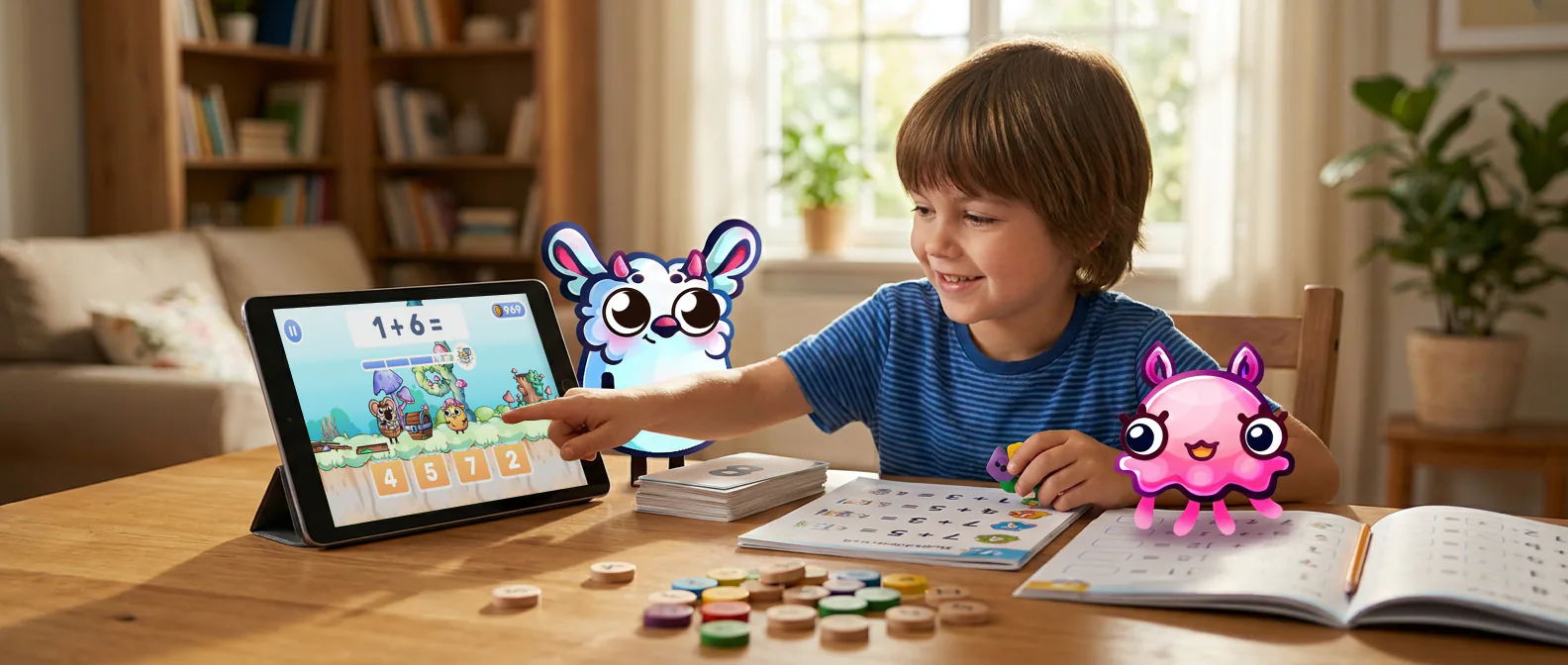
Math game apps do produce real learning, but the honest effect sizes are small to moderate, not life-changing on their own. Meta-analyses pool somewhere between a tiny edge (around d = 0.13) and a modest one (around d = 0.37) over regular instruction.
The best evidence lives at the early math end: short, spaced sessions with a well-designed number game can shift what a 4 or 5-year-old understands about numbers, and the shift can stick, too. How much kids learn also depends on how a game is designed. Transfer to a different kind of problem is much harder than transfer to a similar one, and no learning app has strong evidence that it lifts general reasoning.
The rest of this piece unpacks each of those claims and ends with the four questions worth asking before you install anything.
Why this question matters before you install one more app
You open the App Store, type "math app for kids," and the top results all promise the same two things: your child will have fun, and your child will get better at math. The gap between those two claims is where a parent can get stuck. A game is easy to measure in whether the kid asks for it tomorrow. Learning is slow, invisible, and nobody wants to hand five bucks a month to a slot machine with multiplication facts on it.
Research actually has something to say here. There are meta-analyses pooling dozens of studies. There are randomized controlled trials that followed real kids for weeks or across a full school year. There is a well-known board game study that shaped a lot of later thinking about early math games. And there's a quieter line of work on what actually sticks after the game is turned off. None of it gives a yes or no answer, but together it gives you a much better question to ask.
The research in this article looks at math games from a few different angles. Meta-analyses bring together results from lots of studies to give us a bigger picture of how well digital math games work. Other studies look at specific tools and activities, from math apps to physical number board games.
Some research also explores how kids learn best, including practicing facts from memory and using what they've learned to solve new problems. Together, these findings help us understand how math games can help, what makes them more effective, and what we still don't know. But just because a learning method works doesn't mean every app using it will work. The app itself needs to be tested, too.
What meta-analyses say about digital math games
A meta-analysis is just a careful pooling of many studies into one number. Two of them are the backbone of what we know about digital game-based math learning.
The 2018 meta-analysis: a small-to-moderate effect
Byun and Joung pulled 33 empirical studies on digital game-based learning in K-12 math between 2000 and 2014. Of those, 17 had enough statistical detail to compute an effect size. The pooled weighted result was d = 0.37, which in education research is called a small to moderate effect.
In plain language: kids using game-based math practice did measurably better than kids in traditional instruction, but not dramatically so. The authors themselves concluded that there may be other ways for students to learn math more effectively, and only about half of the empirical studies they found reported enough data to be pooled at all.
The 2019 follow-up: a smaller effect, same direction
A year later, Tokac, Novak and Thompson ran their own meta-analysis across 24 studies covering PreK through 12th grade. They reported an overall effect of d = 0.13, marginally significant at p = 0.02. Positive, but tiny. The authors noted big heterogeneity between studies, meaning some math games worked well, some didn't, and the average hides a lot of design variation.
A later meta-analysis on competition inside game-based learning found an overall effect of d = 0.386 across 25 studies in several subjects, with math among the subjects where competition worked.
What a small effect means for your kid's week
Treat these numbers the way you'd probably treat a nutrition study: real signal, limited magnitude. A d of 0.37 means the average kid in the game groups scored about where a kid at the 64th percentile of the comparison groups did. It's not nothing. It's also not "my child will leap a grade level." Any learning app that promises the second thing is selling.
A decent math game app, used consistently, is a real contributor. It is not a replacement for teaching, and the research literature doesn't say it is.
The Ramani and Siegler board games: clear early-math evidence
Before anyone was writing about math apps on tablets, two researchers were running something simpler. The findings still underpin a lot of what good math apps try to do.
What the 2008 study did
Geetha Ramani and Robert Siegler ran a short randomized intervention with 124 low-income preschoolers. The children played a numerical board game, basically a stripped-down version of Chutes and Ladders with the squares numbered 1 through 10 in a line. Four short sessions, 15 to 20 minutes each, over two weeks. The control group played an identical game except the squares were colored rather than numbered.
That's it. Roughly an hour of total game time. The skills the game works on (count, compare, match a number to a quantity) are the ground every later topic sits on.
What stuck after 9 weeks
The children who played the number game improved on four distinct things: numerical magnitude comparison (which of two numbers is bigger), number line estimation (where does seven belong between zero and ten), counting, and numeral identification. The children who played the color game didn't improve on any of them.
Here's the part worth sitting with. When the researchers tested the kids again 9 weeks after the intervention ended, the gains were still there. From roughly an hour of focused, well-designed play.
Why the linear board mattered
In a follow-up study, Siegler and Ramani ran the same experiment but compared a linear number board to a circular one. Kids who played with the linear board got better at understanding numbers than those who used the circular board, especially at comparing number sizes and placing numbers on a number line. So how a game shows numbers matters, not just whether kids are playing a game. The idea is that a straight, left-to-right number line helps children connect the positions of numbers with their relative sizes. Each move gives them another chance to practice that connection.
The takeaway for apps is specific, not vague. Game design matters more than game presence. A math app whose underlying structure teaches the thing you want learned is more likely to work. An app that just gilds a drill with stars will mostly entertain.
The Berkowitz 2015 iPad math app RCT
For a bigger, parent-involved trial, the one that gets cited most is the Bedtime Math study.
What the trial measured
Berkowitz and colleagues at the University of Chicago ran a randomized field experiment with 587 first-grade families. Four hundred and twenty were given iPads with Bedtime Learning Together, a math-story app meant to be used by parent and child together. The remaining 167 got the same format but with a reading comprehension app. Both groups used them across a school year. The researchers measured math achievement before and after.
The headline result published in Science: the math app raised children's math achievement over the school year, especially for children whose parents had high math anxiety. In the data, the benefit was concentrated in those families and grew the more often they used the app. The authors framed it as a way to break the intergenerational cycle of low math achievement.
What the critique added
The study is important partly because the debate about it is also important. A reanalysis by Michael Frank, published in Science as a formal comment on the original paper, concluded that the trial failed to find strong evidence that the app works, with no significant effect of the intervention on math performance overall. The Berkowitz team stood by their conclusions.
The honest reading: it's one of the better-designed math-app field trials there is, the benefit showed up in one group of families rather than across the board, and reasonable statisticians disagree on how much that subgroup result proves. If the best-studied family math app lands in a "yes but" zone, be skeptical of any app whose marketing lands in "transforms your child."
Retention: what kids actually keep
A number that goes up on a posttest the day you finish the intervention is nice. A number that's still up a month later is the one that matters.
Delayed posttests: the honest picture
The Ramani and Siegler 9-week follow-up is one of the cleanest signals that short game-based practice can produce lasting change in early number understanding. Few studies in the broader meta-analyses test kids again weeks or months later, so there isn't enough long-term data to predict how much of a given app's effect will last. Expect retention to require revisits, not a single run.
Why short daily sessions beat marathon weekends
The decades-old finding that practice distributed across days beats the same minutes crammed into one session shows up everywhere, and math is no exception. The Ramani-Siegler intervention worked at four 15 to 20 minute sessions across two weeks. That's a plausible template for home math practice: short, frequent, regular. A kid who plays 10-15 minutes a day, five days a week, is likely doing more useful work than a kid who crams the same hour into one Saturday sitting.
Retrieval practice vs restudy
For math fact fluency work in particular, there's one effect worth knowing about. In a classroom experiment with second graders learning multiplication, researchers compared retrieval practice using flashcards against restudy by chanting the multiplication facts out loud. Retrieval practice produced stronger fluency gains, both right after practice and a week later.
The implication for an app: a loop that asks "what is 7 × 8" and makes the child answer actually practices math facts more effectively than one that shows the answer and asks the child to repeat it.
That is why fluency practice inside a game is a reasonable fit. The game is just the carrier for a lot of small retrieval attempts, which is exactly what cognitive science says builds math facts into long-term memory. Build enough of those retrieval attempts and you get math fluency: facts recalled fast and without strain.
Near transfer vs far transfer: the honest limit
This is the part the marketing never covers, and it is the single most important idea when you're evaluating any claim about an educational game.
What transfers easily
Near transfer is when a skill carries over to something very similar. Practicing addition within 10 on an app transfers reasonably well to doing addition within 10 on a worksheet. Practicing multiplication facts as a game transfers to multiplication facts on a timed classroom quiz. In cognitive terms, the two tasks share "common elements," which is why the skill carries.
What rarely does
Far transfer is when a skill is supposed to carry to something structurally different. Think: "playing a math game improves general problem solving." Or: "chess makes you better at math." Or: "brain-training apps raise overall intelligence." Large meta-analytic reviews on this question keep landing in the same place. In a widely cited review of chess, music, and working-memory training, Sala and Gobet concluded that far transfer of learning rarely occurs. Training mostly improves the thing you trained and tasks that look a lot like it.
Why "trains your brain for math" is a weak claim
If an app says it builds number sense through numerical practice, that is a near-transfer claim and it is defensible. If an app says it builds "logical thinking" or deeper problem solving through an unrelated puzzle minigame, you're being sold far transfer, which the evidence does not support. Judge an app on what it drills, not on what it promises your child will become.
What makes a math game app actually work
Pulling the research threads together, a short list of features that correspond to the designs that actually have evidence behind them.
Math is the mechanic, not the toll
In the Ramani-Siegler board game, moving the token was the math. The child said "6, 7" to move two spaces from 5. Compare that to apps where the child solves one math problem to earn 30 seconds of a shooter. The second kind is a reward trap. The game part can keep the child in the chair, but the math part was over in seconds and happened only to open the door to something else.
Look for games where solving math problems is part of the gameplay, not just a way to unlock something else.
Spaced repetition built in
A good math app brings a fact back on a schedule rather than letting the child master it once and never see it again. This is just distributed practice in disguise, and it is the mechanism that moves math facts from "I can get it with effort" to "I have it automatically." It also matters more than any single bell or whistle, including adaptive engines, since an adaptive layer without strong spaced retrieval underneath is a slower drill in a nicer wrapper.
Difficulty you can actually set
Research-backed design doesn't throw a child into the deep end. The best interventions start where the child is and move up a step at a time. In practice, for math apps worth paying for, that means per-topic, per-operation settings a grown-up can configure, not a single global difficulty slider.
This is one lever that separates MathHero from drills with graphics: a parent picks the exact band to work on (addition within 10, multiplication facts, subtraction up to 100) and can set the speed and answer format for an individual child.
Feedback that doesn't punish mistakes
Mistakes are information in math. An app that treats a wrong answer as a chance to try again on a close variant, with no mounting penalty, keeps the child in the practice loop. An app that locks a level, flashes "WRONG!", or costs a life for an error can teach avoidance instead. For children with any existing math anxiety, this difference is huge, and math anxiety in elementary school kids is more common than parents often realize. For a kid who's already stuck or anxious about math, the pre-work before any app often matters more than which app you pick.
Want to see math as the game mechanic? MathHero is free to play at five levels a day.
Explore MathHeroRed flags: when "game" is wrapping thin practice
A few patterns to watch for when you're trying an app with your child.
Reward loops that outlive the math
If the child plays for 20 minutes and the actual math exercises add up to maybe 90 seconds of retrieval work, the app is a reward loop with a math garnish, not the best math game for a daily routine. If there isn't much practice, there won't be much gain.
One-and-done content with no revisit
If the app teaches 7 × 8 once, moves on, and never brings it back, that fact isn't being built. The retrieval-practice literature is clear that durable fluency requires repeated return visits across days and weeks. Timed math drills on paper, oddly enough, often do this better than slick educational apps that treat each level as a one-pass checkbox.
Ads inside the practice loop
The worst versions of free math apps monetize attention. Every two problems is an ad. The child learns that math is interrupted, not immersive, and the practice loop is broken on purpose. This is unrelated to game design and purely a business model problem, but it most likely kills whatever learning effect the app could have had.
How this changes your math app pick
Everything above collapses into four practical questions you can ask before downloading anything.
- Does the app actually get my child solving a lot of math per session, or is the math a toll on the way to something else?
- Does it bring math concepts back on a schedule, or is each topic a one-pass checkbox?
- Can I pick exactly the thing my kid needs to work on today, not just the thing the app wants to serve next?
- And does the loop treat mistakes as something to retry, or as something to punish?
A math app that answers yes to all four gives your child the kind of practice the research supports: a lot of short retrieval attempts, spaced across days, with the child willingly in the seat. Which, if you ask the question honestly, is what good math practice looks like whether or not there's a screen involved.
If you want a game-driven app for ages 5 to 10 where solving addition, subtraction, multiplication and division is the gameplay itself, that's how MathHero is built. The whole game can be played free, with no ads, at five levels per day, which, perhaps counterintuitively, is close to the amount of daily math practice recommended for kids anyway. A subscription (with a free trial) removes the daily limit. If you want to see how specific apps answer those four questions side by side, our roundup of the best math apps for kids walks through twelve of them. If you homeschool, our guide on whether math apps work for homeschool covers why kids quit and when to switch.
Common questions
Bottom line
Math apps can help kids build math skills, but results depend on what they practice and how the app supports that practice. Look beyond the graphics and marketing: choose an app that fits your child's needs and gives them meaningful chances to learn.
Pick on the mechanics, not the marketing.
Sources
- Byun, J., & Joung, E. (2018). Digital game-based learning for K-12 mathematics education: A meta-analysis. School Science and Mathematics, 118(3-4), 113-126.
- Tokac, U., Novak, E., & Thompson, C. G. (2019). Effects of game-based learning on students' mathematics achievement: A meta-analysis. Journal of Computer Assisted Learning, 35(3), 407-420.
- Chen, C.-H., Shih, C.-C., & Law, V. (2020). The effects of competition in digital game-based learning (DGBL): A meta-analysis. Educational Technology Research and Development, 68(4), 1855-1873.
- Ramani, G. B., & Siegler, R. S. (2008). Promoting broad and stable improvements in low-income children's numerical knowledge through playing number board games. Child Development, 79(2), 375-394.
- Siegler, R. S., & Ramani, G. B. (2008). Playing linear numerical board games promotes low-income children's numerical development. Developmental Science, 11(5), 655-661.
- Siegler, R. S., & Ramani, G. B. (2009). Playing linear number board games, but not circular ones, improves low-income preschoolers' numerical understanding. Journal of Educational Psychology, 101(3), 545-560.
- Berkowitz, T., Schaeffer, M. W., Maloney, E. A., Peterson, L., Gregor, C., Levine, S. C., & Beilock, S. L. (2015). Math at home adds up to achievement in school. Science, 350(6257), 196-198.
- Frank, M. C. (2016). Comment on "Math at home adds up to achievement in school". Science, 351(6278), 1161.
- Sala, G., & Gobet, F. (2017). Does far transfer exist? Negative evidence from chess, music, and working memory training. Current Directions in Psychological Science, 26(6), 515-520.
- Ophuis-Cox, F. H. A., Catrysse, L., & Camp, G. (2023). The effect of retrieval practice on fluently retrieving multiplication facts in an authentic elementary school setting. Applied Cognitive Psychology, 37(6), 1463-1469.
