
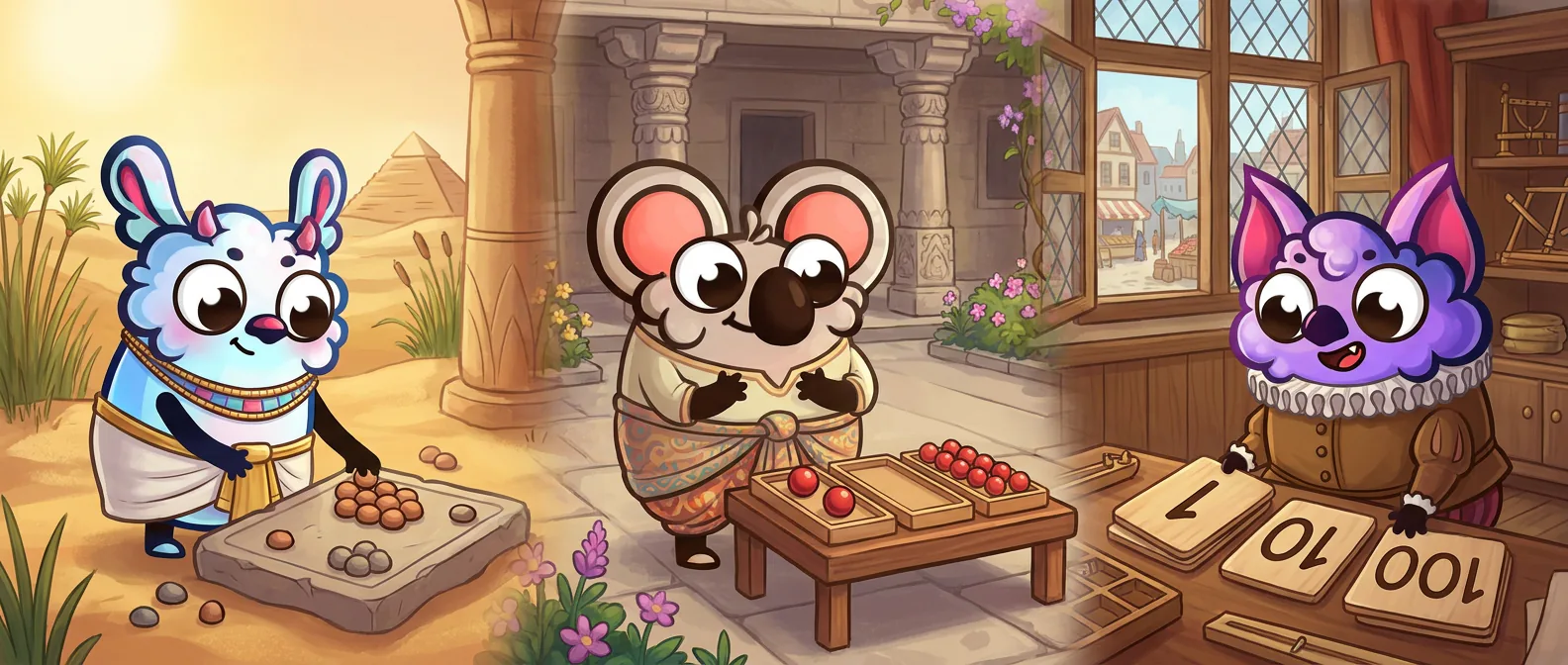
You count in tens because you have ten fingers. Base 10 is the number system that groups everything into tens. Many historians think base 10 took hold because our hands came with a built-in counting kit: ten fingers, always on you, impossible to lose.
What Is Base 10?
Base 10 is a number system that groups numbers into tens using the ten digits 0, 1, 2, 3, 4, 5, 6, 7, 8 and 9. You will also hear this counting system called the decimal system, the decimal number system, or base ten. With it, you can write any whole number using just those ten digits. Add a minus sign or decimal point, and you can write negative numbers and decimals too.
It is the number system you use to read and write every number you meet in a day, from a house number to a grocery total, and these are the numerals your child is learning to read and write at school.
Here is the move that makes the whole thing tick. Count upward and watch what happens when you reach nine. There is no single digit for "ten." So instead of inventing a brand new symbol, you reset the ones digit back to 0 and drop a 1 into a new column on the left: 10.
For example, that is why 10 is written with a 1 and a 0 rather than one fresh symbol. Count ten more and you reset again: 20. Every number you have ever written runs on that one rule. Fill a column, carry one to the next.
That's base 10 in a nutshell: ten digits, and a new column whenever you reach the next power of ten.
Why Tens? Look at Your Hands
The simplest explanation is sitting at the ends of your arms. The most common explanation is that base 10 caught on because humans have ten fingers, and fingers are the first calculator anyone ever owns. Count to ten, run out of fingers, make a mark, start over. Do that for a few thousand years and tens become the obvious way to group things.
You can watch it happen with a five-year-old. Ask them to count a pile of blocks and their fingers come up on their own. The hands just do it, and ten is where they stop. It shows up in how we talk, too: in many languages the words for eleven and twelve are old leftovers meaning "one over ten" and "two over ten."
Is it proven? No. We cannot ask the humans who first grouped things in tens, and a few ancient civilizations went other ways (more on them below). But finger counting appears again and again across languages and continents, and that is why the ten-fingers story is the one most historians reach for. The honest version: it is the best explanation we have, not a receipt.
The Real Trick Isn't Ten Digits. It's Place Value
Base 10 only turns powerful when you add place value: the idea that the same digit is worth different amounts depending on where it sits. The digit 3 in the number 3 is worth three. The same digit in 30 is worth thirty. One digit, new column, ten times the value.
Read any whole number from right to left and each position is worth ten times the one before it. Ones, then tens, then hundreds, then thousands, each column ten times larger than its neighbor. That is why 7 and 70 and 700 are built from the same digit yet mean wildly different things.
The position of a digit determines its value, not the digit alone. A quick way to explain it to a kid: the digit tells you how many, and the column tells you how much each one is worth. Each digit draws its value from the position it sits in. The first digit of 70, for instance, is a 7 in the tens position, and moving that digit one position to the left would make it worth ten times more.
| Column | Thousands | Hundreds | Tens | Ones |
|---|---|---|---|---|
| Value of the place | 1,000 | 100 | 10 | 1 |
| Digit in 2,408 | 2 | 4 | 0 | 8 |
| What it means | 2,000 | 400 | 0 tens | 8 |
This is exactly what your child is doing the first time they add two digits: lining up the tens column with the tens and the ones with the ones. Practicing tens and ones is base 10 in action, even when nobody says the words out loud. Once a child sees that the left digit in a two-digit number counts tens, carrying and borrowing stop feeling like tricks.
Where zero comes in
Place value needs one more piece, and it is a sneaky one: a symbol for nothing. If the tens column is empty, you still have to hold its spot, or 208 collapses into 28. That is the whole job of the zero in 208: it holds the empty tens so the 2 stays in the hundreds and the 8 stays in the ones. Those zeros are not decoration. They are placeholders.
Trailing zeros do the same work in 200, where two zeros hold two empty columns open so the leading digit lands in the hundreds, and you need three zeros in 1,000 to push the 1 all the way into the thousands. Leading zeros, by contrast, add nothing: 007 is just 7.
Treating zero as a real number, and not just a gap on the page, took humans a surprisingly long time. The rules for it were written down in India by the mathematician Brahmagupta in 628 CE, who defined zero as what you get when you subtract a number from itself. That is a bigger leap than it sounds, and it has its own kid-friendly story worth telling on another night.
Quick Trip Through the History of Base 10
Base 10 was not invented in one place on one afternoon. It was built up, piece by piece, by people who never met and mostly never heard of each other. The numerals and the place-value trick arrived from different times and places. Here is the short version, in order.
Ancient Egypt, around 3000 BCE. The Egyptians already counted in tens, some of the earliest traces of base ten we have. They used a different hieroglyph for one, for ten, for a hundred, for a thousand, and so on up. It was base 10, but it had no place value: to represent a big number you drew a lot of symbols and counted them up. It worked. The way large numbers were written was just slow, with no neat column system doing the heavy lifting.
India, by the 7th century. The leap that made modern numbers possible happened on the Indian subcontinent, where Indian mathematicians combined those ten symbols, place value, and a working zero into one number system.
By the time Brahmagupta pinned down how zero behaved in 628 CE, you could represent any number at all with just ten symbols and a set of columns. No new symbol every time the count climbed higher. That combination is the decimal system we still use, and it is why it later became the global standard.
Europe, 1200s to 1500s. The numerals we now call Hindu-Arabic traveled west over centuries, slowly pushing out the Roman numerals Europe had leaned on for ages. An Italian mathematician Leonardo of Pisa, better known as Fibonacci, laid them out for European readers in 1202 in a book called Liber Abaci, urging merchants to drop the clumsy Roman numerals and switch to the Hindu-Arabic numerals with place value.
Centuries later, a Flemish mathematician Simon Stevin published a short booklet in 1585 that brought decimal fractions into everyday use, in a notation that later developed into the decimal point. Stevin did not invent decimal fractions (Arab and Chinese mathematicians had used them earlier), but he is the one who talked Europe into the decimal numbers we write today.
| When | Who | What they added |
|---|---|---|
| ~3000 BCE | Ancient Egypt | A base 10 system with a symbol for each power of ten, but no place value |
| 628 CE | Brahmagupta, India | Rules for zero as a number in the Indian decimal place-value system |
| 1202 | Fibonacci, Italy | Carried the Hindu-Arabic numerals and place value into European trade |
| 1585 | Simon Stevin, Low Countries | Popularized decimal fractions in Europe, in a notation that later led to the decimal point |
If your kid is the type who asks "but who made this up?", there is a whole kid-friendly history of math to read next, plus a companion on who invented times tables.
Other Number Bases People Have Used
Base 10 won, but it was never the only option. Different civilizations built their counting systems around different numbers, and a few of these other number bases are still hiding in your daily life. Here are the number bases worth knowing.
Base 20, the Maya. The Maya counted in twenties, a system called vigesimal, using just three numerals: a dot for one, a bar for five, and a shell for zero. Their base-20 counting system was positional, like ours, and they worked out a zero of their own, independently of India. Why twenty? The usual guess is fingers and toes. Count everything you can reach on your own body and you land on twenty. Base-20 leftovers still turn up in a few languages today.
Base 60, the Babylonians. The Babylonian counting system, borrowed from the earlier Sumerians, ran on sixties. It sounds wild until you check a clock. There are 60 seconds in a minute and 60 minutes in an hour because of that old base-60 system, and a circle probably has 360 degrees for the same reason. Sixty is handy because it divides cleanly so many ways (into halves, thirds, quarters, fifths, sixths), which is exactly what you want when you are splitting up time and angles.
Base 12, the dozen. You still count in twelves more than you notice. A dozen eggs. Twelve inches in a foot. Twelve hours on the clock face. Twelve is another number that divides nicely, which is probably why it hung on for buying things by the dozen.
Base 2 and base 16, the machines. Your phone and laptop do not count in tens at all. Computers operate in binary, base 2, which uses only two digits, 0 and 1, mapping neatly onto "off" and "on." A single binary digit is either a 0 or a 1, and computers store every number, letter and image as long runs of those digits under the hood.
Because long strings of zeros and ones are painful to read and write, programmers also lean on the hexadecimal system, base 16, as a shorter way to represent the same binary numbers.
Hexadecimal works like base 10, but uses sixteen symbols: the digits 0–9 and the letters A–F. In all of these other number bases the core math works the same way, with each column a power of the base rather than a power of ten. For example, in base 16 one column counts all the way up to fifteen before it rolls over into the next.
Binary is worth a closer look because it shows the column trick running on a different base.
What is 11111111 in base 10?
In base 10, the binary number 11111111 is 255. Each binary column is a power of 2 instead of a power of 10, so reading from right to left the columns determine values of 1, 2, 4, 8, 16, 32, 64 and 128. Add those eight values together and you get 255. That is why 255 turns up all over computing: it is the largest number you can store in eight bits when they're treated as an unsigned number.
What is 10101 in base 10?
In base 10, the binary number 10101 is 21. Reading the columns from right to left as powers of 2, they determine values of 1, 2, 4, 8 and 16. Add the columns that hold a 1, which are 16, 4 and 1, and you land on 21. Same column logic as the decimal system, just built on twos. Computers handle numbers like these millions of times a second.
Where Your Child Meets Base 10 Every Day
Counting in base ten is not a museum piece. It is the machinery under almost everything your child counts. Money runs on it: a dollar splits into 10 dimes and 100 cents, with the decimal point marking where the whole dollars stop and the cents begin, so prices are really just decimal numbers.
The metric system runs on it too, where every step up or down is a jump of ten (ten millimeters in a centimeter, a hundred centimeters in a meter), so measurements and their decimal numbers are easy to convert. A length like 2.5 meters is a decimal number, with the decimal point doing the same job it does in a price.
Even the "just add a zero" shortcut is pure base 10. With whole numbers, multiplying by 10 moves every digit one column to the left, leaving a zero in the ones place. Multiplying by 100 moves the digits two columns to the left. With decimals, the decimal point moves too.
You can watch that pattern with the 10 times table, where every answer is the first number with a zero stuck on the end. Those trailing zeros are place-value in action.
So when a child learns place value, they are not memorizing a classroom rule. They are picking up the logic the whole world agreed on, the same understanding that makes money, measurements and mental math click into place at school and at home. Get the tens and ones solid early, and bigger calculations (carrying, borrowing, long multiplication) stop feeling like magic and start feeling like columns. For example, 40 times 7 is just 4 times 7 with a zero added because the 4 is sitting in the tens column.
That is where a bit of playful practice helps. MathHero is a story-driven game where you pick the exact skill your child needs, say 2-digit addition or multiplication, and the math becomes how they move the adventure forward.
You set the topic, the difficulty, the answer format and the monster speed, with separate settings for each child in the family. It covers addition, subtraction, multiplication and division, starting from first addition within 10, and it is free at five levels a day. A few short, regular sessions can make fact practice easier to fit into the day.
None of this changes the big idea, though. You count in tens for the oldest reason there is: look down, and there are ten of them.
Common Questions
Sources
- John J. O'Connor and Edmund F. Robertson, Brahmagupta, MacTutor History of Mathematics Archive, University of St Andrews.
- John J. O'Connor and Edmund F. Robertson, Simon Stevin, MacTutor History of Mathematics Archive, University of St Andrews.
- John J. O'Connor and Edmund F. Robertson, Leonardo Pisano Fibonacci, MacTutor History of Mathematics Archive, University of St Andrews.
- Peter Schumer, When did humans first learn to count?, The Conversation.
- Michael A. Lombardi, Why is a minute divided into 60 seconds, an hour into 60 minutes, yet there are only 24 hours in a day?, Scientific American.
- David Lippman, The Mayan Numeral System, Math in Society (LibreTexts).
