
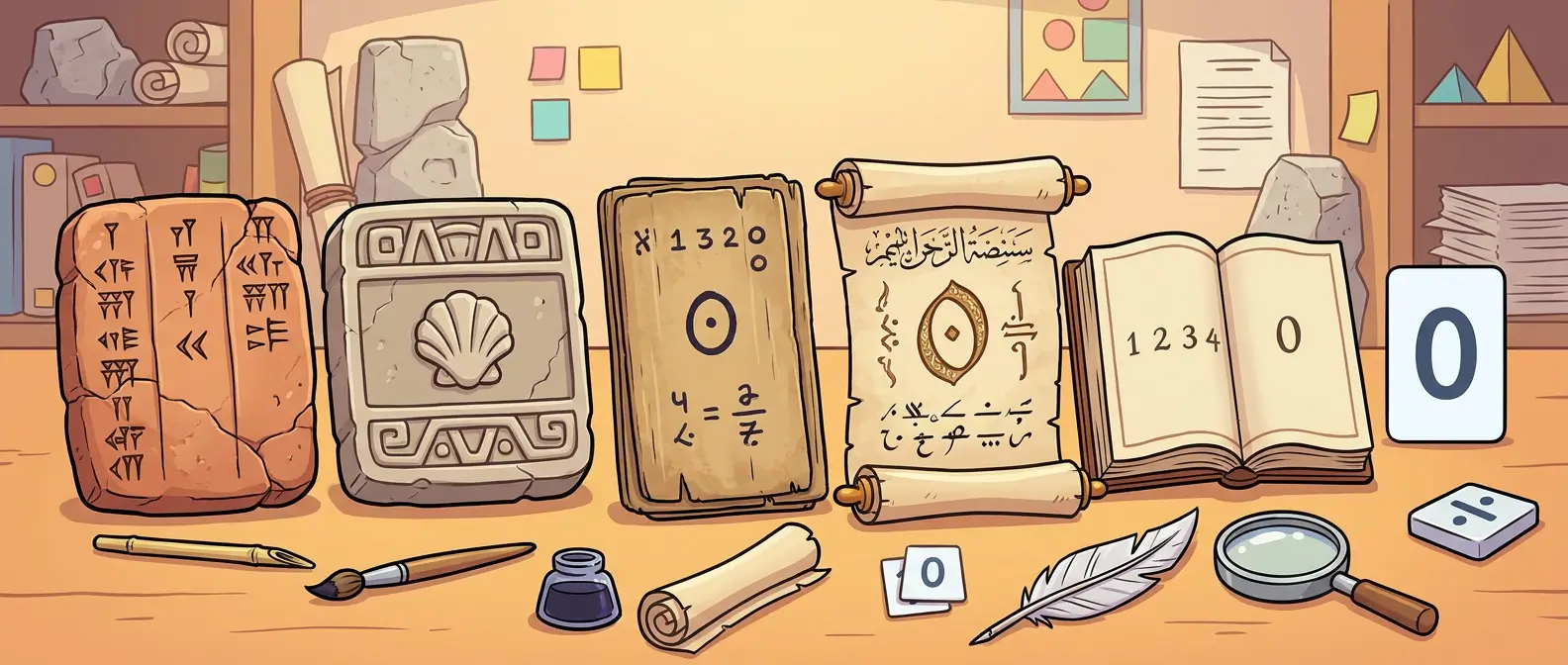
No single person invented zero. Different cultures developed different ways to use it. Babylonian scribes used marks for empty places in written numbers. The Maya developed zero independently in Mesoamerica, often representing it with a shell-shaped symbol. In India, Brahmagupta wrote rules for calculating with zero in 628 CE.
Scholars in the Islamic world helped spread the Indian decimal system. The Persian mathematician al-Khwarizmi explained it in the 9th century, and Fibonacci helped popularize it in Europe with his 1202 book, Liber Abaci.
That's the short version. The long version is a great story, and it's worth telling your kid over dinner.
Two different jobs for one little symbol
Before you can answer "who invented zero," you have to know that zero does two very different jobs in mathematics.
Job one: placeholder in positional number systems. The digit 0 in 205 is not really a number you are counting. It is a marker that tells you the tens position is empty, so the digit 2 in the hundreds decimal place has the value of two hundred, not twenty. Without a placeholder, 25 and 205 would look the same on the page. Messy. That's why every positional system needs some way to denote an empty decimal place, to avoid confusion in written arithmetic. The concept of a placeholder solves that problem in one stroke.
Job two: a number in its own right. The 0 in "3 minus 3 equals 0" is a real quantity with meaning. It sits on the number line. You can add it, subtract it, multiply it, and use it in every kind of calculation. That version of zero helped make algebra, calculus, and modern computing possible. It is the concept of zero as an actual value, not just a mark on a page.
Different cultures developed ways to mark an empty place. In India, mathematicians wrote rules for calculating with zero as a number. This one shift, from placeholder to standalone value, is why the history of zero is so tangled.
The Babylonians: an empty space, then two little wedges
Roughly 4,000 years ago in what is now Iraq, Babylonian scribes wrote on clay tablets using a wedge-shaped script called cuneiform. Their number system was based on 60, not 10. And it used positional notation, meaning the position of a digit changed its value. Numbers were divided across columns for the ones, sixties, and higher positions.
For a long time, they had no zero at all. If a column was empty, they just left a space and hoped you could tell from context. By about the 3rd century BCE they got tired of the guesswork and started drawing two small slanted wedges to indicate that "nothing goes here." That was the earliest known use of a written placeholder for zero in human history. It stands as the earliest such symbol in Mesopotamian records.
But it was only a placeholder, not a number. Babylonian scribes never treated those slanted wedges as a value you could add or subtract. You could not solve "5 minus 5" and get "two wedges." Zero was still a signpost, not a passenger.
The Babylonians did the calculations that eventually became the mathematics of the ancient world. They tracked planets, taxes, and grain harvests. And yet their zero stayed frozen at that placeholder stage for centuries. It could indicate an empty column in a written number, but it never took on a value of its own. For example, a Babylonian scribe could write a symbol showing that the sixties place was empty. But there was no example of a scribe adding or subtracting the placeholder in a calculation.
The Maya: a shell in the jungle
Across the ocean, on the other side of the world, the Maya civilization of Central America invented their own zero. No known contact with Babylon or India.
One Maya symbol for zero looked like a shell. Zero helped them record dates and calculate spans of time. Their Long Count calendar used a place-value system based mainly on 20, with an adjustment for days and years.
A fragment from Stela 2 at Chiapa de Corzo in Mexico is often dated to 36 BCE. But that date depends on reconstructing a damaged inscription, and the reconstructed Long Count date, 7.16.3.2.13, contains no zero. It is evidence of an early calendar, not a shell-shaped zero carved in that year.
The Maya story developed independently of the history of zero in the Old World.
In India, another important part of the story took shape: written rules for calculating with zero.
India: zero grows up and becomes a number
Now for the main event. The zero on your phone screen right now, the round symbol with rules attached, grew up in India.
Indian scholars were thinking about "nothing" as a concept long before they had a symbol for it. In Sanskrit, they used the word śūnya, meaning "empty" or "void." That word matters. It means Indian thinkers were already comfortable with the concept of zero as a mathematical object before they drew a symbol for it. Most cultures worked in the other direction: symbol first, meaning later.
By the 5th century CE, the great Indian mathematician Aryabhata was using a positional decimal system in his astronomical work, the Aryabhatiya. He did not draw a zero, but his whole method needed the concept of empty positions. His work helped set the stage for later Indian mathematics.
Then came Brahmagupta, born in 598 CE in India. In his book Brāhmasphuṭasiddhānta, written in 628 CE, he did something groundbreaking. He treated zero as a number and wrote down rules for working with it. He gave zero the role we call the additive identity in modern mathematics. Adding zero to any number leaves that number unchanged. Subtraction of zero from any number keeps the value the same. Any number multiplied by zero results in zero, so 8 multiplied by 0 equals 0. He also worked with negative numbers, which he called "debts," and positive numbers, which he called "fortunes." His example gave zero a set of clear mathematics rules, not just a shape.
Brahmagupta got one thing wrong, at least by modern standards. He said zero divided by zero equals zero. Today mathematics says it is undefined. Everyone gets a little grace after 1,400 years.
So if someone asks you "who gave zero its first written arithmetic rules?" the answer is Brahmagupta. He was the first person we know of to define zero and give it the arithmetic rules that let it act like every other whole number.
The Bakhshali manuscript: the world's oldest written zero symbol?
You may have read that the Bakhshali manuscript contains the world's oldest written zero. That claim became widely known after Oxford announced radiocarbon results in 2017, placing some of its birch bark in the 3rd or 4th century CE.
An Oxford report published in October 2024 revised those results. Its model places the manuscript's production broadly between the late 8th and early 12th centuries. Radiocarbon tests date the bark, not the ink or the origin of the mathematical ideas. The manuscript remains an important record of dots used as zero placeholders in a decimal place-value system, but the early dating behind the headline is no longer supported.
Truth is, we do not know the exact year or place the round symbol you write today first appeared. What we know is that by Brahmagupta's time, in 628 CE, zero was already a working part of Indian mathematics. The round symbol evolved from a small dot that Indian scribes had been using as a placeholder in the decimal place system for centuries. The written form of zero developed slowly. The small dot eventually evolved into the round symbol we use today.
Zero travels: from India to the Islamic world
Ideas move with people. Around the 8th century, Indian astronomical texts reached Baghdad. The capital of the Abbasid Caliphate was home to a research center called the House of Wisdom. Scholars there translated Sanskrit texts into Arabic and got to work.
The most famous of them was a Persian mathematician named Muhammad ibn Musa al-Khwarizmi (roughly 780 to 850 CE). Around 825 CE, al-Khwarizmi wrote a treatise explaining the Hindu numerals and how to calculate with them. The original Arabic text is lost, but a Latin translation later titled Algoritmi de numero Indorum (roughly, "al-Khwarizmi on Hindu Numerals") survived. That Latin title helped give us the English word algorithm. Another of his book titles gave us the word algebra.
Al-Khwarizmi used the Arabic word for zero: ṣifr, meaning "empty." That word is doing a lot of heavy lifting even today. In Arabic mathematics texts, zero was represented by a small round mark, and ṣifr became cipher in English (a code, or the digit 0) and, through Latin and Italian, eventually zero. Every time you say "zero," you are speaking a slightly worn-down Arabic word that was itself a translation of Sanskrit śūnya. The concept and the number traveled together.
Meaning traveled across three languages before it landed in yours.
MathHero keeps kids ages 5–10 practicing the arithmetic these scholars built — addition through division, wrapped in a story.
Try it freeFibonacci helps popularize zero in Europe
One mathematician who helped popularize zero in Europe was Fibonacci.
Leonardo of Pisa, better known as Fibonacci, grew up in North Africa in the late 1100s. His father worked as a customs official in Bugia (now Béjaïa, Algeria). As a boy, Fibonacci watched Arab merchants doing calculations on paper with a set of ten symbols, 0 through 9. That made counting on the Roman system look like carrying groceries with your teeth.
He came home to Italy fired up about what he had learned. In 1202, he published Liber Abaci, "The Book of Calculation." It opened with a line that basically said: here are the nine Indian figures, and here is a sign called zephirum (from Arabic ṣifr). Together they let you write any number in the world.
Liber Abaci was a hit with Italian merchants. Calculating a multi-currency invoice took a fraction of the time it had on an abacus or a counting board. Bankers loved it. Traders loved it.
City governments, on the other hand, were nervous. In 1299, Florence reportedly started restricting Hindu-Arabic numerals in some official and commercial settings. The stated reason: a 0 could be turned into a 6 or a 9 with a sneaky pen stroke, and a whole extra digit could be tacked onto a bill to inflate a price. Roman numerals, clumsy as they were, were harder to forge. Several other Italian and German cities followed with similar restrictions through the 1300s.
The ban failed. The math was too useful. By 1500, most European merchants were using Hindu-Arabic numerals for bookkeeping, having spent two full centuries in a slow tug-of-war with Roman numerals. By 1600, the changeover was near-complete across the centuries-old trading cities of Europe.
Zero in the Indian decimal system, passed westward through the Islamic world, had arrived in Europe to stay. Modern mathematics as a written form was now firmly built on the digit 0.
Why "any number multiplied by zero equals zero"
Kids ask this one a lot. Why does 7 × 0 = 0, and not 7?
Try it with cookies. If you have 7 plates and each plate has 0 cookies on it, how many cookies do you have? Zero. That's what multiplication means in early math: adding a number to itself a certain number of times. Adding "no cookies" seven times still gives you no cookies.
Now flip it. If you have 0 plates and each plate has 7 cookies on it, how many cookies do you have? Still zero, because you do not have any plates.
What about division by zero? In ordinary arithmetic, it is undefined. For a child who knows multiplication, try this: 10 ÷ 2 = 5 because 2 × 5 = 10. But 10 ÷ 0 would need a number that gives 10 when multiplied by 0. There is no such number.
Zero and negative numbers
Once you have zero as a real number, you get something else for free: negative numbers.
Draw a number line. Put positive numbers to the right: 1, 2, 3, 4. Put negative numbers to the left, indicating values below zero: -1, -2, -3, -4. Zero sits right in the middle, the exact meaning of "not positive and not negative." Zero is the separator and the additive identity.
Brahmagupta was the first person to write clear rules for negative numbers too, way back in 628 CE. He called them debts, which is a great example to use with a kid. If you owe your friend 3 candies (that's -3), and your grandma gives you 3 candies (that's +3), adding them gets you zero. Debt paid. Same idea works when you write down 5 minus 5, and the remainder is zero.
Zero today: powering science, technology, and modern mathematics
Zero is not just a museum piece. Almost everything modern, in science, mathematics, and engineering, runs on it. If you had to name one abstract concept that quietly powers the world, this would be a strong candidate. Zero is the quantity that makes every other quantity possible to write down.
Every computer on Earth stores numbers, images, sound, and text as long strings of two digits: 1 and 0. That's binary, a positional number system with only two symbols. It could not exist without zero. When your phone plays a song or renders this article on the internet, zero is doing millions of calculations per second in the background. Every letter and character you see on this screen is represented by a sequence of 1s and 0s. Modern computing technology is built on the presence and absence of a single digit.
Zero is also central in science. Scientists talk about "the zero point of a scale," and "absolute zero," the coldest possible temperature, estimated at −273.15 °C. In science, zero is often the calibration point that lets every other value have meaning. When a thermometer reads zero degrees, that's a reference point developed and agreed on by international standards. Every measurement above or below zero is defined by its distance from that fixed value.
Modern mathematics leans on zero at every level. Algebra uses zero to solve equations. For example, when you set an expression equal to zero, you can determine the values of the variable that make the equation true.
Calculus uses zero to define limits and derivatives, the foundation for the mathematics of physics and engineering. Geometry uses zero for the origin of a coordinate plane, the single point where every axis meets.
Money is another place where zero shows up in everyday calculations. A bank balance of zero is different from the absence of an account. A price of zero means free. To determine profit margins, accountants use zero as the break-even reference. Anything above is gain. Anything below is loss. The loss estimated as a percentage is measured against that same zero baseline.
None of this would exist without a small round symbol that a lot of ancient scribes were afraid to write down.
What kids should take away
Here is the story stripped down, in case you want to tell it while brushing teeth:
- Long ago, people counted just fine, but they had no way to write "nothing."
- Several cultures came up with a placeholder symbol so numbers like 205 would not look like 25. Babylonians used two slanted wedges. Maya used a shell. Indians used a dot.
- In India, Brahmagupta wrote arithmetic rules for zero in 628 CE.
- Arab scholars picked up the Indian decimal system and carried it west. Al-Khwarizmi wrote the how-to guide, and his name gave us the word "algorithm."
- The Italian mathematician Fibonacci helped popularize it in Europe with his book Liber Abaci in 1202.
- Europeans resisted for a couple of centuries, then gave up and started using it too.
The idea of zero looks obvious once you've grown up with it. It was not obvious. It took roughly two thousand years and three continents to bake.
For the wider story this one sits inside, read who invented math, and for the multiplication side of it, who invented times tables.
Common questions
Practice zero with your kid
Once your child gets that zero is a real number, they can start using it in real problems, and that is where things click.
Start easy. "You have 5 apples. You eat 5. How many left?" Then flip it. "You have 0 apples. Your friend gives you 3. How many now?" Then move to the placeholder side of things: "What number is this? 2, 0, 5." Read it out slowly. Two hundred and five. Ask why the zero is there.
Let your child explain: 205 means 2 hundreds, 0 tens, and 5 ones. Write 25 next to it and ask, "What changes when we take the zero away?" Use 205 = 200 + 0 + 5 and 25 = 20 + 5 to make the difference clear.
Keep the conversation short and let your child explain their thinking. For regular arithmetic practice in a game format, MathHero is a story-driven math game for kids aged 5 to 10. Children solve short sets of math facts to move the adventure forward.
Kids practice addition, subtraction, multiplication, and division while earning coins and collecting outfits and gear. Your child can finish the whole game for free, with no ads, at five levels a day. A subscription with a free trial removes the daily cap.
Zero may mean "nothing", but it gives your child a lot to explore.
Sources
- St Andrews History of Mathematics, A history of zero
- St Andrews History of Mathematics, Brahmagupta
- St Andrews History of Mathematics, Fibonacci
- The Role of Solar Observations in Developing the Preclassic Maya Calendar, Latin American Antiquity
- Non-Power Positional Number Representation Systems, Bijective Numeration, and the Mesoamerican Discovery of Zero
- Chivall, D., Lladó-Buisán, V., Howell, D., & Evison, G. (2024), Radiocarbon dating of the Bakhshālī manuscript, University of Oxford
- Encyclopædia Britannica, Liber abaci
- Wikipedia, Al-Khwarizmi
- HistorIQly, Origins of Hindu-Arabic Numerals
