

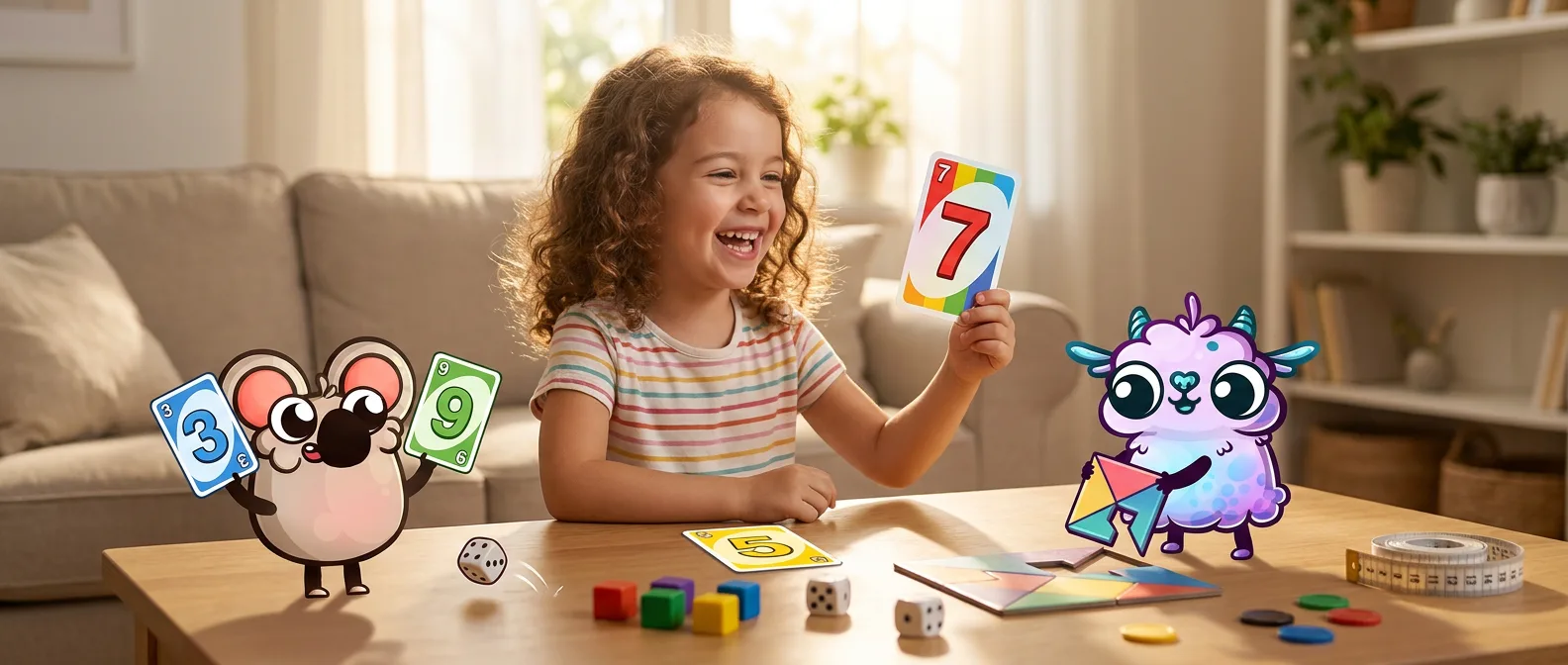
Math becomes fun the moment it stops being a page to finish and starts being a skill your child can actually use and apply. Kids don't need to be convinced that math is important. They need opportunities to play with it, talk about it, and use it before they're asked to perform it on a worksheet.
So if you want to make math fun at home, you don't have to create elaborate lessons. You should look for better reasons to use math in your daily life. Once children see math as something they can do rather than something they have to get right, their attitude can start to change.
Quick answer: how to make math fun
To make math fun for a child ages 5 to 10, swap passive drilling for active play:
- Turn math practice into games, puzzles, and card games instead of worksheets
- Find real-life examples in your daily routine: cooking, shopping, sports statistics, building, and even car rides
- Make mistakes normal and problems low-stakes, so your child keeps trying
- Keep it short. Ten focused minutes can be much more productive than trudging through 40 frustrating ones.
- Use a game-based math app for independent practice
You don't have to do all of these every day. The goal is to make math a normal part of life rather than another chore to check off the list.
Why math stops being fun
Math usually stops being fun for one reason: it turns into performance. Speed tests, red pen marks, and the pressure to get the right answer quickly can make children feel like everyone is watching to see whether they are "good at math." In a classroom, students often notice who works quickly and who needs more time.
Rote memorization can add to that frustration when children are expected to remember facts without understanding what those facts mean. Fluency is important, but children also need opportunities to reason, make connections, and understand why their answers make sense.
When math becomes 40 problems that all look the same, the learning process can feel like a chore. Students stop asking questions. They just want the page finished. This is one reason teachers often incorporate games and other engaging activities into math instruction.
Math anxiety can build early
Math anxiety is a stress response to math tasks, and it can show up in young students well before middle school. It looks like stalling, frustration, tears, "I'm just bad at math," or a stomach ache at homework time. When a child begins associating math with failure or embarrassment, piling on more worksheets isn't always the answer. Sometimes the first step is lowering the stakes and rebuilding confidence.
You cannot make math fun by masking the same stressful practice with a decorated worksheet. For a child who has started to dread math, fun should be part of the repair, not just the wrapping.
Build a positive attitude first
Your reaction to math teaches more than any lessons you could deliver.
Here are three strategies I recommend:
- Never say "I was bad at math too." It may feel comforting, but children can hear it as confirmation that struggling with math is something they should simply accept. Try, "Math wasn't always easy for me, but I learned how to work through it."
- Praise the process, not just the speed. "You checked your work" or "Wow! You used a great strategy to solve that problem" shows your child what actually matters.
- Treat wrong answers as information. Instead of immediately correcting the answer, ask, "Tell me how you got that." A mistake gives you a chance to see your child's thinking and helps them learn from it.
Watch your own reactions. Some kids are very good at reading our faces.
If your child gives an incorrect answer and you immediately look worried, frustrated, or surprised, they may learn that being wrong is something to avoid. Try to stay curious instead: "Hmm. Let's see what happened here."
Incorporate games and puzzles
Games can hide repetition inside something your child actually wants to do!
That doesn't mean every game has to be explicitly educational. A good math game gives children a reason to calculate, compare, estimate, strategize, or make decisions while they're playing.
The goal isn't to trick your child into learning. It's to give them enough meaningful practice that the skills become more comfortable.
That is how fluency gets built: enough reps, low stakes, and immediate feedback. Repetition can build speed, while puzzles can build understanding. A strong math learner needs both!
Card games that build number sense
One deck of cards can give you plenty of opportunities to practice math with almost no preparation.
- Addition War. Deal the cards between two players. Each player flips two cards and adds them. The player with the higher sum wins the round. You can increase the challenge by flipping three cards or asking players to explain how they found their sums.
- Multiplication War. Use the same idea, but multiply the two cards instead. This can make practicing multiplication facts feel much less like memorization.
- Salute. Three players each get cards. Two players hold a card to their forehead without looking at it, while the third player gives a clue such as the sum or product of the two visible cards. The players have to use that information to figure out their own card.
Older students can do any of the games above with positive numbers (spades and clubs) and negative numbers (diamonds and hearts).
And don't underestimate the power of letting your child beat you. A little competition can make practice much more memorable!
Puzzles and brain teasers for problem solving
Puzzles move the focus from calculating to reasoning. They rekindle the part of mathematics kids actually like: figuring things out. Sudoku, math bingo, tangrams, logic grids, and pattern puzzles all encourage problem solving and spatial reasoning rather than recall.
Puzzles give kids a chance to practice flexible thinking, which can be especially useful when they encounter unfamiliar problems. Board games count too, and they let kids explore strategy alongside arithmetic. Anything with scoring, dice, or resource trading is quietly a math game.
You can even let your child create a problem for you to solve! Kids often become much more interested in math when they get to be the teacher.
After a puzzle or problem, ask: "Is there another way you could have solved it?"
That one question can open the door to multiple strategies and help your child understand that math isn't just about solving problems in the same way every time.
Make it group work, not solo drilling
Math doesn't always have to happen quietly at a desk.
Play a card game with your child or work on a puzzle together. Have siblings compare strategies! Let your child explain their thinking to you. Talking through a problem gives children a chance to organize their thoughts and hear how someone else approaches the same problem.
Working in pairs or groups also normalizes struggle and mistakes because everyone can see that other people can get stuck too.
Use real-life examples
Real-life examples answer the question every kid eventually asks: "When am I ever going to use this?"
Try:
- Cooking and baking — fractions, doubling, measurement
- Cutting a pizza — equal parts, fractions
- A $10 grocery budget — addition, subtraction, estimation
- A pretend store at home — money, change, budgeting
- Sports statistics — averages, ratios, comparison
- Painting a room — area, perimeter, geometry
- Road trips — time, distance, division
Give your child an actual job whenever possible. Let them be involved by holding the money, counting the change, or deciding which item is the better deal. Have them help double the ingredients for a recipe. Let them estimate how long it will take to get somewhere and then compare their estimate with the actual time. You are handing over a task, so pull your examples from your daily lives rather than a workbook.
Make math hands-on
Math is abstract, which can make some concepts difficult for young children to understand.
Hands-on materials give children something they can see and manipulate while they're developing those abstract ideas.
Try buttons, coins, LEGO bricks, measuring tapes, blocks, dice, or even snacks!
Building with blocks can give children opportunities to develop spatial reasoning in ways that a worksheet can't always provide. Movement can help, too. Draw a number line on the sidewalk with chalk and have your child hop along it. Create a treasure hunt where each clue involves a math problem. Build something and measure it. For younger children especially, math is everywhere: counting steps, sorting toys, comparing sizes, building towers, and figuring out how many snacks everyone gets.
You don't need fancy materials! You just need to notice the math that's already around you.
Where math apps fit
Here is the honest limitation of everything above: it depends on you being available. Cooking together is wonderful on a Sunday afternoon, but it is a lot harder to pull off at 7 p.m. on a Wednesday when dinner isn't ready, laundry is still on the couch, and everyone is tired.
That's where a good math app can help. It gives children an opportunity for independent practice when you don't have the time or energy to sit beside them. Ideally, it provides immediate feedback, lets children work at an appropriate level, and gives them enough interaction to keep practicing.
Screen time guilt is real, and technology gets blamed for plenty. Used well, technology is the one piece of math learning that keeps running when you are not in the room: challenges at your child's own pace, instant feedback, no audience watching them fail. Math-related apps also log the practice for you, so you stop guessing whether anything is sticking.
What separates good math programs from busywork
Not all math related apps are built the same, and the technology matters less than what it asks your child to do.
Look for these three things:
- Math is part of the action. Your child has to solve problems to move forward, not watch an interactive cartoon between questions.
- The level fits your child. Either the app adapts at your child's own pace, or you can set the difficulty yourself.
- There are no distracting ads or pressure to spend money. Rewards and game elements can be motivating, but they shouldn't feel like a slot machine.
The best technology can almost disappear behind the activity.
Your child is focused on solving the problem, getting feedback, and figuring out what comes next. The practice happens because they want to continue playing!
How MathHero makes math fun
MathHero is a math game for kids ages 5 to 10, built on a simple idea: make math the action, not homework attached to the fun. Your child plays an interactive, story-driven adventure! To build, race, battle, open new areas, and rescue characters, they need to solve short sets of math facts. Instead of completing a worksheet and then getting to play, the math itself moves the game forward. There are no video lessons, and that is deliberate: the structured practice itself does the teaching.
Parents can choose the topic and adjust the level of practice. You can focus on individual multiplication facts, such as the 7's times tables or 9's times tables, and choose between typed answers and multiple choice.
That flexibility is useful for families with multiple children working at different levels because the same game can be adjusted to meet different needs. MathHero offers five levels of play per day for free, with no ads or locked content. A subscription with a free trial removes the daily limit.
For a family looking for a way to add a few minutes of independent math practice to the day, that can be a simple option.
Start playing MathHero for free
What a fun math week looks like
You do not need a program. You need to create a rhythm. Nothing you buy will make math fun on its own.
- Weekdays: 10 minutes on the app, on their own
- One evening: a card game or a problem solving puzzle, 15 minutes, together
- Weekend: one real-world moment, cooking, shopping, or building something
- Anytime: you saying "that's a great question" or "what an interesting strategy" instead of "just try harder"
That's enough. You don't need an elaborate curriculum, a dedicated math corner, or hours of practice every night. Small, positive experiences can add up.
And remember: you are the parent, not the teacher. You don't have to turn every grocery trip or dinner into a math lesson. Let some moments simply be fun!
When fun is not enough
Games aren't a solution to every math difficulty.
If your child continues to struggle with basic facts well into elementary school, freezes on problems they previously solved successfully, or becomes extremely distressed whenever math appears, talk with their teacher.
Teachers usually see the pattern and can tell you whether it is a gap or a confidence problem. Fun can make practice easier to approach, but it doesn't replace targeted support when a child needs it. And the sooner you ask for help, the sooner you can address the gap.
On the nights when everyone is frustrated, take a break, and try again tomorrow.
Common questions about how to make math fun
How do I make math fun for a child who already hates it?
Start by taking the pressure off. For a little while, replace worksheets and timed practice with card games, puzzles, real-life math, a game-based app, and enjoyable practice. Let your child experience success without constantly correcting or timing them.
At what age should we start?
Math play can start very young. Children naturally explore counting, sorting, comparing, shapes, and patterns during the preschool years. More structured practice can become appropriate around age 5, depending on the child's development and skills. The important thing is to meet your child where they are rather than rushing them toward the next skill.
How long should daily math practice be?
Ten to fifteen minutes for most kids ages 5 to 10. Short and consistent is often easier to maintain than occasional long sessions. And if your child is frustrated, more minutes aren't necessarily going to make the learning better.
Do math games actually build math skills, or just entertainment?
Games that give children meaningful opportunities to solve problems as they progress can help build fluency. Games where math is a loading screen between the fun parts do not, because no learning happens in the gap. The key question is simple: Is the math the mechanic that moves them through the game, or is it just the loading screen?
Should I sit with my child while they practice?
For games, real life math, and group work, yes. For independent fluency practice, though, you don't necessarily need to sit next to your child and watch every answer. Some kids work faster and worry less when nobody is watching the screen. Your job isn't to hover. You can be available, show interest, celebrate their effort, and let them know that getting an answer wrong isn't a big deal.
Keep math fun for the long run
Math gets easier when practice stops feeling like a battle. Make it part of your family's routine and keep it meaningful and the stakes low. Let consistency do most of the work. Sometimes making math fun simply means making it feel safe, useful, and manageable. The goal is not to raise a child who finishes worksheets. It's to raise one who knows that when math gets hard, they can keep going.