

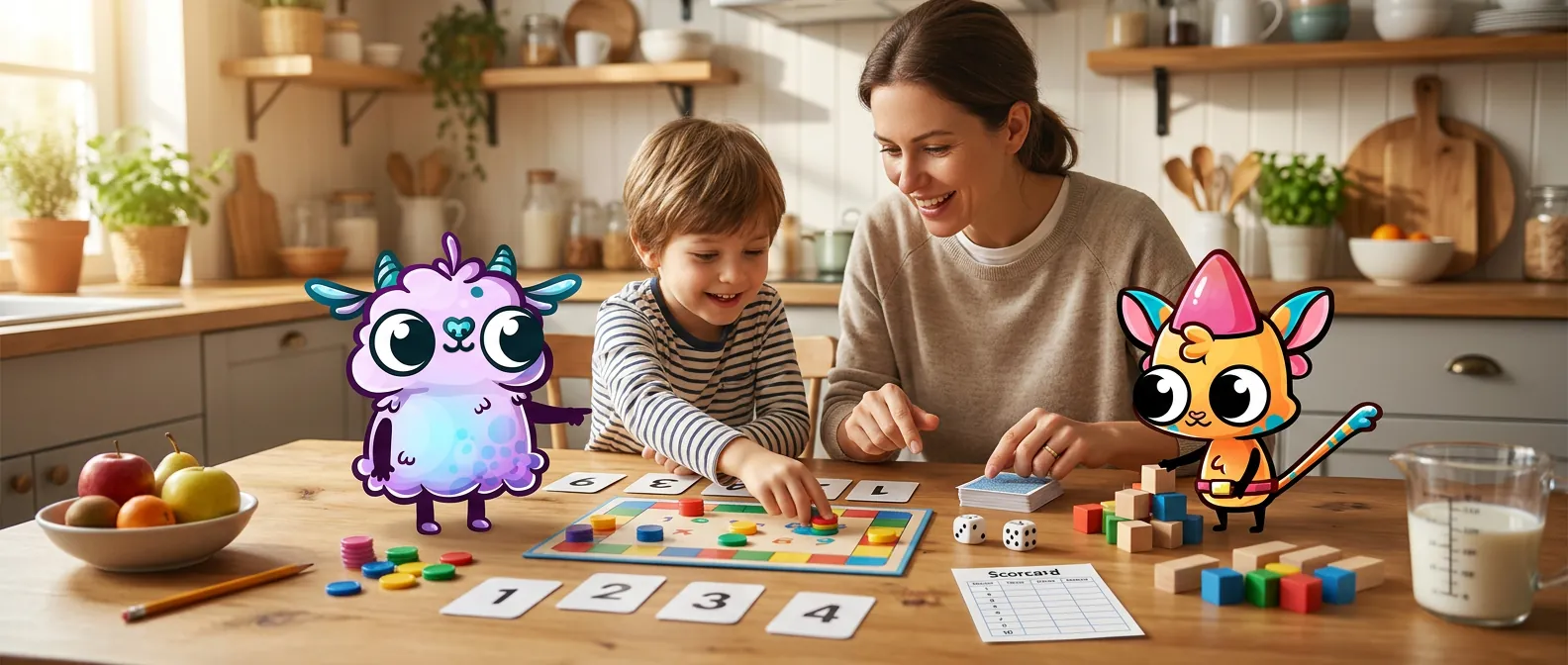
Between school, work, dinner, and everything else on your family's calendar, adding even just one more thing can feel overwhelming. So when your child's teacher suggests practicing math at home, you might be thinking, "Who has time for that?"
As a math teacher and mom, I get it!
The good news is that supporting your child's math learning doesn't always mean planning lessons or spending your evenings working through extra worksheets. Instead, you can be on the lookout for little ways to incorporate math into your daily lives! Sometimes it looks like playing a card game, measuring ingredients, or asking, "How many more do we need?"
This guide focuses on children around ages 5–10, or kindergarten through fourth grade. During these years, children are building foundations in counting, addition, subtraction, multiplication, and division. There are plenty of simple ways to support those skills at home, even if math wasn't your favorite subject growing up.
If math makes you a little nervous, you're certainly not alone! A research review cited estimates suggesting that about one in six people in the U.S. experience high levels of math anxiety. And in the OECD's PISA 2022 findings, around 40% of students across OECD countries reported feeling nervous, helpless, or anxious when working on math problems or homework.
That doesn't mean math time at home has to feel stressful, too. The ideas below focus on simple games and everyday activities that give your child opportunities to practice, talk through their thinking, and build their confidence!
Why family math matters
When I say "family math," I'm talking about the math that happens when you play, talk, and solve everyday problems together. It might be counting spaces on a board game, figuring out how many plates to put on the table, or making equal groups of snacks.
These moments give children opportunities to connect numbers to something they can see and understand. Instead of only seeing subtraction as a problem on a worksheet, they experience it when they have eight crackers, eat three, and figure out how many are left. As a middle school math teacher, I see how much students rely on these early foundations.
They also get to practice explaining their thinking. When you ask, "How did you figure that out?" you learn much more than whether they got the right answer.
Small daily doses of math related to a child's day can make math seem more relatable and less overwhelming when they encounter math problems in school.
Everyday math hiding in your day
You probably already have opportunities to talk about math built into your routine. The trick is noticing them and inviting your child to join in! Look for the numbers 1–20 on signs during a car ride. Count objects around the house and read the numbers aloud. Count how many more minutes until the timer beeps. Small activities, done often, build real math skills in context. These everyday activities don't cost anything, and you can explore these ideas without pulling out a worksheet.
In the kitchen
Cooking creates so many hands-on opportunities to count, measure, compare, and explore whole numbers and fractions! Not to mention, it's a great way to interact and connect with your child.
For younger children, that might mean counting three eggs or putting one spoon at each place setting. Older children can help measure ingredients or figure out how much you need when doubling or halving a recipe.
Try questions like:
- "We need two cups. How many half cups would that take?"
- "This recipe makes twelve muffins. If four people each eat two muffins, how many will be left?"
- "Which measuring cup holds more? How can you tell?"
Let them pour, compare, and test their ideas when possible. Seeing two half-cups fill one whole cup helps make sense of the abstract concept of fractions.
At the grocery store
You don't need to turn the entire shopping trip into a math activity. One or two questions are plenty!
Your child could count apples, compare prices, or estimate the cost of your items before you reach the cash register. If you pay with cash, you could also teach your child about how much change you should receive.
For example:
- "We have four bananas, but we need six. How many more should we get?"
- "These crackers cost about three dollars, and the yogurt costs about four dollars. About how much will we spend in total?"
- "Which brand of cereal costs less?"
Choose questions that fit what your child already understands. Comparing two prices might be a good starting point; comparing unit prices is a more advanced task. You can also teach older children different strategies for finding the sale price or percentage off a price.
During everyday routines
Setting the table, sorting laundry, and cleaning up toys all offer opportunities to practice. You might ask your child to match socks, sort blocks by shape, or figure out how many forks are missing from the table. Integrating math like this helps math seem less like a school subject and more relevant to children's everyday lives.
Even a car ride can include a quick counting game: "We already saw six blue cars. How many more would we need to see to reach ten?" Keep it casual and low stakes! If your child isn't interested in that moment, you can try again another time.
Math games for home
Games give children a reason to use math, try strategies, and practice skills more than once. One thing I encourage parents to remember: practice doesn't always need to be a race. Being able to find an answer quickly is useful, but understanding how to get there matters too. Give your child time to think, use objects, or explain a strategy!
Simple card games
A regular deck of cards can go a long way. Remove the face cards and let aces represent "one."
- Addition War: Each player flips over two cards and adds their numbers. The player with the greater sum wins the round. If your child needs to count the symbols on the cards, let them!
- Make Ten: Lay ten cards face up and look for pairs that add to ten. Remove each pair and replace it with two cards from the deck. If no pairs are available, add another card. When your child finds a pair, ask how they knew those numbers went together.
- Multiplication War: For children working on multiplication, each player flips two cards and multiplies the numbers. The greater product wins. Start with a smaller set of cards if the full deck includes facts your child isn't ready for yet.
- For older children: You can adjust the same game as your child's skills grow. Comparing one card at a time might be just right for one child, while adding or multiplying works for another. You can also let black cards (spades and clubs) represent positive numbers and red cards (diamonds and hearts) represent negative numbers in Addition or Multiplication War!
Dice games
Roll two dice and ask your child to find the total. Notice how they approach it. Do they count every dot, start with one number and count on, or recognize a fact they know?
You can also take turns rolling and adding to a running total. Choose a target, such as twenty or fifty, and see who reaches it first. For subtraction practice, roll two dice and subtract the smaller number from the larger one. For multiplication, find the product. If competition leads to frustration, work together toward a shared goal instead.
Hands-on math activities
You don't need a special math kit to help your child see what numbers mean.
Use blocks to build equal groups. For example, make three groups of four and ask, "How many blocks are there altogether?" Then arrange those same blocks into three rows of four. That connects multiplication to something your child can build and count.
Other options include:
- Making a floor number line and hopping forward or backward.
- Building and extending patterns with blocks or crayons.
- Sharing counters equally among stuffed animals.
- Playing board games that involve counting spaces or keeping score.
- Creating homemade math puzzles on index cards.
Start with materials you already have and a skill your child is practicing!
Digital math games and screen time
Digital games can be another way to fit math practice into your routine. As a parent, I understand the appeal of an activity your child can use while you're getting dinner ready!
Still, I would look beyond whether an app is labeled "educational." Can you adjust the difficulty? Does your child understand the math they're practicing? Does the game encourage them to keep trying, or are they getting frustrated and guessing?
MathHero is one option for children ages 5–10. It combines a story-based adventure with practice in addition, subtraction, multiplication, and division. Parents can adjust the math topics, difficulty, and monster speed to better match their child's needs. Two children at different levels? Each child gets their own profile with its own topics and difficulty, so siblings can share the app!
The whole game can be completed for free, with a limit of five levels per day. An optional subscription removes that limit.
You can also connect the game to hands-on practice. If your child was solving multiplication problems, ask them to build one of those problems with blocks and explain their thinking.
During independent gameplay, check in occasionally. You might ask, "What kind of problems were you solving?" or "Show me how you figured that one out."
If your child is struggling with a concept, pause and explore it together using drawings or objects. A game can provide practice, but your child may still need help understanding what the numbers mean.
MathHero isn't designed to teach counting from scratch, so it's best for children who already have basic number recognition. And it doesn't cover fractions or geometry. For the core mental-math years, though, it turns practice into fun, while providing opportunities for regular practice that can build fluency over time.
Want short math practice your child can play while you cook dinner? Set MathHero to the topics they're working on, free for five levels a day.
Explore MathHeroFree resources for math at home
Before buying anything, start with what you already have access to.
Your child's teacher
If you aren't sure what to practice, your child's teacher is a good starting point.
Ask, "What is one skill we could work on at home, and what would that practice look like?" A specific starting point is much easier to use than a general suggestion to "practice math." Their teacher may also have games, materials, or resources that connect to what your child is learning in class!
Your public library
Ask your librarian for books that fit your child's age and interests. Counting books, shape books, puzzles, and stories about sharing or comparing can all give you something to explore together. Reading math books at bedtime can give you another chance to count, compare, and solve problems together!
While reading, you can pause to ask:
- "How many do you see?"
- "Who has more?"
- "What do you think will happen if they share those equally?"
You don't have to ask a question on every page. Enjoying the story together matters too!
Free materials you can make
Homemade resources don't need to look fancy to be useful. A number line drawn on paper, a set of handwritten number cards, or a handful of blocks can support plenty of practice!
Try writing a few addition facts on index cards and asking your child to sort them into groups: facts they know, facts they can figure out, and facts they want help with. That gives you a starting point without buying another workbook or printing a stack of activities.
Online, plenty of sites give away free printable games, number lines, and activity ideas sorted by grade band. The Math Learning Center's free Math at Home activities are organized by grade and mathematical content, with activities families can use at home. NRICH's free math games and activities offer another good option, with games for ages 5 to 11 covering number, measurement, geometry, statistics, and strategy. For younger children, PBS KIDS' math activities offer simple ways to build counting, number sense, and problem-solving into everyday play.
National math resource hubs hand out tools, tips, printable activities, story books, and simple curriculum guides for families who want more structure. Free resources like these save you money, and there are resources for every grade. Homeschool families lean on this kind of curriculum, too. Between the library and a couple of trusted resources, you have more free materials than you'll ever use, so explore a few, give your kids some choice, and keep the ones they like. These are real learning opportunities at no cost.
Talking about math the right way
If math was difficult for you growing up, it can be tempting to say, "I was never good at math either." I understand wanting your child to know they aren't alone. But we also want to leave room for them to believe they can learn. How you talk about math matters more than most parents realize.
You can be honest and encouraging at the same time: "Math was hard for me sometimes, too. Let's see what we can figure out together."
When your child makes a mistake, get curious about it. An incorrect answer can help you see what they understand and where they need support.
Try asking:
- "Can you show me what you did?"
- "What part feels confusing?"
- "Could we draw a picture?"
- "Does that answer make sense with the problem?"
I especially like asking children to explain an answer they got right. We don't want "How did you get that?" to become a signal that they made a mistake! Encouraging children to explain their thinking develops mathematical reasoning and deepens their understanding.
Be specific with encouragement, too. Instead of only saying, "You're so smart," notice what they did: "You tried another strategy when the first one didn't work," or "That drawing helped you organize the problem." You're helping them recognize tools they can use again.
Noticing your child's progress
Progress isn't always a higher score or a faster answer. Sometimes it's a child who used to freeze when they saw a problem but now knows how to get started. They might begin using a strategy on their own or can explain something they couldn't explain last week.
Look for changes such as:
- Needing less help to begin.
- Choosing a strategy that makes sense.
- Explaining why an answer works.
- Making fewer errors on a familiar skill.
- Feeling more comfortable trying.
Choose a small goal based on where your child is right now. For example, "We're going to practice pairs that make ten," is easier to act on than, "We need to get better at math." You can revisit a few similar problems later to see what has changed. Keep the focus on understanding, and celebrate the progress you notice.
A few parent tips for homework and support
Games and everyday activities can feel relaxed. Homework can be a different story, especially when everyone is tired.
Here are a few things I encourage parents to try:
- Model a growth mindset out loud. We can show children what to do when learning feels difficult. That might mean trying another strategy, asking for help, or looking back at a mistake to understand what happened.
- Ask your child to show you what they learned. If the strategy looks unfamiliar, start with, "Can you show me how your teacher did it?" You don't have to pretend you already know.
- Give them time to think. It's easy to jump in when you can see the answer. Try giving your child a little space before offering help.
- Use a question to help them get started. "What do you know so far?" or "What is the problem asking?" can help them find an entry point.
- Take a break when frustration takes over. If everyone is upset, pushing through may not lead to much learning. Pause, reset, and communicate with the teacher if homework is regularly becoming a struggle. Your child's teacher needs to know when work that appears manageable at school is taking an hour and causing tears at home.
Family math night at home
If your family enjoys games, you could set aside an evening to play a few together. Keep it simple: one card game or board game and a delicious snack can make things fun!
You can also play "Guess My Number." One person chooses a number within an agreed range, and everyone else asks yes-or-no questions: "Is it greater than ten?", "Is it even?", "Is it less than fifteen?", and so on.
For younger children, use a smaller range and keep a number line nearby. Older children can try a larger range or ask questions about multiplication facts and factors. Let your child choose a game or make up a variation. Giving them a little ownership can make the experience more enjoyable for everyone. Also, if a whole math night doesn't fit your schedule, you can always just play one quick round after dinner. It still counts!
When to reach for extra support
Sometimes a child needs more support than games and everyday practice can provide. If your child consistently struggles with the same skills, becomes very upset about math, or makes little progress despite support, reach out to their teacher.
Bring specific examples:
- "They can count all the objects, but they have trouble figuring out how many are left when some are taken away."
- "They know some multiplication facts, but they don't seem to understand what multiplication represents."
- "They can do the homework with help, but they can't get started independently."
Those details can help the teacher identify a useful next step. Depending on your child's needs, that might include a different explanation, targeted practice, school-based support, or tutoring. Asking for help is part of supporting your child. You don't have to have every answer, and you don't need to turn your home into a classroom. Start with one manageable activity, pay attention to your child's thinking, and build from there.
Grabbing a deck of cards and setting aside a few minutes of quality time together is a perfectly good place to begin!
Sources
- Luttenberger, S., Wimmer, S., & Paechter, M. (2018). Spotlight on math anxiety. Psychology Research and Behavior Management, 11, 311–322.
- OECD (2023). PISA 2022 Results (Volume I): The State of Learning and Equity in Education. OECD Publishing.
- Berkowitz, T., et al. (2015). Math at home adds up to achievement in school. Science, 350(6257), 196–198.
- Haimovitz, K., & Dweck, C. S. (2016). Parents' views of failure predict children's fixed and growth intelligence mind-sets. Psychological Science, 27(6), 859–869.
- Verdine, B. N., et al. (2014). Deconstructing building blocks: Preschoolers' spatial assembly performance relates to early mathematical skills. Child Development, 85(3), 1062–1076. Summary: Playing with blocks may help children's spatial and math thinking (SRCD).
- PBS KIDS for Parents. Numbers & Counting: Teaching your four-year-old numbers and counting.
- The Math Learning Center. Math at Home: free activities for families.
